
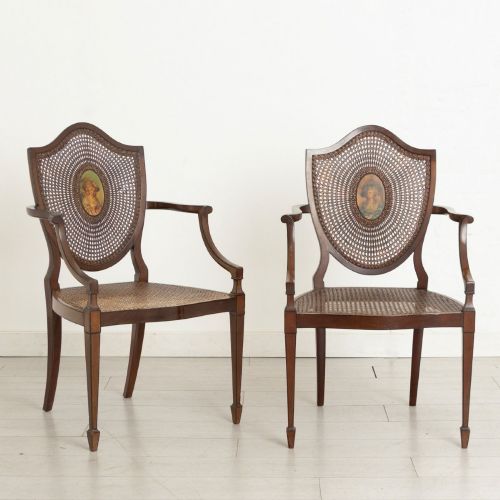


French Cane Back Chairs
French cane back chairs bring period seating into a room, offering carved wood frames paired with woven natural panels.
French Cane Back Chairs
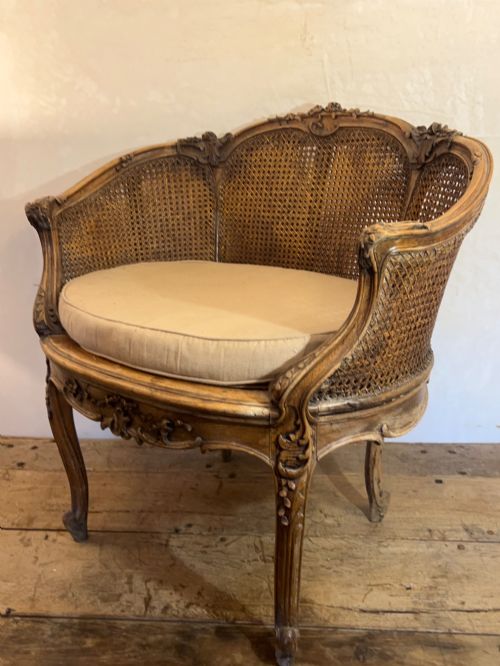
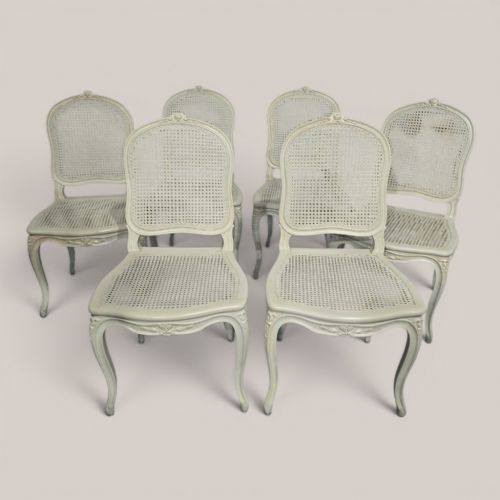
French cane back chairs are seating forms that combine wooden frames with woven panels, appearing across nineteenth century and early twentieth century periods. Buyers searching for french cane back chairs encounter dining chairs, armchairs, bergères, and settees built in styles such as Louis XV, Louis XVI, and French Provincial.
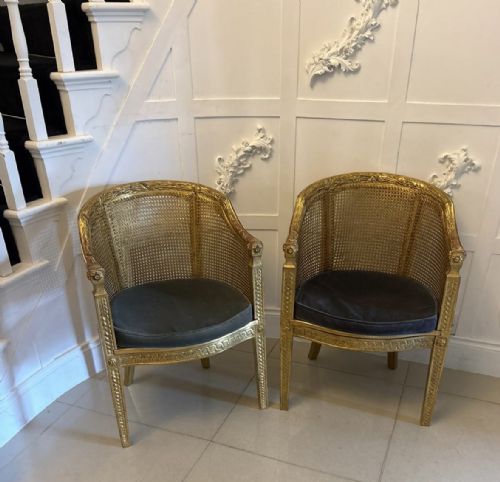
The selection ranges from single salon chairs and matched sets of dining chairs to library armchairs and drawing room sofas. Common regional and stylistic variants include gilded or painted finishes alongside exposed walnut, oak, mahogany, and beech frames.
Makers and workshops produced these forms across diverse scales, from child size chairs to sets of twelve dining seats. The overarching grouping relies on woven cane work applied to the backrest or seat alongside traditional wood carving.
Materials and construction
Frames are constructed from solid hardwoods including walnut, beech, oak, and mahogany, often shaped with hand carving or finished with paint and giltwood. Workshops utilised these timbers to support structural loads while delivering curved cabriole legs or straight fluted profiles.
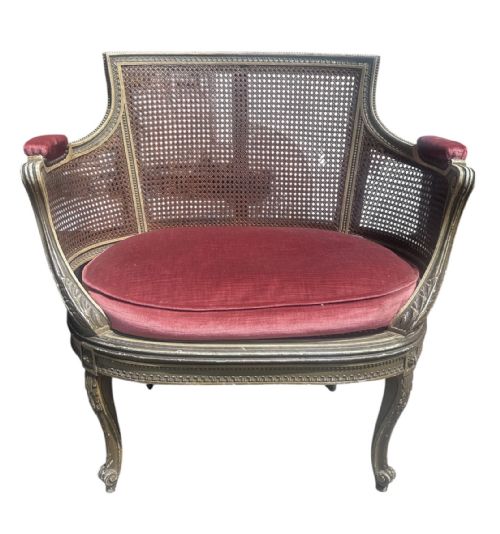
The characteristic backrests and seats utilise cane and rattan cane woven directly through drilled holes in the wooden rails. Artisans combined this open weave with upholstered elements such as velvet, fabric cushions, and down stuffing in bergère and corbeille designs.
Walnut, beech, and oak form the primary wood frames across the current site inventory, paired with cane and painted finishes.
Evaluating craftsmanship and condition
Quality rests in the precision of the hand carving, the tightness and uniformity of the cane weave, and the integrity of the underlying hardwood frame. Better examples display crisp floral motifs, well-proportioned cabriole or neoclassical legs, and tightly tensioned natural cane without breaks.
Significance also depends on whether pieces survive as matched sets or pairs rather than single items, alongside the originality of surface treatments such as period paint or gilding. Altered frames or entirely replaced cane panels shift a piece away from its original state.
The French Cane Back Chairs Glossary
- Bergère
- An enclosed upholstered armchair with wooden framing and a cane or upholstered back and sides. This form typically includes a loose seat cushion and dates frequently to nineteenth century French workshops.
- Cane
- Woven material made from the peeled outer bark of rattan palms. It provides a resilient, breathable panel for chair backs and seats.
- Giltwood
- Timber coated with a thin layer of gold leaf or gilt paint. It appears often on decorative salon armchairs and settees from the nineteenth century.
- Louis XV Style
- A curved rococo design movement characterised by asymmetric scrollwork, cabriole legs, and floral carving. It recurs across nineteenth century seating furniture.
- Medallion Chair
- A chair featuring an oval or circular upholstered or caned backrest framed by carved wood. This form is strongly associated with neoclassical and Louis XVI revival pieces.
French Cane Back Chairs: Frequently Asked Questions
How do I clean cane panels?
Dust cane gently with a soft brush and wipe occasionally with a damp cloth using mild soap. Avoid soaking the material to prevent the natural fibres from becoming brittle.
Keep the room humidity moderate so the rattan retains its flexibility over decades of daily use.
Can I use these chairs daily?
Many dining chairs and library armchairs are built sturdy enough for regular seating if the cane remains taut and the wood joints stay firm. Heavier users should exercise caution with older fine cane panels.
Consider adding a thin custom cushion to distribute weight evenly across fragile antique seats.
How do I tell Louis XV from Louis XVI?
Louis XV pieces feature flowing curves, asymmetrical cartouche backs, and cabriole legs. Louis XVI design introduces straight fluted columns, geometric symmetry, and rectangular or medallion backs.
Looking at the leg profile and corner joints immediately separates these two major French stylistic periods.
Are replacement cane seats acceptable?
Re-caning is a traditional maintenance process required for antique seating survival. Expert re-weaving using compatible gauge material preserves both utility and aesthetic value.
Original cane is uncommon on nineteenth century survivors, so professional re-weaving ensures continued functionality.