
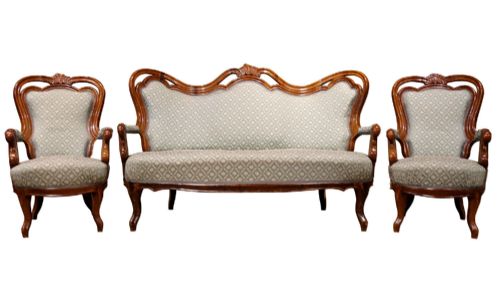


French Canape Set
A french canape set brings coordinated seating to a reception room, offering matching sofas and chairs crafted in classical European revival styles.
French Canape Set
A french canape set comprises a main settee paired with matching armchairs or salon chairs, designed to furnish formal nineteenth and early twentieth century rooms. These ensembles typically surface as three-piece or five-piece groupings, though larger seven-piece collections occasionally appear.
The aesthetic draws heavily on historical design vocabulary, ranging from Louis XV and Louis XVI revivals to Rococo and Empire styles. Pieces originate predominantly from the nineteenth century, extending into the early twentieth century, and utilise woods such as walnut, mahogany, beech, and giltwood.
Buyers encounter matching seating upholstered in period textiles like damask, velvet, tapestry, and plain fabric. The grouping ensures a unified decorative scheme within a parlour or salon.
Materials and construction
Carpenters shaped structural frames from hardwoods including walnut, beech, and mahogany, alongside softwood foundations that received layers of applied giltwood or paint. Carved ornamentation defines the frames, displaying scrollwork, foliage, and classical motifs suited to the respective revival period.
Upholstery techniques involve traditional stuffing secured over webbing and springs, finished with decorative textiles like damask, velvet, and tapestry. These coverings are fastened to the timber frames using decorative tacks or gimp braid to conceal the edges.
Distinctions in construction and finish
Quality rests upon the crispness of the wood carving and the choice of primary timber, where dense walnut and fire-gilt surfaces outperform softer woods and plain painted finishes. Complete suites that retain their original matching upholstery and uniform fading demonstrate greater integrity than assembled groupings.
The structural rigidity of the joinery and the depth of the hand-carved details separate standard production items from finer salon suites commissioned for substantial residences.
The French Canape Set Glossary
- Canape
- A traditional French settee or sofa featuring an upholstered back and seat with exposed wooden framing. It forms the central seating piece in a larger salon suite.
- Giltwood
- Timber coated with a thin layer of gold leaf or metallic gilt preparation. This finish appears frequently on formal nineteenth-century revival seating.
- Damask
- A reversible figured fabric traditionally woven with patterns in lustrous warp and mat threads. It provides durable and decorative upholstery for formal parlour suites.
- Louis XVI Revival
- A nineteenth-century decorative style inspired by the neoclassical reign of Louis XVI. It is characterised by straight tapered legs, fluting, and geometric symmetry.
French Canape Set: Frequently Asked Questions
What pieces comprise a set?
A standard grouping includes a canape settee accompanied by matching armchairs, typically forming a set of three, five, or seven pieces.
These suites were designed to provide uniform seating for guests in formal reception rooms and parlours.
How do I identify the style?
Styles are determined by the carved wooden motifs and leg shapes, which emulate historical periods like Louis XV, Louis XVI, and Empire.
Revival pieces from the nineteenth century adapt these earlier monarchical aesthetics using contemporary workshop techniques.
What woods were used?
Cabinetmakers utilised walnut, mahogany, beech, and softwood frames finished with giltwood or paint.
Walnut and mahogany frames often showcase hand-carved details such as floral ribbons and scrolling foliage.
How should I place them?
These matching suites suit principal reception rooms, large drawing rooms, or master bedrooms where coordinated period seating is desired.
Arranging the settee and matching chairs together recreates the traditional salon grouping intended by nineteenth-century designers.