





French Bronze Bookends
French bronze bookends bring weight and decorative presence to a shelf, combining sculptural quality with practical library use.
French Bronze Bookends
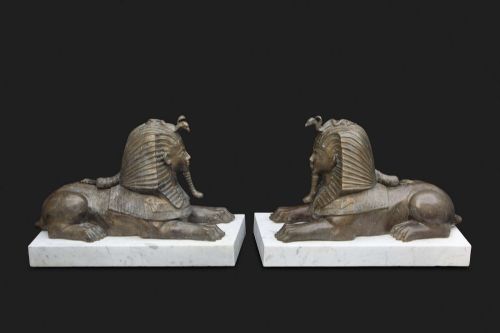
French bronze bookends appear primarily in nineteenth century classical forms and twentieth century modernist designs. Buyers seeking french bronze bookends encounter everything from monumental sphinxes to domestic animals mounted on heavy stone bases.
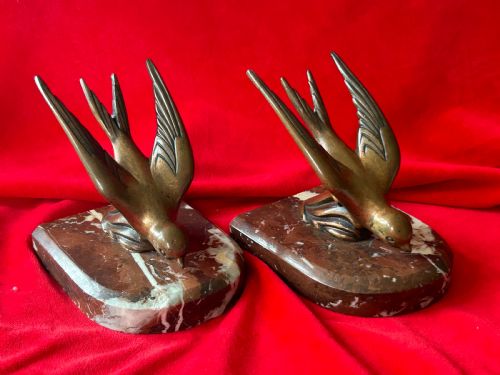
The twentieth century brings streamlined Art Deco subjects such as pelicans, elephants, squirrels, and penguins. Earlier nineteenth century examples lean towards classical figures, putti, and mythological subjects cast in rich patinated metal.
Many pairs utilise mixed media, pairing cast metal figures with contrasting marble or carrara marble plinths. These dual components provide the necessary gravity to hold heavy volumes in place securely.
Materials and construction
Foundry work combines traditional casting methods with careful surface finishing, utilising bronze, spelter, and brass. Figures receive patination, paint, or silvering to achieve specific tonal depths.
Mounts rely on dense stones such as marble and red marble to anchor the lighter metal sculptures. Bases are frequently heavy slabs that balance the forward or upward thrust of the figures.
French Bronze Bookends Retail Price Guide 2026
Typical asking prices for french bronze bookends among the pieces listed under this phrase on Sellingantiques today, from the lower quarter to the upper quarter. They describe what is for sale here now, not the wider market.
Library shelves gain character instantly when guarded by stern bronze penguins and leaping storks rather than plain wooden blocks.
Distinctions in quality
Quality rests in the crispness of the casting and the articulation of fine details in the metalwork. Superior examples retain complex patination and sharp chisel work rather than soft, rounded edges.
The selection and fit of the stone base heavily influence the overall standard of the piece. Matching marble plinths with harmonious veining and secure mountings separate standard workshop output from finer studio productions.
Max Le Verrier·Pierre-Jules Mene·GUAL
The French Bronze Bookends Glossary
- Spelter
- A zinc alloy commonly utilised as a substitute for bronze in decorative castings. It takes patination well while offering a lighter alternative for sculptural bookends.
- Patina
- The surface sheen and coloration developed through age or chemical treatment on metal. This finish protects the underlying alloy and adds visual depth.
- Ormolu
- Gilded bronze produced by applying a mercury and gold amalgam to the metal surface. It yields a brilliant golden lustre seen on library pieces.
- Carrara marble
- A type of white or blue-grey marble quarried in Italy. It provides a dense, elegant foundation for mounted sculptures.
French Bronze Bookends: Frequently Asked Questions
How heavy are these bookends?
Most pairs incorporate dense marble or stone plinths to provide substantial weight. This heaviness ensures the pieces can support large volumes without tipping.
Smaller animal figures rely on the combined mass of the metal and stone base to function effectively on a shelf.
Are all these pieces solid bronze?
The selection includes items cast in solid bronze alongside pieces formed from spelter, brass, and patinated metal. Many designs combine metal sculptures with distinct stone bases.
Materials are specified individually to reflect the distinct composition of each cast object.
What periods do these designs represent?
The inventory spans the nineteenth century through to the Art Deco period of the nineteen-thirties. Earlier works feature classical ladies and putti.
Later twentieth century items showcase streamlined animal subjects and Egyptian revival motifs.
How should I clean the marble bases?
Stone plinths require gentle dusting with a soft, dry cloth to protect the polished surface. Avoid harsh chemical cleaners that might dull the natural marble.
Metal figures benefit from similar light care to preserve the original patination and finish.