


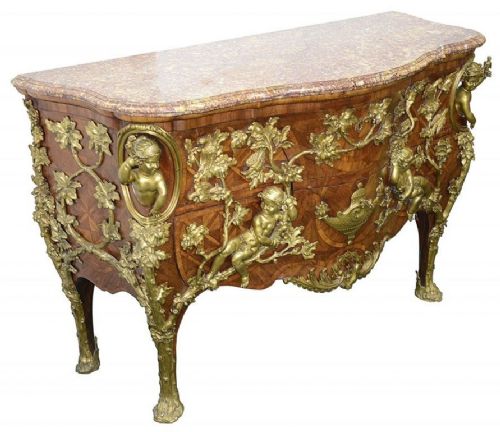


French Bombee Chest of Drawers
These French bombee chest of drawers items bring serpentine forms and marble tops into a room, offering both generous storage and rich surface detail.
French Bombee Chest of Drawers
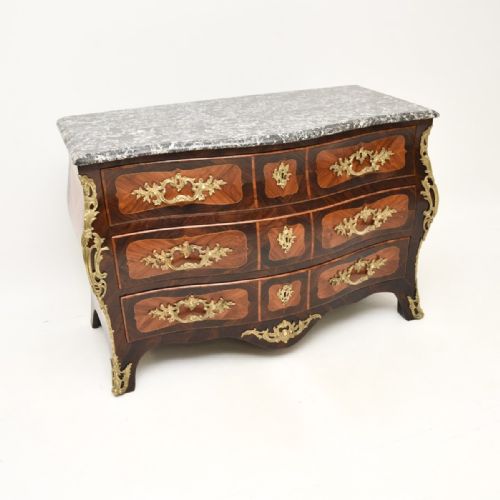
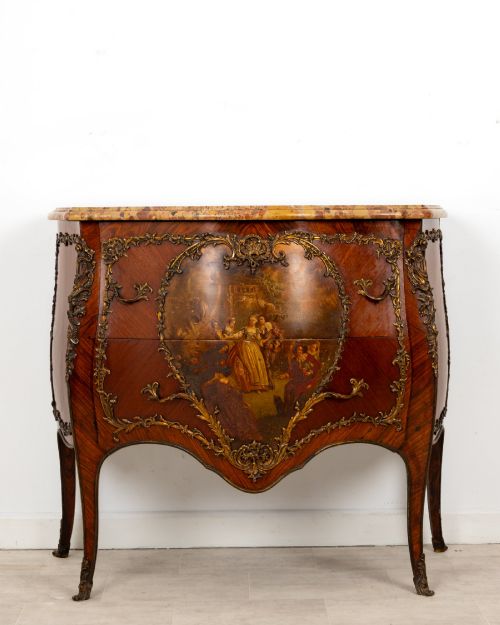
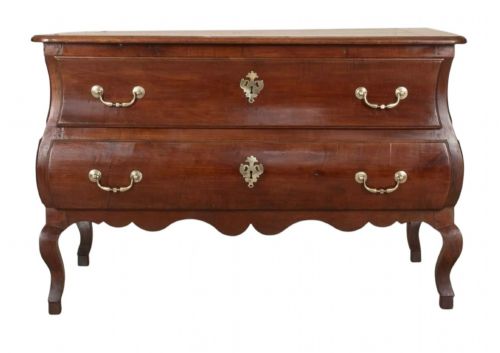
A french bombee chest of drawers, often listed simply as a commode, presents a distinctive swollen or bulging profile that defines its silhouette. These pieces appear most frequently from the nineteenth century alongside eighteenth-century origins, often carrying the Louis XV style or its later revival.
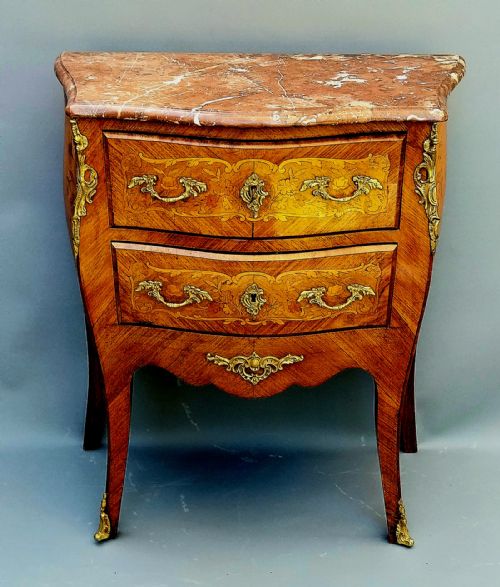
Makers shaped these items with substantial proportions, frequently topping them with shaped marble slabs. Forms range from compact provincial sauteuse chests to grander urban marquetry commodes associated with Parisian workshops.
The aesthetic draws heavily on French Rococo traditions, prioritising curved lines and asymmetrical floral motifs. Buyers encounter both original eighteenth-century examples and robust revival pieces dating towards nineteen-hundred.
Materials and construction methods
Cabinetmakers built these carcases using hardwoods such as walnut, cherrywood, and exotic veneers like kingwood and rosewood laid over a solid timber frame. Marquetry patterns demonstrate intricate timber selection, creating pictorial or geometric surfaces across the curved drawer fronts.
Ormolu and gilt-bronze mounts embellish the corners, handles, and apron, cast in swirling Rococo forms that accentuate the swelling contours. Heavy marble slabs, cut to follow the exact serpentine outline of the chest, sit directly upon the timber top.
The furniture spans the eighteenth and nineteenth centuries, heavily reflecting Louis XV and Rococo revival aesthetics.
Distinctions in craftsmanship
Quality reveals itself in the fluency of the timber movement and the precision of the veneer matching across curved surfaces. Finer pieces demonstrate superior hand-chased gilt-bronze mounts that integrate seamlessly with the carcase contours.
The structural integrity of the swollen drawer fronts and the weight and polish of the fitted marble top separate standard production from exceptional work. Early eighteenth-century joinery contrasts with later revival execution, though both require careful handling of complex wood movements.
Jacques Birckle·Charles Cressant
The French Bombee Chest of Drawers Glossary
- Bombe
- A swelling or bulging contour characteristic of continental furniture fronts and sides. This outward curve requires advanced woodworking skill to veneer successfully.
- Commode
- A low chest of drawers or cabinet introduced in France during the late seventeenth century. These items typically feature multiple drawer tiers and decorative mounts.
- Ormolu
- Gilt bronze used for decorative mounts and furniture hardware. The process involves applying a gold amalgam to cast bronze before heating.
- Marquetry
- Patterns of wood veneer applied to a furniture structure to create decorative designs. Artisans cut various coloured timbers to form intricate floral or geometric scenes.
- Sauteuse
- A small commode featuring two drawers rather than the traditional three. This lighter form often originates from regional French workshops.
French Bombee Chest of Drawers: Frequently Asked Questions
What is a bombe chest?
A bombe chest is a piece of furniture featuring rounded, swelling sides and drawer fronts that curve outward. This bulging profile requires skilled woodworking to construct and veneer.
Such shapes emerged strongly during the eighteenth century and returned in nineteenth-century revival pieces, offering a dramatic silhouette for domestic interiors.
How do I date these chests?
Dating relies on examining the timber species, construction techniques, and mount quality. Eighteenth-century examples often show specific regional joinery and hand-cut elements.
Revival pieces from the nineteenth century frequently utilise machine-sawn timbers underneath sophisticated veneers, reflecting the manufacturing standards of their era.
Are the marble tops original?
Marble tops on these commodes are shaped precisely to follow the complex serpentine contours of the wooden carcase below. Original marble typically shows appropriate age wear and matches the exact perimeter profile.
Replacements occasionally occur due to historical damage, making the edge fit and stone type important areas for observation.
Where were these commodes used?
These commodes functioned primarily as refined storage furniture in principal rooms such as bedrooms and salons. Their decorative surfaces displayed porcelain and lighting.
Provincial and Parisian households alike utilised them to combine practical drawer space with formal decorative presence.