
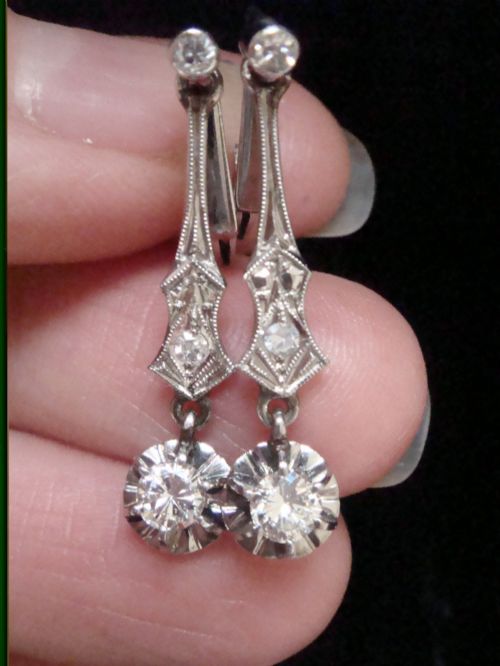


French Diamond Drops
French antique diamond drops are sophisticated jewels defined by old cut stones and delicate settings, offering timeless elegance to any collector.
French Diamond Drops
When you search for french antique diamond drops, you encounter a refined selection of historic jewels spanning the Georgian, Victorian, Edwardian, and 1940 periods. These pieces primarily manifest as drop earrings, alongside select necklaces, pendants, and dormeuses earrings.
The assortment relies heavily on Edwardian craftsmanship, showcasing characteristic lightness and intricate metalwork alongside earlier Georgian and Victorian examples. Drop earrings dominate the selection, bringing movement and light close to the face through well-proportioned hanging designs.
How they were made
Maker construction combines precious metals such as 18ct yellow gold, platinum, and silver-topped gold, reflecting the shifting metallurgical preferences of each era. Platinum frequently appears in Edwardian items for its strength, allowing delicate millegrain settings that secure small stones without heavy metal borders.
Gems are shaped by hand into old cuts, transitional cuts, and rose cuts, maximising sparkle under candlelight or early electric illumination. Sapphires and natural pearls occasionally join the diamonds, mounted securely within multi-part hinged or drop configurations.
Current listings feature pieces spanning four distinct eras: Georgian, Victorian, Edwardian, and the 1940 period.
What varies in quality
Quality differences lie in the harmony of the stone cutting and the delicacy of the surviving metalwork. Hand-cut diamonds display individual facets that capture light differently than modern symmetrical stones, and superior examples maintain crisp detail in their settings.
The integrity of the original mounts and the matching of stone pairs in drop earrings dictate the overall distinction of a piece. Finer items preserve their original fastenings and retain tight, clean joints without visible modern repairs.
The French Diamond Drops Glossary
- Old cut
- A hand-faceted diamond cut popular before modern brilliant standards, featuring a smaller table and high crown that produce a soft, warm glow.
- Rose cut
- A historic diamond cut with a flat base and a domed crown of triangular facets resembling an unopened rosebud.
- Dormeuses
- French sleeping earrings designed with secure, comfortable closures allowing them to be worn continuously, often featuring diamond drops.
- Millegrain
- A decorative jewellery technique creating a raised border of tiny metal beads along the edges of settings.
- Transitional cut
- A diamond cut from the early twentieth century that bridges the older antique styles and the modern round brilliant.
French Diamond Drops: Frequently Asked Questions
What are french antique diamond drops?
These pieces are historic pendant jewels, predominantly earrings and necklaces, originating from French workshops across the Georgian, Victorian, and Edwardian eras. They utilise traditional hand-cut diamonds mounted in gold and platinum.
Collectors prize them for their distinct period character, delicate metalwork, and the unique appearance of old-cut stones which catch light differently than modern gems.
How do I wear antique drop earrings?
Antique drop earrings suit evening wear and special occasions, though many smaller dormeuses styles suit daily use. Their gentle movement draws the eye and complements updos or swept-back hairstyles.
Store them separately in a lined box to protect the delicate drops and historic settings from scratching against other items.
How can I tell Edwardian pieces apart?
Edwardian items typically feature platinum combined with yellow gold, utilising lacy openwork and millegrain detailing. The designs emphasise light, airy motifs such as garlands, ribbons, and symmetrical geometric drops.
Earlier Victorian and Georgian pieces often employ heavier gold or silver-topped gold settings with closed-back foils or chunkier hand-cut stones.
What is an old cut diamond?
An old cut diamond refers to stones shaped by hand before the invention of modern automated sawing and faceting machines. These stones feature smaller tables, higher crowns, and larger culets at the base.
This historical cutting style produces a distinctive candlelit sparkle that characterises antique diamond jewellery from the eighteenth and nineteenth centuries.