


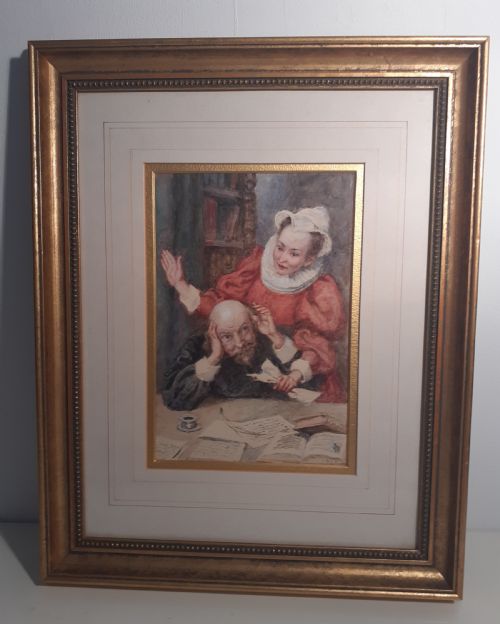
Framed Tudor Portrait Artwork
Framed tudor portrait artwork brings sixteenth-century faces into modern rooms through later revivals and historical painting.
Framed Tudor Portrait Artwork
Framed tudor portrait artwork captures the distinct appearance of English monarchs, nobles, and figures from the sixteenth century, rendered primarily in later periods. Buyers seeking framed tudor portrait artwork encounter oil paintings and watercolours executed during the seventeenth, eighteenth, nineteenth, and early twentieth centuries. These pieces reflect historical revivals rather than original sixteenth-century production, utilising styles from Tudor and Renaissance revivals to Victorian historical genre.
The selection on this page centres on oil on canvas and watercolour formats, often housed in gilded wood frames. Subjects include prominent historical figures such as King Henry VIII, Sir Thomas More, and Mary Stuart Queen of Scots, alongside anonymous Elizabethan gentlemen. The execution spans various revival movements, showing how later artists interpreted earlier portraiture traditions.
Materials and construction
These works rely on oil paint applied to canvas or wood panels, alongside pencil and watercolour on paper. Artists utilised traditional pigments to build rich, dark tones characteristic of historical portraiture. Supporting these surfaces, frames constructed from wood incorporate giltwood, gold leaf, and gilded finishes.
The framing techniques match the revival aesthetic, using heavy moulding and gold leaf to emulate earlier periods. Canvases are stretched over wooden frames, while watercolours are protected behind glass within ornate wooden surrounds.
Henry VIII appears multiple times, proving that even centuries later, nobody can resist a monarch with strong accessories.
Assessing quality
The integrity of the accompanying frame also determines the overall standard. Original giltwood frames that complement the age and style of the artwork elevate the piece above those housed in mismatched or later replacements.
Alfred Holst Tourrier·Christoffel Bisschop·William Aikman·George Perfect Harding
The Framed Tudor Portrait Artwork Glossary
- Tudor / Renaissance Revival
- A nineteenth-century artistic movement that recreated the visual style, dress, and subjects of the Tudor and Renaissance eras. Artists adopted these historical themes to appeal to Victorian collectors interested in national heritage.
- Giltwood
- Wood that has been coated with a thin layer of gold leaf or gold paint. This material was standard for framing significant portraits across the eighteenth and nineteenth centuries.
- Oil on Canvas
- A painting technique using pigments suspended in a drying oil medium applied to a stretched woven fabric support. This combination allowed for deep colour saturation and longevity.
- Historical Genre
- A category of painting that depicts scenes from past eras, often blending narrative elements with portraits of known historical figures. Victorian artists frequently utilised this approach to dramatize British history.
Framed Tudor Portrait Artwork: Frequently Asked Questions
Are these portraits painted in the sixteenth century?
No, the pieces available date from later centuries, including the seventeenth, eighteenth, nineteenth, and early twentieth eras. They represent historical revivals and interpretations rather than original Tudor-period production.
Artists of later generations recreated these likenesses using the techniques and materials of their own time, often reflecting Victorian or Edwardian fascination with British history.
What subjects typically appear in these artworks?
Subjects include prominent English monarchs like King Henry VIII and Mary Stuart Queen of Scots, alongside nobility such as Sir Thomas More and Lucy Russell. Anonymous sitters described as Elizabethan gentlemen also feature.
These figures are shown in characteristic period attire, frequently displaying badges of office or elaborate ruffs that define the historical aesthetic.
How should I hang a framed portrait?
Choose a wall with stable humidity away from direct sunlight to protect both the canvas or paper and the gilded wood frame. Ensure the hanging hardware is securely fixed to support the weight of the wooden structure.
Pairing these dark, atmospheric works with neutral wall colours helps the rich tones of the oil paint and gold leaf stand out in a modern interior.
What framing materials are common?
Frames are constructed primarily from wood, finished with giltwood, gold leaf, or gilded surfaces. These ornate surrounds mirror the historical weight of the portraits within.
The combination of dark oil paint and reflective gold framing is a defining characteristic of this category.