
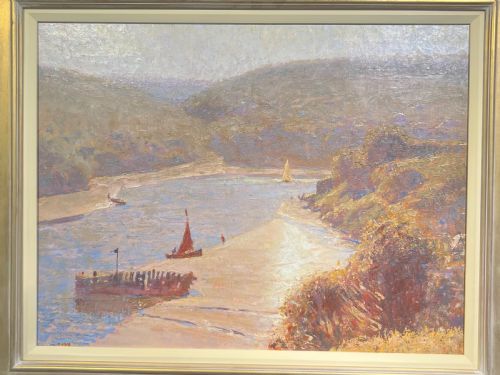
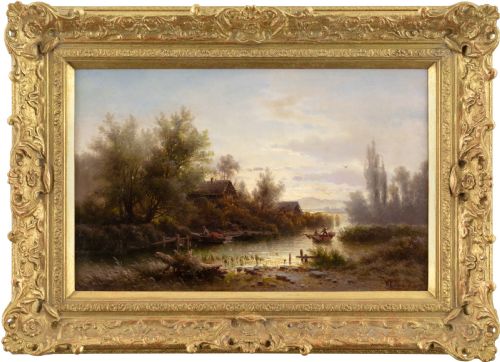
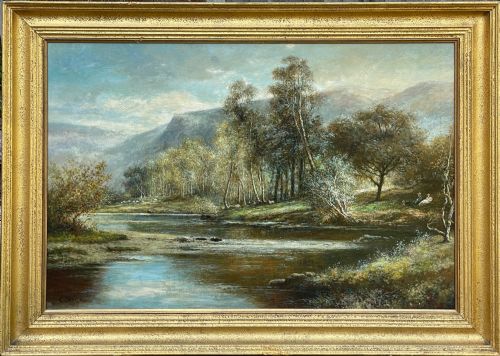
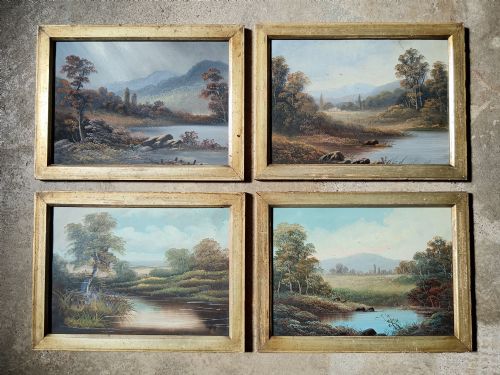


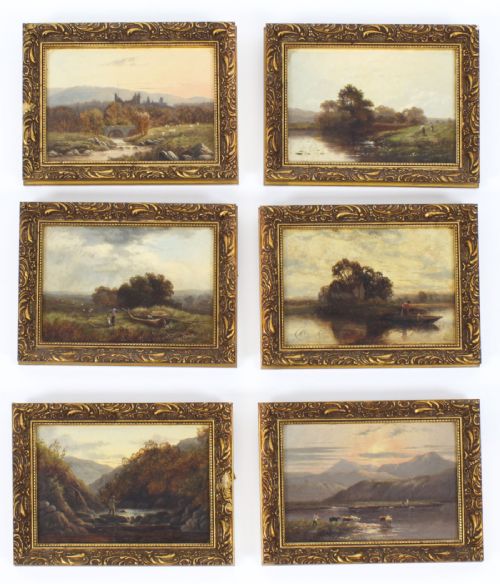


Framed River Scenery Painting
A framed river scenery painting captures flowing water and open banks, bringing traditional landscape art directly into your home.
Framed River Scenery Painting
A framed river scenery painting typically depicts rural waterways, bridges, and pastoral riverbanks captured across various historical periods.
You are most likely to encounter nineteenth-century and early twentieth-century examples on this page, reflecting British landscape traditions.
The selections span individual framed works and grouped sets, encompassing both intimate watercolours on paper and larger canvases.
Materials and Technique
Artists painted primarily with oil paint or watercolour, applying pigment onto prepared canvas, wood panels, or heavy paper.
Works are typically presented within period wood frames, frequently finished with gilt wood or gold leaf detailing.
Cows frequently wade into the background of these rivers, seemingly placed by artists solely to judge the scale of the water.
Assessment of Quality
Quality rests in the precision of brushwork and the artist's ability to render natural light and atmospheric depth along the riverbank.
The integrity and original condition of the accompanying wood frame contribute significantly to the overall merit of the piece.
Cecil Allan Mould·Albert Rieger·William Mellor·Amos Green·William Hoggatt·Noel Harry Leaver·Ernest Higgins Rigg·Thomas Swift Hutton·Robert John Hammond·James Poole·Thomas E Francis
The Framed River Scenery Painting Glossary
- Canvas
- A heavy woven fabric stretched across a wooden stretcher frame to serve as a durable support for oil painting.
- Gilt Wood
- Wood carved and coated with a thin layer of gold leaf or metallic gilt for decorative framing.
- Watercolour
- A painting method where fine pigments are suspended in a water-based solution and applied to paper.
- Wood Panel
- A solid wooden board utilised as a rigid painting support prior to or alongside the adoption of canvas.
Framed River Scenery Painting: Frequently Asked Questions
What subjects appear in these paintings?
These works primarily feature natural waterways, Scottish bridges, mountain streams, and cattle grazing peacefully along rural riverbanks.
Many compositions focus on specific regional landscapes across Britain, Wales, and Switzerland during the nineteenth and early twentieth centuries.
How should I hang these framed works?
Ensure you use appropriate fixings suited to the weight of the timber frame and the wall construction of your room.
Position the painting at eye level away from direct sunlight to protect both the painted surface and the delicate gilt wood.
Are these paintings signed by the artists?
Many of the listed works bear original signatures or attributions to named British and European painters from the period.
Signed pieces often provide a clearer historical record of the artist and the specific geographical location depicted.
How do I identify the period of a painting?
The period can often be deduced from the painting style, artist active dates, and the construction methods of the frame.
Nineteenth-century works generally display traditional realism and naturalism, while early twentieth-century pieces hint at early impressionist influences.