
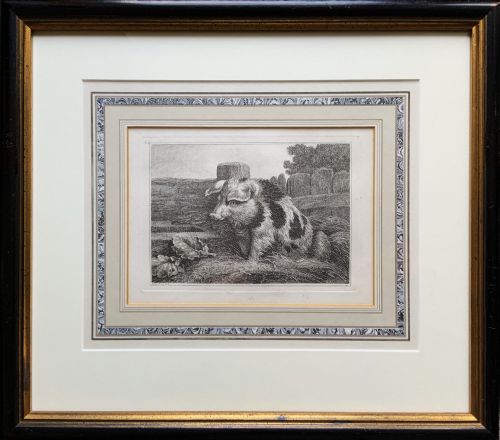
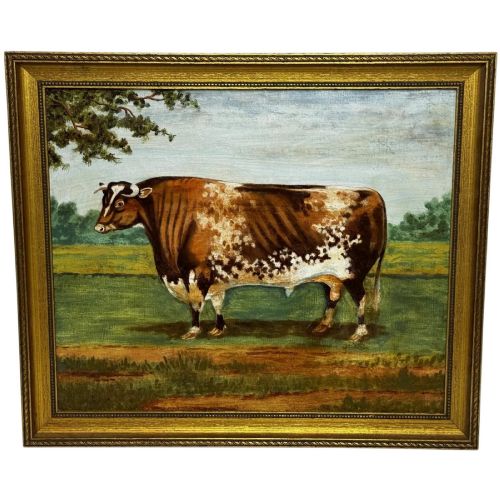
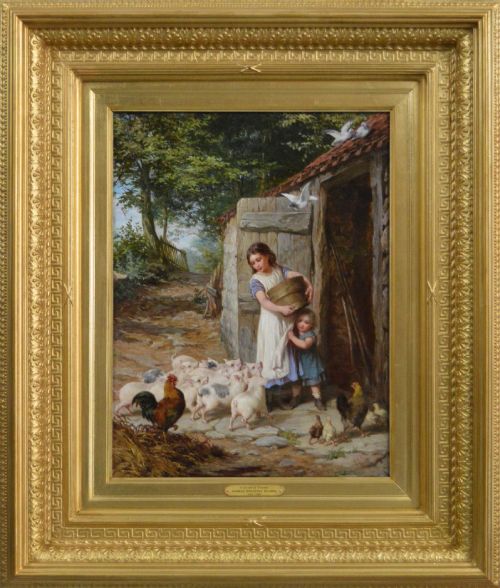
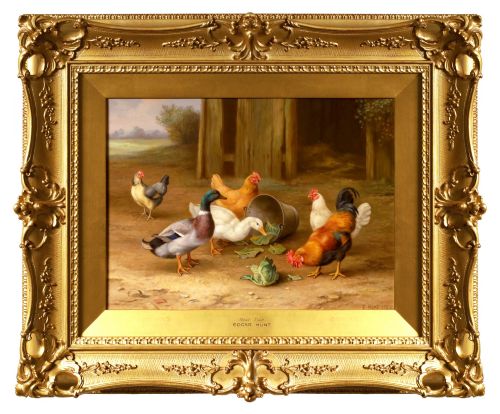
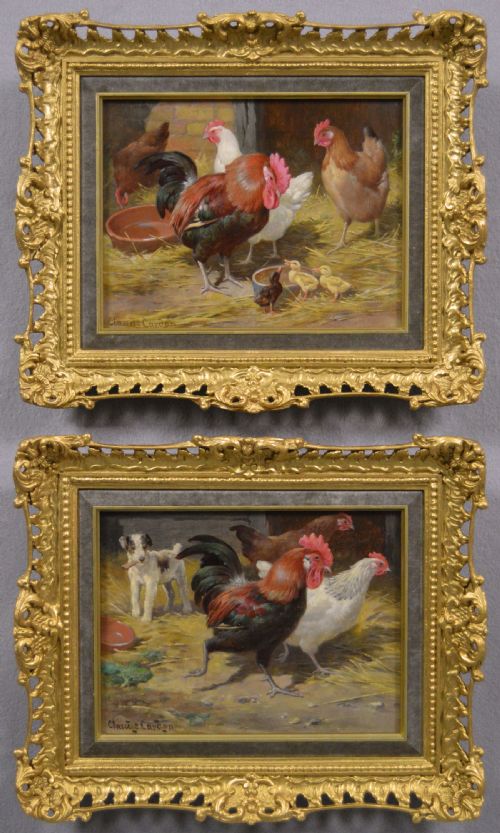


Framed Farm Animal Art
Framed farm animal art brings rural life indoors, depicting cattle, sheep, and poultry in oil and watercolour within period wood and gilt frames.
Framed Farm Animal Art
Framed farm animal art centres on pastoral scenes, featuring prize bulls, sheep in fields, and poultry in farmyards created during the nineteenth and early twentieth centuries.
The pieces on this page comprise oil paintings on canvas and board, watercolours, and antique prints housed in wooden and gilt frames.
Victorian British and continental schools dominate the selection, portraying domestic livestock and rural genre scenes with careful observation.
Materials and technique
Artists painted primarily in oil upon canvas or wooden board, applying pigment to capture the texture of animal coats and feathered plumage.
Watercolour served for lighter works on paper, while frames utilised wood, sometimes finished with gold leaf or gilt details.
Guinea pigs and rabbits occasionally share the farmyard alongside horses, cattle, and poultry.
Judging quality
Quality rests upon the artist's command of anatomy and proportion, distinguishing a convincing shorthorn bull from a stiff rendering.
Surface preservation matters greatly, as original canvas tension and unblemished paint layers maintain the integrity of these pastoral works.
George Augustus Holmes·Edgar Hunt·Claude Cardon·Franz van Severdonck·John Frederick Herring Jnr·Samuel Joseph Clark·Eugene Verboeckhoven·Percival Glenfern·Pierre Emmanuel Dielmans·Thomas Sidney Cooper·W A Clark·George Smith RSA·A Davis·H Strafford·Louis Marie Dominique Robbe·Charles Hunt Jnr
The Framed Farm Animal Art Glossary
- Animalier
- An artist who specialises in the realistic portrayal of animals. These painters often studied livestock closely in farmyard settings.
- Genre painting
- A work depicting scenes from everyday life involving ordinary people and domestic animals. Such pieces often include figures feeding poultry or tending horses.
- Giltwood
- Wood carved and covered with a thin layer of gold leaf or gilt paste. This material frequently frames nineteenth-century oil paintings.
- Pastoral realism
- An artistic style depicting rural subjects with an emphasis on naturalistic detail. It forms the foundation of many Victorian farmyard scenes.
Framed Farm Animal Art: Frequently Asked Questions
What subjects appear in these works?
Paintings show cattle, sheep, pigs, horses, and poultry in farmyards or pastures. Figures occasionally accompany the livestock in genre scenes.
Domestic farm animals remain the central focus across canvases and watercolours alike.
How do I date a piece?
Signatures, artist life dates, and canvas stamps offer the clearest chronological clues. Stylistic markers of the Victorian and Edwardian periods also help.
Framing materials can provide supplementary evidence regarding the age of the artwork.
Where should I hang these works?
Kitchens, dining rooms, and studies suit pastoral subjects well, echoing their traditional rural themes. Direct sunlight should be avoided to protect the oil or watercolour medium.
Matching the wood tone of the frame to surrounding furniture helps integrate the piece into a room.
What framing is typical?
Original frames frequently consist of moulded wood finished with gilt or gold leaf. These settings complement the darker earth tones found in nineteenth-century canvases.
Some works retain simpler wooden borders depending on their origin.