

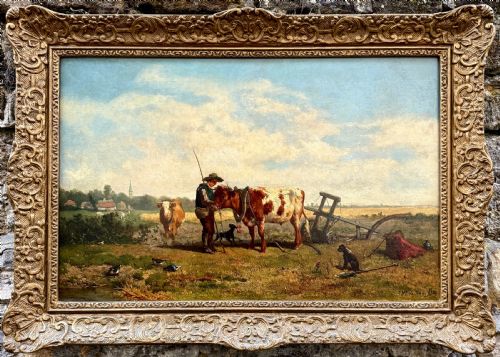


Framed Agricultural Landscape Art
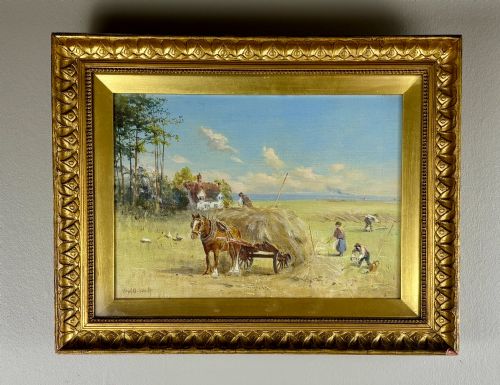
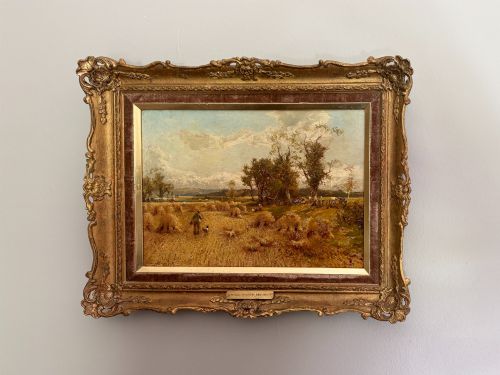
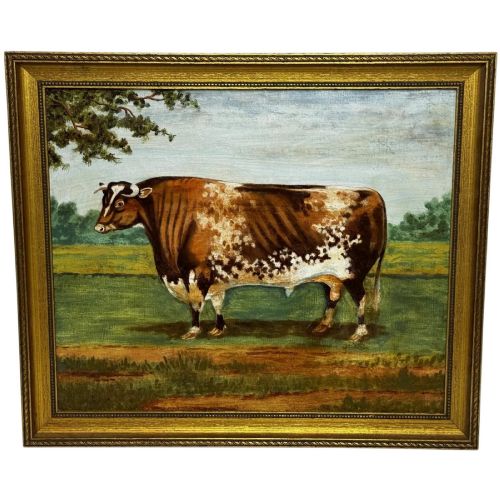
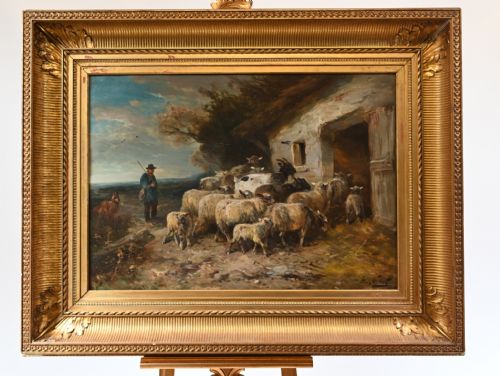
Framed agricultural landscape art brings the working countryside into the room, showing heavy horses, harvest fields, and farmyard animals.
Framed Agricultural Landscape Art
Framed agricultural landscape art captures the rural economy of the nineteenth and early twentieth centuries through depictions of ploughing horses, cattle, and farm hands at work. A buyer examining this selection encounters oil paintings on canvas and watercolours on paper, often housed in period wooden or gesso frames.
The prevalent examples span the Victorian and Edwardian eras up to the mid-twentieth century, recorded by British and European painters. These works document traditional farming methods, haymaking, and pastoral scenes before mechanisation altered the countryside.
How They Were Made
Artists worked primarily in oil paint on stretched canvas or applied watercolour to paper, building compositions that focused on natural light and agricultural labour. Canvases were secured in timber frames, sometimes finished with moulded gesso ornamentation or ebonised surfaces.
Etchings also appear among the works, created through inked metal plates printed on paper. These methods combined durable supports with traditional framing to preserve rural subjects across generations.
Listings feature canvases, watercolours, and etchings spanning the nineteenth century, Victorian, Edwardian, and nineteen-fifties periods.
What Varies in Quality
Quality rests upon the artist's command of anatomy, light, and atmosphere, separating competent topographical records from accomplished painterly observations. The handling of working horses, cattle, and human figures reveals the draughtsmanship behind the composition.
The integrity of the physical object also matters, including the preservation of the original paint surface or watercolour pigment, alongside the suitability and condition of the accompanying wood or gesso frame.
Henry Schouten·Johannes de Haas·A M Gauci·Herbert Dicksee·Oswald Garside·Raimond Louis Lecourt·James William Booth·Herbert Royle·Percival Glenfern·John Atkinson·J C Grey·George Soper·Arthur Charles Dodd·Vernon Stokes·Rowland Henry Hill·Joseph Kirkpatrick·W A Clark·Joseph Paulman·J L Van Leemputten·John Percy Cooke·W E Millner·Arthur Claude Strachan·Walter Duncan·George Cole·Sonia Lawson
The Framed Agricultural Landscape Art Glossary
- Oil on canvas
- Pigment suspended in drying oil applied to a woven fabric support stretched over a wooden frame. This medium allowed artists to work with rich textures and deep colour blending.
- Watercolour
- Paint made from water-soluble pigments applied to paper. It creates transparent washes of colour that rely on the white of the paper for luminosity.
- Etch
- A printmaking technique where acid cuts into uncoated portions of a metal plate to hold ink. The inked design is then transferred to paper under pressure.
- Gesso
- A paint mixture consisting of a neutral binder mixed with chalk, gypsum, or pigment. It was built up on wooden frames to create smooth surfaces for gilding or moulding.
- Ebonised frame
- Wood treated with a finish that darkens the grain to imitate ebony. This dark border creates a sharp visual boundary for pastoral paintings.
Framed Agricultural Landscape Art: Frequently Asked Questions
What periods do these artworks come from?
The selections span from the nineteenth century through the Edwardian period and into the nineteen-fifties. Most works date from the late Victorian and early twentieth centuries.
During these decades, artists frequently recorded traditional rural life and agricultural practices across Britain and parts of Europe.
Are these paintings original works?
The category includes original oil paintings on canvas, original watercolours on paper, and printed etchings. Each piece represents the hand of the artist or printmaker who created it.
Signatures and dates often appear within the composition or on the margins of the paper.
How should I hang framed art?
These works require placement away from direct sunlight and damp environments to protect canvas, paper, and wooden frames. Stable indoor humidity keeps wood and gesso stable over time.
Ensure wall fixings match the weight of the heavier oil paintings and substantial timber frames.
What subjects feature in these scenes?
Common subjects include shire horses ploughing fields, hay carts during harvest, cattle resting near water, and shepherds with flocks. These rural depictions focus on daily farm labour and livestock.
Artists captured working horses and agricultural landscapes before modern machinery transformed farming.