

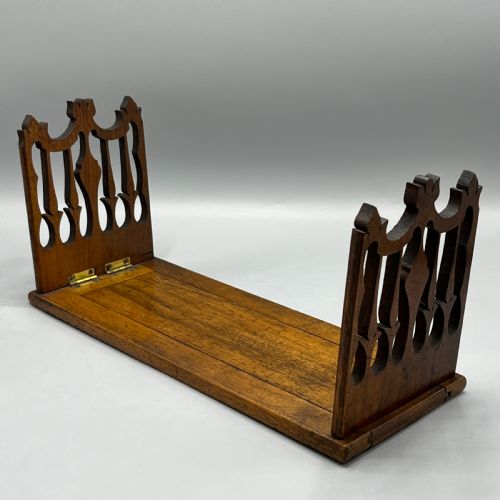


Folding Book Slide
A folding book slide keeps your library in order on a desk or shelf while collapsing neatly when not in use.
Folding Book Slide
A folding book slide is a desk accessory designed to hold volumes upright between expanding wooden ends. The examples you encounter here span the nineteenth century, including Victorian and Regency periods, alongside specific regional workshops. Most pieces on this page utilise an extending mechanism that allows the length to adjust according to the number of books held.
The primary forms vary from simple wooden racks to elaborately decorated novel rests equipped with folding action. You will find items originating from English workshops as well as overseas traditions such as Anglo-Indian and Jerusalem craftsmanship. These objects served both practical library functions and decorative desk display purposes in period homes.
How they were made
Cabinet makers constructed these pieces using dense hardwoods like walnut, rosewood, coromandel, and ebonised wood, often incorporating maple or olive wood for visual contrast. Metal elements such as brass mounts provided structural reinforcement and operated the sliding mechanism. Inlays of bone, boxwood, and intricate Tunbridge ware added decorative surface detail to the wooden bodies.
Specialised techniques included micro-mosaic inlay work for Jerusalem pieces and chip-carving for Anglo-Indian teak items. Patented actions, such as those by Betjemanns, integrated mechanical brass hinges and slides into the wooden frame. Polishing and ebonising completed the surface treatment to highlight the natural grain of the timber.
Folding Book Slide Retail Price Guide 2026
Typical asking prices for folding book slide among the pieces listed under this phrase on Sellingantiques today, from the lower quarter to the upper quarter. They describe what is for sale here now, not the wider market.
Materials recorded on this page include brass, walnut, rosewood, ebonised wood, bone, coromandel, boxwood, and olive wood.
What varies in quality
Quality in a folding book slide rests on the choice of timber and the precision of the mechanical action. Superior examples feature luxurious exotic veneers like coromandel or rosewood paired with robust brass hardware that operates smoothly. Lesser pieces employ plain stained woods with simpler joinery and basic folding joints.
The intricacy of the surface decoration further distinguishes the range. Finely detailed Tunbridge ware banding or elaborate carved teak displays a higher tier of craftsmanship than plain or minimally decorated alternatives.
Betjemanns patent
The Folding Book Slide Glossary
- Folding book slide
- A desk accessory with expanding sections designed to hold books upright and fold away when empty. It provides an adjustable storage solution for heavy or numerous volumes.
- Tunbridge ware
- Woodware decorated with tiny mosaic tiles of various coloured woods to form geometric or pictorial scenes. It originated in the Kent town of Tunbridge Wells during the nineteenth century.
- Novel rest
- A nineteenth-century term for an adjustable book holder or desk stand designed to keep reading material at a convenient angle. These often featured folding hinged supports.
- Coromandel
- A dense, heavy timber imported from Asia, prized for its dark brown colour and striking black grain. Cabinet makers used it extensively for high-end Victorian luxury goods.
- Ebonised wood
- Timber stained or treated to imitate ebony, creating a solid black finish. This technique was popular in Victorian furniture and desk accessories for dramatic contrast.
Folding Book Slide: Frequently Asked Questions
How do folding book slides work?
These pieces use a sliding mechanism embedded within the wooden base to expand or contract. The hinged or telescoping sections allow the overall length to change smoothly.
When adjusted to the desired span, the ends hold volumes firmly upright between them. Folding variants can collapse flat for storage when not supporting books.
Where were they used in the home?
Victorian and Regency owners placed these items on library tables, writing desks, and parlor sideboards. They kept reference books or current reading volumes close at hand.
They also functioned as decorative display pieces on mantelpieces or occasional tables. Their compact nature suited the formal study as well as the private drawing room.
What materials are most common?
Walnut and rosewood form the foundation of many nineteenth-century examples found on this page. Exotic timbers like coromandel and olive wood appear on more decorative pieces.
Brass mounts provide the structural linkage for the sliding mechanisms. Bone, boxwood, and micro-mosaic details add surface ornamentation.
How do I distinguish regional styles?
Anglo-Indian pieces typically feature deep carved teak wood with intricate floral motifs. Jerusalem examples often showcase olive wood constructed with geometric Tunbridge or mosaic patterns.
English Victorian items lean towards polished walnut, coromandel, or ebonised finishes with brass mounts. Recognising the timber and decorative technique clarifies the origin of each piece.