
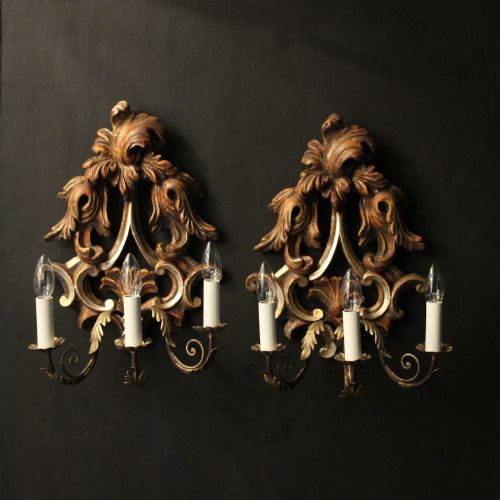


Florentine Candle Appliques
These florentine candle appliques bring carved, gilded warmth to a wall, offering rich Italian texture from the early decades of the twentieth century.
Florentine Candle Appliques
Florentine candle appliques are decorative wall lights designed to hold candles, originating from workshops in Italy during the early twentieth century. These pieces primarily take the form of wooden wall lights configured with single or multiple arms for illumination.
How they were made
Makers shaped these wall lights using carved wood and gesso as the foundational base for ornamentation. Artisans then applied layers of gold leaf, silver leaf, or polychrome paint to achieve the luminous metallic finishes characteristic of the region.
Details such as crystal elements and beaded work appear alongside carved wooden scrolls and arms. The construction relies on traditional joinery and carving techniques suited to creating ornate wall-mounted lighting fixtures.
Object types seen on this page are exclusively wall lights, ranging from single arm formats up to configurations with four arms.
What varies in quality
The refinement of the carving separates standard production from finer work, particularly in the crispness of acanthus leaves and scrollwork. Depth of relief and the intricacy of the wooden forms dictate the visual weight of each piece.
Application of the metallic leaf and polychrome pigments influences the overall brilliance and depth of the surface finish. The presence of integrated crystal or beaded components adds another layer of complexity to the construction.
The Florentine Candle Appliques Glossary
- Giltwood
- Wood that has been coated with a thin layer of gold leaf. This technique provides a durable and reflective metallic surface across carved details.
- Gesso
- A plaster mixture applied to wood as a smooth base for gilding and painting. It allows craftsmen to carve fine details before applying gold leaf.
- Polychrome
- The practice of decorating surfaces in a variety of colours. Painted highlights often complement the gilded areas on Italian wall lights.
- Rococo
- An ornate design style marked by asymmetry, scrollwork, and curved lines. Florentine lighting often incorporates these decorative flourishes.
Florentine Candle Appliques: Frequently Asked Questions
How do I mount these wall lights?
These appliques typically mount directly to a wall using secure fixings suited to the weight of the timber and gesso construction. Professional installation is recommended to support the structure safely.
Ensure the mounting point aligns with any internal wiring if the pieces have been adapted for modern electrical use rather than strictly holding candles.
Are these lights wired for electricity?
Many antique wall lights of this type originate as candle holders and may require professional adaptation for electric bulbs. The titles describe them primarily as wall lights or appliques designed for illumination.
Consult a qualified electrician to assess the internal channels and backplates before attempting any wiring conversion.
How should I clean gilded wood?
Dust the surface gently with a soft, dry brush to remove particles without disturbing the delicate gold or silver leaf. Avoid liquid cleaners and harsh chemicals entirely.
Moisture can damage the underlying gesso and wood, so dry maintenance preserves the original metallic finish over time.
What period do these pieces date from?
The available pieces date from the early twentieth century, specifically spanning the nineteen-hundreds to the nineteen-thirties. This era saw continued production of traditional Florentine styles in Italian workshops.
Characteristics from Italian Baroque and Rococo revivals heavily influence the decorative vocabulary of this period.