

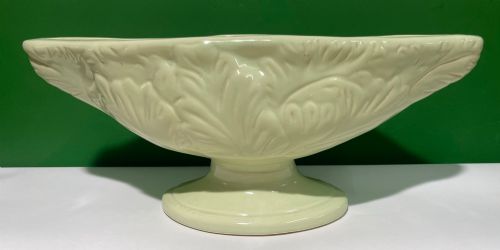

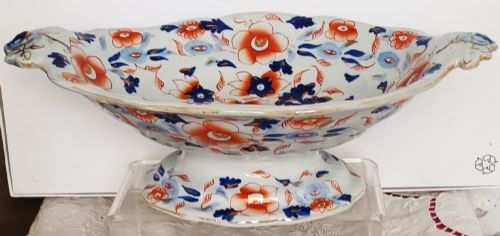


Floral Pedestal Bowl
These floral pedestal bowl pieces bring table centrepieces and footed comports into the room, built for display and service across the nineteenth and early twentieth centuries.
Floral Pedestal Bowl
A floral pedestal bowl is typically found in ironstone, porcelain, and glass, taking forms such as footed comports, centrepieces, and tazzas. These vessels stand upon raised bases, designed to hold fruit, flowers, or simply to anchor a dining table or sideboard.
The selections span the Victorian, Edwardian, and Art Nouveau eras, drawing on styles from Rococo Revival and Georgian to the distinctive Japanned patterns of the nineteenth century. Makers and factories across England and continental Europe shaped these pieces during periods ranging from the eighteen-eighties to nineteen-twenties.
Buyers encounter everything from large German porcelain centrepieces adorned with applied roses to sturdy English ironstone comports and silver-plated copper vessels. Each iteration serves the same traditional function of elevated display, whether rendered in blue and white transferware or gilt-accented ceramic.
How they were made
Potters and ceramists utilised ironstone, porcelain, and earthenware, shaping bodies through moulding and throwing before applying glazes and hand-painted or transfer-printed designs. Enamels and gold leaf frequently highlight raised details, particularly on pieces originating from English and German manufactories.
Glassmakers employed cutting, etching, and engraving techniques upon clear and coloured metal, producing footed vessels that catch the light from multiple angles. Metalworkers combined silver plate with copper bases, while others cast pewter into organic Art Nouveau motifs alongside cameo glass.
Floral Pedestal Bowl Retail Price Guide 2026
Typical asking prices for floral pedestal bowl among the pieces listed under this phrase on Sellingantiques today, from the lower quarter to the upper quarter. They describe what is for sale here now, not the wider market.
Some German porcelain centrepieces feature tiny applied roses and cheerful putti scrambling up the stem.
What varies in quality
Quality rests in the crispness of the modelling, especially where applied floral elements and sculptural figures adorn porcelain centrepieces. Finer examples display meticulous hand-painting and precise gilding that remains sharp across the contours of the pedestal and rim.
The weight and balance of the vessel dictate its structural integrity, with superior glass showing deep, clean wheel-cutting rather than superficial pressing. Ironstone and pottery vary according to the clarity of the transfer print and the depth of the glaze.
Ulisse Cantagalli·Schierholz Plaue·Maling·C.G. Schierholz and Sohn·Mason·Orivit·Eichwald
The Floral Pedestal Bowl Glossary
- Comport
- A shallow bowl raised on a high foot or pedestal, traditionally used for serving fruit or sweets at the table. These pieces often match larger dinner services.
- Tazza
- A small, shallow saucer-like vessel mounted on a stem and foot, originating in the Renaissance and revived during the nineteenth century for display purposes.
- Ironstone
- A heavy, durable type of earthenware patented in the nineteenth century to rival true porcelain. It accepts transfer printing and enamel colours exceptionally well.
- Japanned
- A style of decoration emulating Japanese lacquerware, featuring dark grounds and metallic motifs common on nineteenth-century ironstone and pottery.
- Cloisonné
- A metalwork technique where thin wire partitions are soldered to a base and filled with enamel paste before firing.
Floral Pedestal Bowl: Frequently Asked Questions
What is a pedestal bowl used for?
These elevated vessels primarily served as dining table centrepieces for fruit, flowers, or sweetmeats during formal meals. In modern settings, they function effectively as standalone decorative objects on sideboards or coffee tables.
Their raised profile draws the eye upward, making them natural focal points for interior display without crowding surface space.
How do I date a ceramic pedestal bowl?
Dating relies on identifying backstamps, factory marks, and stylistic indicators such as the heavy gilding of the Victorian period or organic forms of Art Nouveau. Material composition, such as the dense body of nineteenth-century ironstone, also provides a reliable chronological anchor.
Comparing glaze characteristics and decorative motifs against known factory production windows narrows the era of manufacture further.
What is the difference between a comport and a tazza?
A comport generally refers to a deeper footed bowl used for service, while a tazza is typically flatter and wider, resembling a shallow saucer on a stem. Both share the defining pedestal structure that lifts the vessel above the table surface.
Historical terminology often blurs these definitions, but the depth of the well remains the most practical guide.