
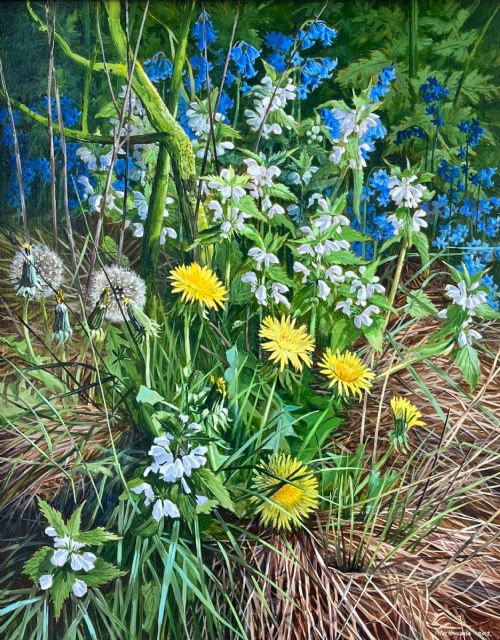


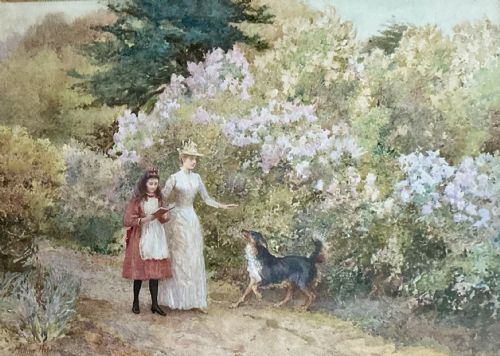


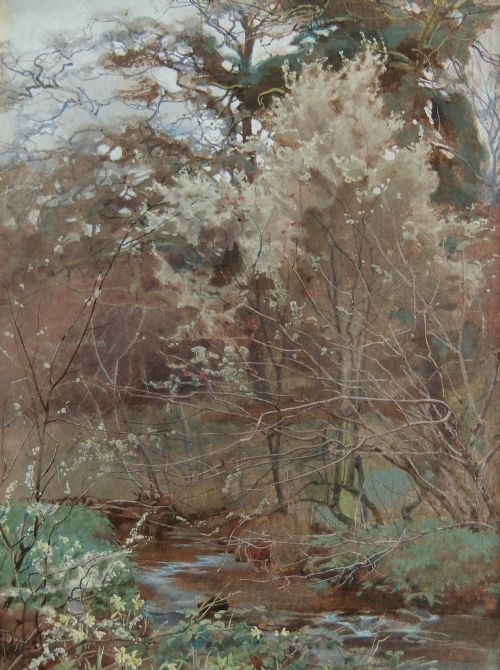


Floral Landscape Artwork
Floral landscape artwork brings together natural scenery and blooming gardens, offering buyers a vivid window into historic outdoor spaces through oil and watercolour.
Floral Landscape Artwork
Floral landscape artwork captures botanical settings, country gardens, and natural vistas across various historic periods. Buyers encounter pieces ranging from Victorian watercolours to later twentieth-century mixed media compositions.
The most common examples on this page are British watercolours and oil paintings from the late nineteenth and early twentieth centuries. These works frequently depict walled gardens, country houses, and seasonal blossoms rendered by listed artists.
Alternative forms include Japanese cloisonne plates featuring landscape motifs and decorative paintings on canvas or paper. Each object balances landscape scenery with prominent floral elements.
Materials and Technique
Artists relied primarily on watercolour pigment on paper and oil paint on canvas to build these scenes. Mixed media and glass components also appear among the listed works.
Watercolour pieces utilise fluid washes and delicate brushwork on paper support, often capturing light in cottage gardens. Oil paintings employ heavier pigment layers on canvas to achieve depth in larger woodland and parkland views.
Listings feature paper, canvas, wood, glass, and watercolour pigment.
Assessing Quality
Quality rests in the precision of the brushwork and the artist's ability to render light and botanical detail simultaneously. Superior examples capture distinct flower varieties and atmospheric conditions with assured handling.
Compositional strength separates standard decorative pieces from finer artistic achievements. Works by established painters demonstrate a superior command of colour harmony and spatial depth within the garden setting.
Peter Newcombe·Harry Wanless·Thomas Bromley Blacklock·Arthur Hopkins·Theresa Stannard·Ernest Higgins Rigg·Lilian Stannard·Alfred W Parsons·Owen Bowen·David Woodlock·Jane Utley·Beatrice Parsons·Edgar Bundy·George Frederick Nicholls·Ralph Hedley·Fred Merriman·Minnie Smythe
The Floral Landscape Artwork Glossary
- Watercolour
- A painting method where fine pigment is suspended in a water-based solution and applied to paper. It allows for translucent washes of colour.
- Oil paint
- A slow-drying medium composed of pigments suspended in a drying oil, typically linseed oil. This material permits rich textures and blended tones on canvas.
- Cloisonne
- An ancient technique for decorating metalwork objects with coloured glass paste separated by strips of metal wire. Japanese examples often integrate natural scenery into the design.
- Mixed media
- An artwork format utilising multiple distinct artistic materials and mediums within a single piece. This approach combines elements like paint and ink.
- Impressionism
- A nineteenth-century art movement characterised by relatively small, thin yet visible brush strokes and an emphasis on accurate depiction of light. British and French practitioners applied this to garden landscapes.
Floral Landscape Artwork: Frequently Asked Questions
What periods do these pieces date from?
The selection spans from the Victorian era and the late nineteenth century through the Edwardian period and the early twentieth century. Later twentieth-century works also appear.
Most items concentrate around the decades between eighteen-eighty and nineteen-fifty, reflecting popular landscape and garden painting traditions.
How were these artworks originally displayed?
Paintings on paper and canvas were typically framed behind glass or mounted on stretchers for domestic interior display.
Framed watercolours and oil paintings decorated the walls of country houses and urban drawing rooms alike.
How do I care for antique watercolours?
Works on paper require protection from direct sunlight to prevent the watercolour pigments from fading over time. Maintaining stable indoor humidity levels also preserves the paper support.
Displaying pieces away from damp environments ensures the materials remain stable for decades.
Are all the paintings signed by the artist?
Many pieces feature visible signatures or attribution to named historical painters, while others remain unsigned examples of the period.
Attributions rely on stylistic evidence, recording techniques, and period documentation associated with the workshop or artist.