




Cottage Garden Landscape
These cottage garden landscape paintings capture rural domestic scenes through watercolours and oils from the Victorian period to the mid-twentieth century.
Cottage Garden Landscape
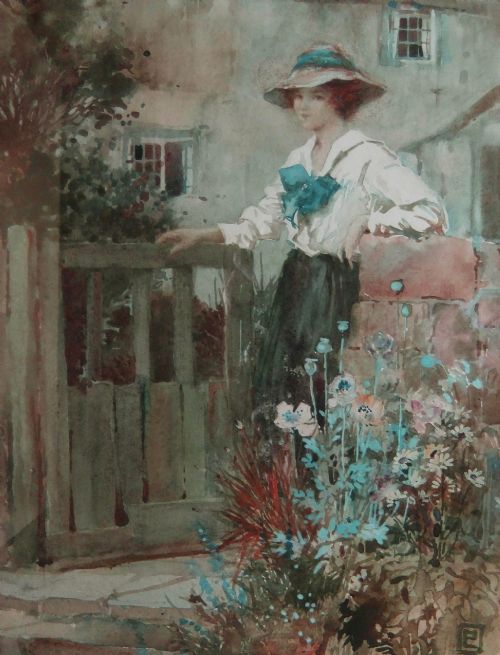
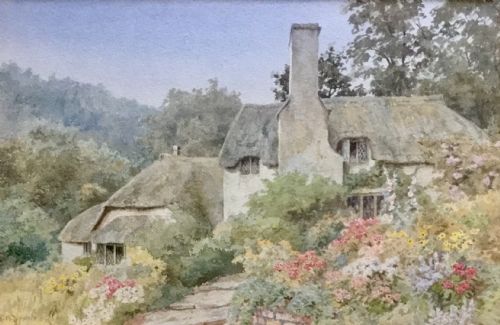
When you search for a cottage garden landscape, you enter a visual world of rural homes, floral pathways, and country life recorded across the nineteenth and twentieth centuries. The pieces on this page comprise paintings in watercolour and oil, alongside mixed media works that depict domestic scenes, rustic gates, and walled gardens.
You are most likely to meet watercolours on paper from the Edwardian period, alongside oil paintings on canvas representing British Impressionism and late Victorian rural genres. These works frequently focus on specific subjects such as feeding hens, children with pets, and thatched houses surrounded by summer blooms.
The origin of these pieces sits firmly within British traditions, capturing specific locations from Somerset to Yorkshire alongside imaginative pastoral scenes. Artists recorded rural architecture and horticulture using techniques that range in date from the nineteenth century through the 1940s.
Materials and Technique
Artists relied primarily on watercolour pigment applied to paper or oil paint laid upon canvas and wooden supports. These media allowed painters to capture the varied textures of thatched roofs, timber frames, and dense floral planting.
Paintings were frequently framed in wood and protected beneath glass, particularly in the case of watercolours from the early twentieth century. Canvas works in oil utilised the heavier texture of the fabric to build up richer layers of pigment for garden and coastal scenes.
Artistic styles represented include British Impressionism, Edwardian Pastoral, and Victorian Rural Genre.
Quality and Execution
Quality in these paintings rests upon the handling of light and the surety of the brushwork in rendering natural forms like foliage and weathered timber. Stronger pieces display a confident command of watercolour washes or oil impasto that brings depth to the garden setting.
The success of a composition often depends on the integration of human or animal figures - such as children, gardeners, or pets - within the domestic landscape. Works that maintain atmospheric coherence across both the structural architecture and the surrounding flora represent the upper tier of the range.
Percy Lancaster·Theresa Stannard·Owen Bowen·Ernest Higgins Rigg·Kershaw Schofield·Lilian Stannard·David Woodlock·Herbert Royle·Arthur Claude Strachan·John Abernethy Lynas-Gray·Thomas Nicholson Tyndale·Jane Utley·Henry John Sylvester Stannard·Benjamin D. Sigmund·George Frederick Nicholls·Minnie Smythe·Sidney Valentine Gardner
The Cottage Garden Landscape Glossary
- Watercolour
- A painting method in which the paints are made of pigments suspended in a water-based solution. This medium dominates the early twentieth-century works on paper found in this selection.
- Oil Paint
- A slow-drying paint made with pigments suspended in a drying oil, typically linseed. It allows for rich blending and textured application upon canvas or wood.
- British Impressionism
- A painting style influenced by the French movement but characterised by a distinctly domestic and pastoral British subject matter. It appears frequently in the oil paintings from this era.
- Mixed Media
- An artwork in which more than one medium or material has been employed. These pieces combine various drawing and painting supplies on a single surface.
- Impasto
- The process of laying paint thickly on an area of the surface so that it stands out from it. This technique gives tactile weight to floral elements in oil works.
Cottage Garden Landscape: Frequently Asked Questions
How do I date a cottage garden watercolour?
Dating relies heavily on artist signatures, exhibition records, and stylistic markers typical of the Edwardian period or the 1920s. Framing materials and paper types can also offer contextual clues.
Many works carry direct dates inscribed by the artist alongside the title, providing a clear point of origin within the nineteenth or twentieth century.
What is the difference between oil and watercolour in these works?
Watercolour pieces are executed on paper, often protected by glass, offering a lighter and more luminous depiction of rural flora. They frequently date from the early twentieth century.
Oil paintings utilise canvas or wood supports, allowing for heavier pigment layers and greater textural depth in rendering garden scenes and rustic cottages.
Are these paintings British in origin?
The majority of the works reflect British artistic traditions, movements such as English Impressionism, and specific regional locations like Somerset and Yorkshire. The subjects themselves focus on domestic rural life.
The styles encompass Victorian rural genres and Edwardian pastoral scenes that document the changing British countryside during the early decades of the twentieth century.
How should I frame and display paper watercolours?
Watercolours on paper require conservation mounting to ensure the pigment remains separated from the protective glass. Archival framing helps preserve the delicate medium over time.
Displaying these works away from direct sunlight prevents the fading of watercolour pigments and maintains the integrity of the original paper support.