
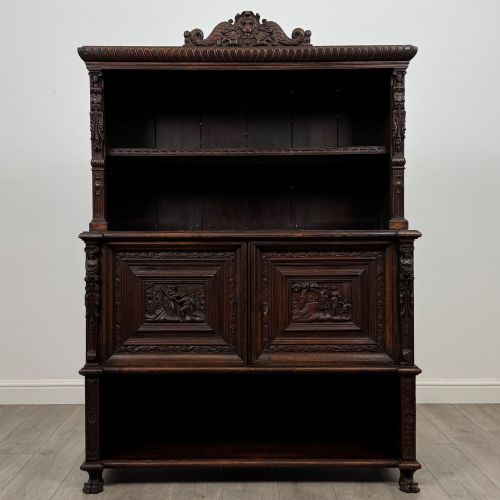
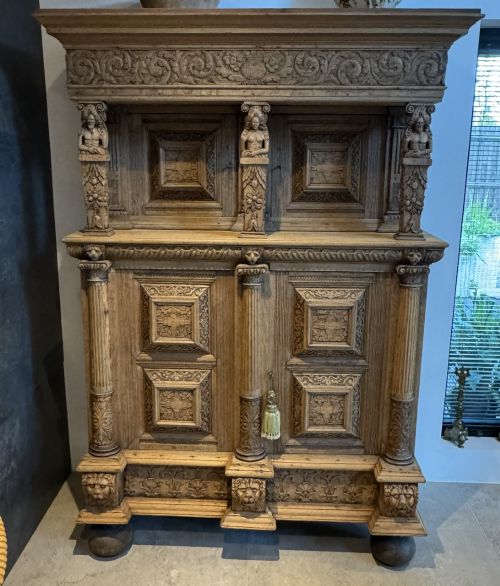


Flemish Court Cupboard
A flemish court cupboard brings robust timber and deep historic carving into a room, offering substantial presence and storage.
Flemish Court Cupboard
When you search for a flemish court cupboard, you encounter robust storage pieces designed for prominent display and practical holding. The selection spans robust items from the 16th century through to the 19th century, alongside Victorian revivals.
You meet heavy timber forms including hall cupboards, cabinets on stands, and sideboards. Oak dominates the selection, shaped through styles like Renaissance Revival and Flemish Baroque.
The version you are most likely to encounter on this page is the 19th-century carved oak cabinet or hall cupboard reflecting earlier Renaissance traditions. These pieces combine architectural proportions with pronounced relief carving.
How they were made
Makers utilised solid oak and walnut as the primary structural woods, selecting timber for its strength and grain. Carpenters shaped these panels with hand tools, applying deep relief carving to doors, friezes, and stiles.
Iron and brass hardware, such as hinges, handles, and lock plates, were forged and fitted by hand to secure heavy doors and drawers. Glass panels occasionally appear in upper sections, while architectural mouldings define the distinct tiers of the cupboards.
The listings span from the 16th century through the Victorian era, executed primarily in solid oak with occasional walnut.
What varies in quality
The distinction between ordinary and exceptional work rests upon the depth, crispness, and spatial harmony of the carving. Master carvers achieved deep undercut relief with crisp edges and expressive faces, whereas lesser pieces display flat, mechanical incisions.
Construction methods also separate standard items from superior examples, particularly the integration of architectural details like lion masks, pilasters, and panelled doors. Original hardware, well-fitted joints, and timber selection dictate the overall integrity of the piece.
The Flemish Court Cupboard Glossary
- Court cupboard
- A heavy timber storage piece typically built in two tiers, used for displaying plate and storing household goods. These forms often feature enclosed upper and lower sections.
- Renaissance Revival
- A style popular in the 19th century that reinterprets 16th-century architectural motifs, symmetry, and classical ornamentation. It frequently employs heavy carved oak.
- Cabinet on stand
- A cabinet supported by a distinct framework or base, lifting the primary storage compartment off the floor. This form highlights the vertical presence of the piece.
- Flemish Baroque
- An ornate style characterised by exuberant curves, rich foliate carving, and dramatic sculptural elements. It developed from earlier Renaissance principles in the Low Countries.
- Lion mask
- A decorative carved motif depicting the face of a lion, frequently applied to furniture corners, drawers, and friezes. This symbol denotes strength and status.
Flemish Court Cupboard: Frequently Asked Questions
What is a flemish court cupboard?
A flemish court cupboard is a heavy timber storage piece originating from or styled after the woodworking traditions of Flanders. These items typically feature two distinct tiers and elaborate carved ornamentation.
They serve as both functional storage and striking decorative centerpieces within large rooms.
How were these cupboards used?
Historically, households utilised these heavy cupboards to store valuable plate, linens, and provisions while displaying status. The enclosed compartments kept contents secure and protected from dust.
Today, owners use them in dining rooms, halls, and large living spaces for tableware, books, and collections.
How do I identify a 16th century piece?
A 16th century piece displays authentic period construction methods, hand-split timbers, and wear consistent with centuries of use. The carving reflects the pure Renaissance aesthetic of the era rather than later revivals.
Such early examples show distinct tool marks and structural joinery not replicated in later centuries.
How do I live with heavy oak furniture?
Living with heavy oak furniture involves placing pieces on sturdy flooring away from direct heat sources that can dry out the timber. Regular dusting and occasional waxing help maintain the finish.
Because of their substantial weight and physical presence, these cupboards anchor a room and require adequate surrounding space.