


Fitted Leather Vanity Box
A fitted leather vanity box offers a portable sanctuary for travelling essentials, uniting sturdy hide exteriors with meticulously arranged internal compartments.
Fitted Leather Vanity Box
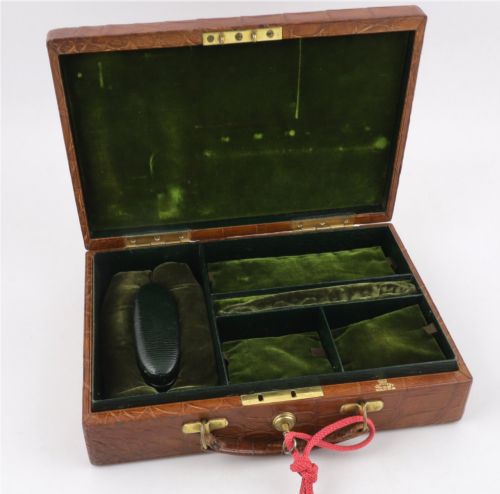
A fitted leather vanity box brings together portable luxury and practical organisation, serving travellers from the Georgian era through to the Art Deco period. These pieces appear in forms ranging from compact jewellery cases and gentleman's valet suitcases to fully equipped dressing boxes.
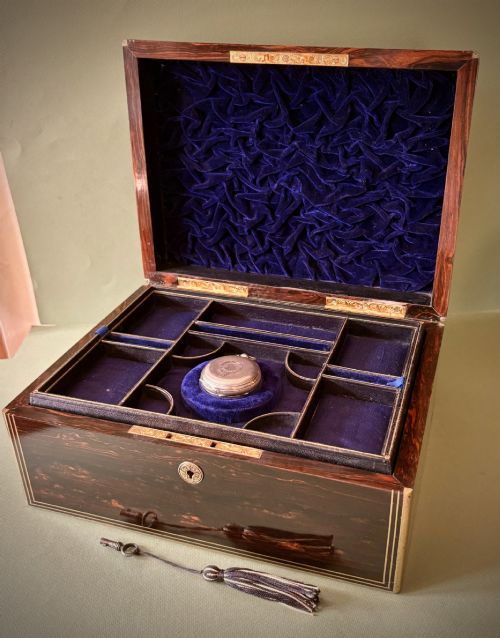
The version most commonly met on this page combines a durable leather or crocodile leather exterior with a tailored interior designed to hold grooming items securely. Velvet linings and dedicated slots protect delicate items during transit.
These items reflect the travel habits of past centuries, where maintaining a personal toilette away from home required purpose-built containers. Each example demonstrates how form follows function in the evolution of personal luggage.
How they were made
Makers constructed these boxes using a wooden carcass encased in leather, brass, or crocodile leather, often incorporating brass hardware for security and reinforcement. The exterior hides underwent careful treatment to withstand the rigours of carriage and rail travel.
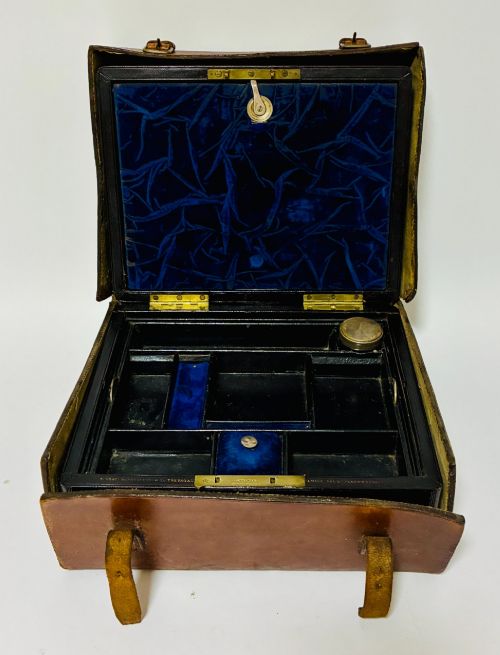
Interiors required precise carpentry to create fitted sections lined with velvet, housing tailored accessories such as cut glass scent bottles, sterling silver gilt items, and celluloid implements. Each compartment was shaped specifically to hold its designated tool firmly in place.
Several boxes still retain their original travelling outer covers, proving that historic luggage also needed its own waterproof winter coat.
What varies in quality
Quality reveals itself in the integrity of the internal fittings and the completeness of the original contents, such as matching cut glass bottles and silver or silver-gilt items. Finer examples retain their original leather outer cases and functional locking mechanisms.
The choice of materials, from standard leather to exotic crocodile hide, alongside the complexity of the interior arrangement, marks the distinction between standard travel gear and high-end bespoke commissions.
J C Vickery·F West
The Fitted Leather Vanity Box Glossary
- Dressing case
- A portable box fitted with compartments and containers for personal grooming and hygiene products. These cases often included glass bottles and brushes.
- Silver-gilt
- Silver that has been coated with a thin layer of gold on its surface. This technique provided the rich appearance of solid gold while utilising a more stable base metal.
- Valet suitcase
- A piece of luggage designed specifically for a gentleman's clothing and grooming accessories. It typically featured structured internal fittings for daily essentials.
- Celluloid
- An early thermoplastic material used for handles and implements in travel sets. It offered a practical and consistent finish for items handled frequently.
Fitted Leather Vanity Box: Frequently Asked Questions
What fits inside a fitted leather vanity box?
These boxes typically accommodate grooming tools, jewellery, and glass scent bottles within dedicated internal compartments. Each space is tailored to prevent movement during travel.
Gentlemen's and ladies' sets differ slightly in their contents, reflecting the specific toilette requirements of the period in which they were made.
How do I care for the leather exterior?
Leather surfaces benefit from gentle cleaning and occasional conditioning to maintain suppleness and prevent the hide from drying out. Avoiding direct sunlight and damp environments preserves both the leather and any internal velvet lining.
Original brass hardware and locks require minimal intervention, needing only soft dusting to maintain their metal finish.
Are the glass bottles and accessories usually original?
Many surviving boxes retain their matching cut glass bottles and fitted implements, often featuring hallmarked silver or silver-gilt tops. Complete sets with their original outer leather cases are particularly prized.
Inspecting the snugness of fit within the compartments often helps determine whether the accessories belong to the original commission.
How can I tell the period of a vanity box?
Stylistic clues such as the choice of materials, lock designs, and the nature of the internal fittings help indicate whether a piece originates from the Georgian, Victorian, or Edwardian era. Maker marks or retailer stamps provide more precise chronological anchors.
The presence of specific materials like celluloid often points towards late nineteenth or early twentieth-century manufacturing techniques.