




Fine Diamond Brooch
A fine antique diamond brooch carries the light of past centuries pinned to a lapel, offering enduring craftsmanship and gemstone brilliance.
Fine Diamond Brooch
A fine antique diamond brooch is a wearable ornament designed to fasten to garments, spanning periods from the Victorian era through the Edwardian, Art Deco, and mid-century phases. Buyers exploring this selection encounter diverse forms ranging from floral sprays and geometric bar brooches to versatile pendant brooches that transition onto chains.
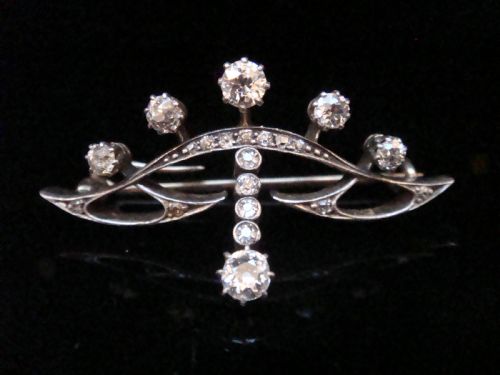
The pieces available here bridge late nineteenth-century yellow gold settings and the crisp platinum-topped designs of the early twentieth century. Common configurations include crescent shapes, bow motifs, and heart bar brooches incorporating pearls, sapphires, and rubies alongside the central diamonds.
Originating across European workshops, these jewels demonstrate how jewellery design shifted from heavy gold foundations towards delicate white metal mountings that maximised stone luminosity.
What varies in quality
Quality in these pieces rests upon the integration of design and the calibre of the primary gemstones, distinguishing mass production from masterwork execution. The weight and cut of the diamonds, whether old European cut or transitional, dictate the brilliance of the piece.
Structural integrity of the metalwork, the matching of secondary stones like natural pearls or sapphires, and the subtlety of openwork platinum frames separate standard items from superior examples.
Some brooches double as tiaras, proving that historical aristocracy knew how to multitask at short notice.
Cartier Paris
The Fine Diamond Brooch Glossary
- Old cut
- A diamond cut characterised by a high crown, small table, and open culet, typical of stones shaped before modern faceting standards.
- Platinum
- A dense, durable white metal utilised extensively in Edwardian and Art Deco jewellery to hold fine stones securely without heavy prongs.
- Pendant brooch
- A dual-purpose piece equipped with a hidden loop or bail allowing it to be worn either pinned to clothing or suspended from a necklace chain.
- Bar brooch
- A slender horizontal pin featuring central gemstone clusters or symmetrical motifs.
- Pavé
- A setting technique where multiple small gems are closely set together with minimal visible metal, creating a continuous surface of sparkle.
Fine Diamond Brooch: Frequently Asked Questions
How do I wear a pendant brooch?
These versatile pieces feature integrated pin mechanisms on the reverse for traditional garment attachment, alongside hidden loops that accommodate necklace chains.
This dual functionality allows you to transition the jewel seamlessly from a lapel ornament to a central necklace pendant.
What periods do these brooches represent?
The selection spans multiple eras, including Victorian, Edwardian, Art Deco, and mid-century design phases.
Victorian pieces often favour yellow gold and larger gem clusters, whereas Edwardian and Art Deco examples showcase platinum-topped openwork and geometric symmetry.
Are the pearls natural?
Many period pieces incorporate natural pearls formed organically in saltwater or freshwater environments before the advent of cultured pearl farming.
These organic gems complement the diamonds and sapphires, adding a soft lustre that contrasts with the sharp sparkle of the stones.
What metal combinations should I expect?
Jewellers of the nineteenth and early twentieth centuries combined yellow gold, white gold, platinum, and silver within single items.
Silver and platinum were frequently utilised on the face of the jewel to project a bright white background for the diamonds, supported by gold shafts for strength.