
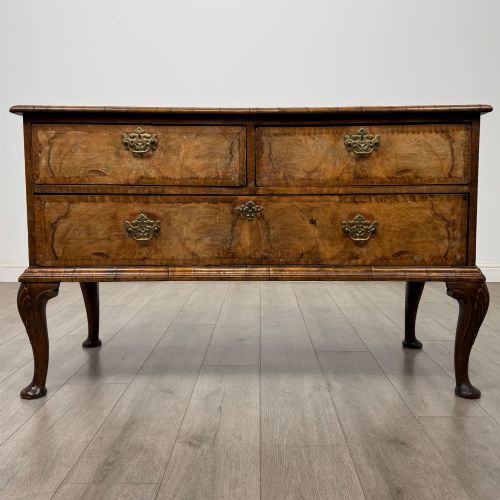
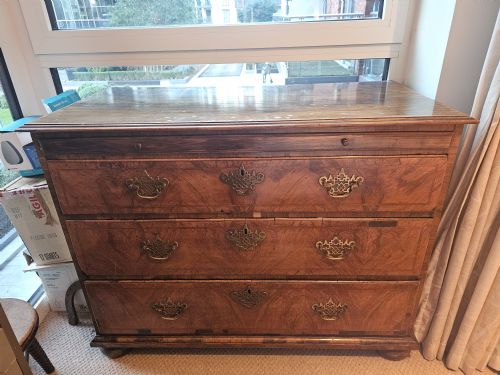


Featherbanded Walnut Commode
These featherbanded walnut commode examples are distinguished by rich timber and intricate banded inlay, offering timeless storage for the discerning interior.
Featherbanded Walnut Commode
A featherbanded walnut commode is a chest of drawers constructed during the late seventeenth and eighteenth centuries, taking forms such as Queen Anne, William and Mary, and Georgian pieces. Buyers searching this phrase encounter case furniture made in two sections, alongside variants featuring sliding top panels or compact proportions.
The dominant forms on this page include walnut chests of drawers associated with the Queen Anne, George I, and George II periods. These items combine practical drawer storage with ornamental timber veneers, often accented by inlaid details and period brass handles.
Originating from British cabinet-making traditions, these pieces utilise primary woods like walnut and burr walnut, frequently supported by oak carcases. They survive as functional drawer units that reflect the domestic storage needs of early Georgian and eighteenth-century households.
How they were made
Cabinet-makers constructed these pieces using walnut veneer applied over secondary timbers like oak, employing featherbanding to create decorative borders around the drawer fronts. This technique required precise cutting of wood veneers to form symmetrical herringbone or banded patterns.
Metalwork played a structural and decorative role, with brass handles and escutcheons fitted to secure the drawers and accent the dark timber. Construction methods typically involved building chests in two distinct sections for easier transport within large houses.
Some early chests arrive in two distinct sections, cleverly designed so ancestors could haul them up winding staircases.
What varies in quality
Quality in these pieces rests upon the selection of timber figures, where burr walnut and carefully matched veneers elevate the visual impact of the facade. The fineness of the featherbanding and the crispness of the inlaid work demonstrate the maker's hand.
Proportion and scale distinguish finer examples, particularly smaller proportions that demand greater precision from the artisan. The survival of original brass handles and the integrity of the walnut veneer surfaces further determine the standing of each piece.
The Featherbanded Walnut Commode Glossary
- Featherbanding
- A decorative inlay technique where veneers are cut and arranged at opposing angles to resemble a feather or herringbone pattern. This detail frames drawer fronts on period furniture.
- Burr Walnut
- A specialised timber cut from walnut tree growths, prized for its swirling, highly figured grain patterns. It appears on high-status eighteenth-century cabinet work.
- Commode
- A term historically applied to low chests of drawers used for storage in domestic chambers. These pieces evolved through various Georgian styles.
- Veneer
- A thin layer of superior wood applied to a secondary timber base, such as oak. This method allowed craftsmen to display rich grain patterns economically.
- Escutcheon
- A protective metal plate surrounding a keyhole on a drawer front. On these pieces, brass escutcheons complement the matching handles.
Featherbanded Walnut Commode: Frequently Asked Questions
What is a featherbanded walnut commode?
A featherbanded walnut commode is an eighteenth-century chest of drawers featuring decorative banded inlay around the drawer edges and surfaces.
These pieces were built during periods such as the Queen Anne and Georgian eras, utilising walnut veneers over oak carcases.
How do I date an 18th-century walnut chest?
Dating relies on stylistic markers such as bracket feet, cornice mouldings, and the design of the brass hardware.
Construction methods, including whether the chest is built in two sections, also help identify whether a piece belongs to the William and Mary or George II periods.
What wood is used in these commodes?
The primary wood visible on the exterior is walnut, often including highly figured burr walnut veneers for visual depth.
Secondary timbers like oak appear inside the drawers and within the internal carcase construction to provide structural stability.
How were these pieces used historically?
These chests functioned as primary storage furniture in bedchambers and dressing rooms for clothing and valuables.
Some specialised variants included sliding top panels or compact proportions tailored for specific domestic spaces.