

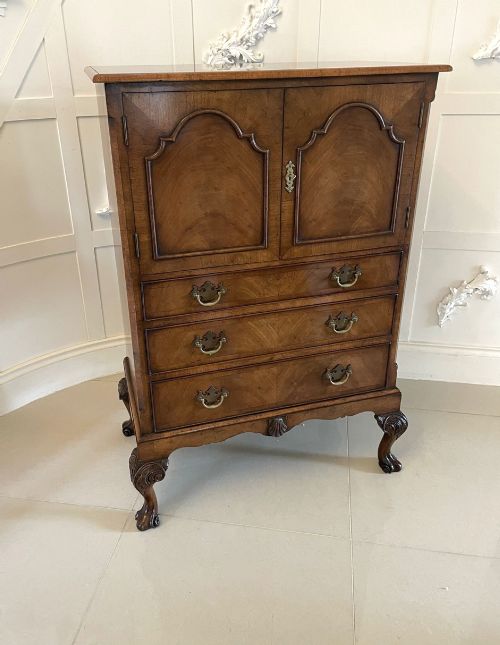
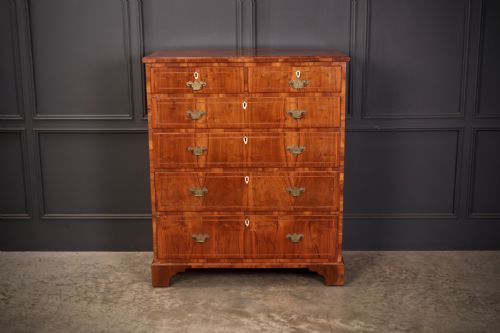
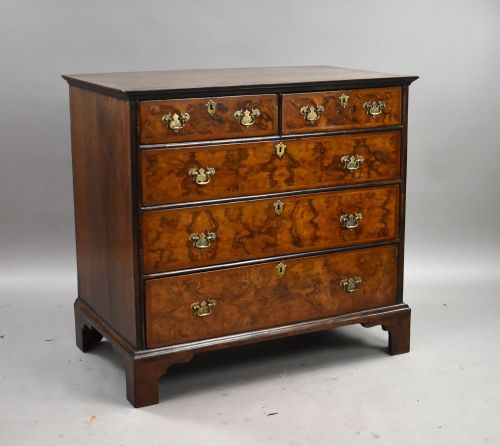
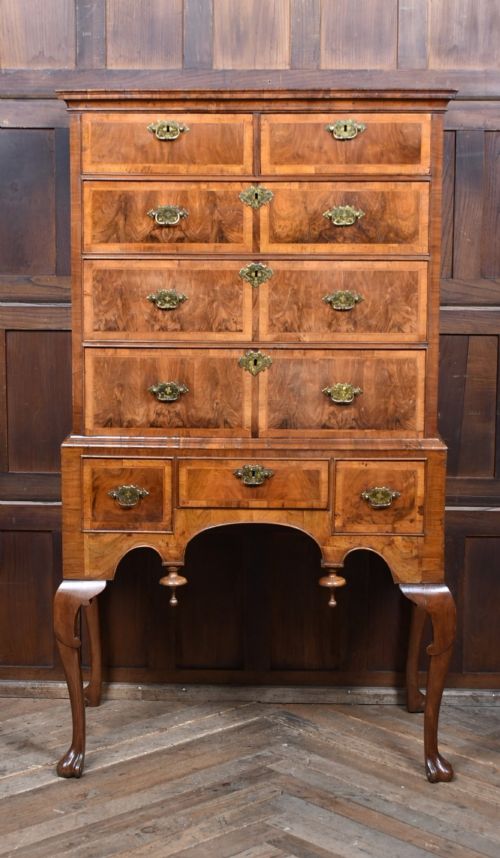


Feather Banded Cabinet
These feather banded cabinet examples combine rich timber veneers with precise border inlay, offering practical storage grounded in early periods.
Feather Banded Cabinet
A feather banded cabinet encompasses case furniture such as chests of drawers, bureaux, lowboys, and cupboards defined by distinct decorative edging. These forms emerge primarily across eighteenth-century and Georgian eras, alongside later revival pieces from the twentieth century.
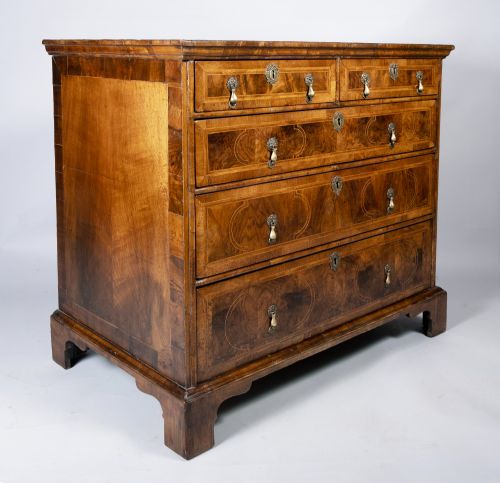
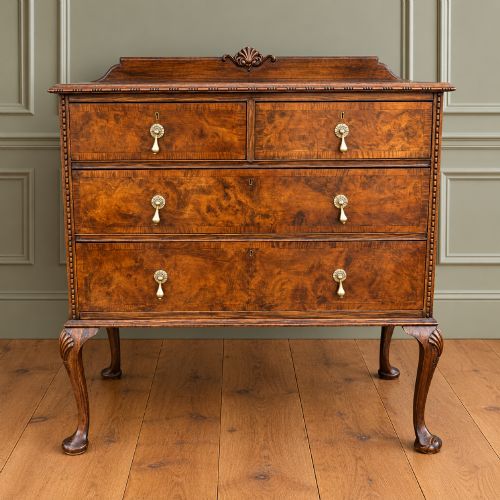
The version most commonly met on this page is the walnut chest of drawers or bureau, often exhibiting figured burr surfaces framed by linear banding. Pieces span from compact lowboys and corner cupboards to taller chests on stands and press cupboards.
The selection reflects both genuine eighteenth-century craftsmanship and later stylistic interpretations from periods like nineteen-twenty and nineteen-thirty. Walnut remains the defining timber uniting these diverse storage forms.
How they were made
Makers constructed these carcases using solid timbers such as oak, applying figured walnut and burr walnut veneers to the primary visual surfaces. Feather banding involves cutting small veneer slices diagonally and arranging them in a herringbone pattern around drawer fronts and borders.
Hardware details such as brass handles and escutcheons complement the timber work, while internal components occasionally incorporate secondary woods like oak and inlay wood. Surface treatments accentuate the natural figuring of the walnut grain and the precise geometry of the banding.
Feather Banded Cabinet Retail Price Guide 2026
Typical asking prices for feather banded cabinet among the pieces listed under this phrase on Sellingantiques today, from the lower quarter to the upper quarter. They describe what is for sale here now, not the wider market.
Listings feature walnut and burr walnut across eighteenth-century, Georgian, and twentieth-century periods.
What varies in quality
The grade of a feather banded cabinet depends largely on the selection and matching of the walnut veneers across the drawer fronts and top surfaces. Highly figured burr walnut and symmetrical grain arrangements elevate the visual impact of the piece.
Execution of the feather banding itself distinguishes finer examples, requiring precise angles and clean mitres where the directional grain meets at the corners. The integration of period hardware and proportioned small scales also contributes to the distinction between standard and superior pieces.
The Feather Banded Cabinet Glossary
- Feather banding
- A decorative border made from small pieces of veneer laid diagonally to form a herringbone design. It typically frames drawer perimeters and top edges on eighteenth-century furniture.
- Burr walnut
- A prized timber harvested from walnut tree growths, producing swirling, knotty grain patterns. It provides rich decorative surfaces on prominent panels and drawer fronts.
- Lowboy
- A small side table featuring drawers, raised on four legs. These low tables often share the same walnut veneers and banded drawer details as larger case pieces.
- Escritoire
- A writing cabinet featuring a fall-front or slant-front enclosing smaller internal compartments and drawers. These fall-front desks provide compact writing spaces above storage drawers.
Feather Banded Cabinet: Frequently Asked Questions
What periods do these cabinets come from?
The listings include pieces originating in the eighteenth century, spanning the reigns of George the First and George the Second, alongside Georgian examples. Later interpretive pieces from the early twentieth century, specifically nineteen-twenty and nineteen-thirty, also appear.
These dates reflect both antique manufacture and later revival periods that adopted similar walnut construction techniques and decorative banding styles.
How were these cabinets used originally?
These forms served primarily for domestic storage, holding clothing, linens, or valuable documents within private rooms. Bureaux and escritoires provided dedicated writing surfaces alongside compartmentalised storage for correspondence.
Smaller variants like lowboys and corner cupboards functioned as auxiliary surface furniture or specialised storage within domestic interiors.
What woods are typically found in these pieces?
Walnut and burr walnut dominate the exterior surfaces, providing rich figuring and colour variation. Oak and various inlay woods frequently serve as secondary timbers for carcase construction and internal drawer linings.
Brass hardware and occasional bone details complete the material palette observed across the listed objects.
How do chests on stands differ from standard chests?
Chests on stands elevate the main storage carcase upon a separate supporting frame with legs, altering the overall proportion and height of the furniture. Standard chests of drawers rest directly on the floor or on short bracket feet.
This elevated form creates a lighter visual presence while maintaining substantial drawer capacity.