




Expanding Wooden Book Slide
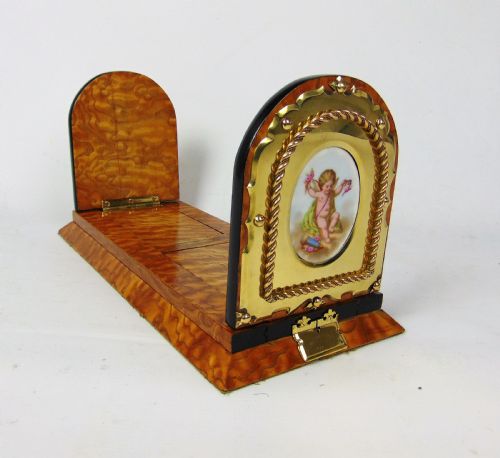
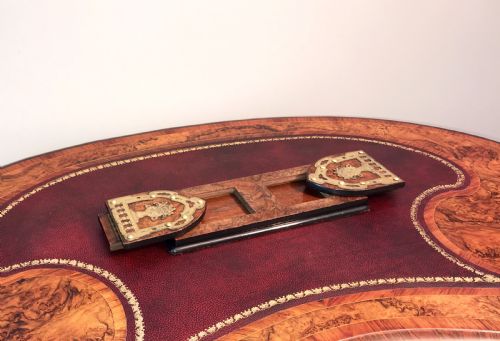
An expanding wooden book slide keeps a growing row of volumes upright on a desk or table while adjusting to fit the space.
Expanding Wooden Book Slide
An expanding wooden book slide provides a practical desktop accessory designed to hold varying numbers of volumes securely between two upright ends. The pieces seen on this page span the Victorian and Edwardian eras, along with examples from around nineteen hundred and nineteen twenty.
Most examples rely on a sliding mechanism where one or both ends move along a base to shorten or lengthen the span. Common forms include simple wooden troughs as well as elaborately decorated novel rests intended for home libraries.
How they were made
Cabinet makers utilised a variety of timbers including walnut, burr walnut, rosewood, oak, olive wood, coromandel, ebony, and teak. Selected pieces incorporate carved detailing such as Anglo-Indian work or intricate mosaic patterns like Tunbridge Ware.
Metal mounts in brass frequently reinforce the hinges, corners, and sliding actions of the wood. Additional decorative elements include bone inlay and finely painted porcelain plaques set into the upright ends.
Expanding Wooden Book Slide Retail Price Guide 2026
Typical asking prices for expanding wooden book slide among the pieces listed under this phrase on Sellingantiques today, from the lower quarter to the upper quarter. They describe what is for sale here now, not the wider market.
What varies in quality
The standard of an expanding wooden book slide rests on the choice of timber and the precision of its joinery. Finely figured grains like burr walnut or coromandel command attention alongside pieces featuring specialist decoration such as hand-painted porcelain or micro-mosaic woodwork.
Mechanical smoothness also defines the better examples, where the sliding action moves without binding or wobble. Solid brass mountings and robust internal tracks indicate a higher grade of desk accessory produced for well-appointed Victorian libraries.
The Expanding Wooden Book Slide Glossary
- Book slide
- A desktop stand with movable ends designed to hold volumes upright. It expands to accommodate more books or contracts to save space.
- Tunbridge Ware
- Woodworking characterised by tiny mosaic tiles assembled from different coloured woods to form geometric or pictorial scenes. It originated in Kent during the nineteenth century.
- Novel rest
- An alternative term for a book slide or book rack, often featuring folding or hinged ends. These pieces were popular on Victorian desks and reading tables.
- Coromandel
- A dense, heavily grained hardwood imported from Asia, valued for its rich dark colour and contrasting streaks. Makers used it for luxury nineteenth-century boxes and book slides.
- Ebonised
- Timber treated with a dark stain or finish to imitate ebony. This technique provided a stark, formal appearance on Victorian desk accessories.
Expanding Wooden Book Slide: Frequently Asked Questions
How do expanding book slides work?
These accessories feature a base with a central track or overlapping sections that slide in and out. This movement allows the upright ends to adjust the overall length according to how many volumes sit between them.
Most mechanisms operate smoothly by hand, relying on wooden channels or brass runners beneath the baseboard to keep the movement aligned.
Where were book slides used?
They sat on library desks, study tables, and drawing room surfaces throughout the Victorian and Edwardian periods. Their primary role was keeping working volumes tidy and accessible near an armchair or writing table.
Because they adjusted in size, owners could move them easily from a small table to a larger bookcase shelf as their collection of texts changed.
What woods are most common?
Walnut and oak appear frequently among surviving examples, reflecting standard Victorian and Edwardian furniture production. More decorative pieces utilise exotic timbers such as rosewood, coromandel, and burr walnut.
Regional variations also introduce specific materials like olive wood from Jerusalem, teak from Anglo-Indian workshops, and ebony.
How should I care for antique wood?
Keep wooden book slides away from direct heat sources and strong sunlight to prevent the timber from drying out or warping. Dust them gently with a dry cloth and avoid harsh chemical polishes.
Checking the brass mounts and sliding tracks occasionally ensures the moving parts continue to operate without straining the surrounding wood.