



Etruscan Revival Drop Earrings
These etruscan revival drop earrings bring ancient classical motifs into the nineteenth century, offering distinct archaeological detail that appeals to collectors of historic jewellery.
Etruscan Revival Drop Earrings
When you search for etruscan revival drop earrings, you encounter Victorian designs inspired by archaeological discoveries in Italy, characterised by classical motifs and revival aesthetics. These pieces appear principally from the Victorian period, alongside Edwardian examples.
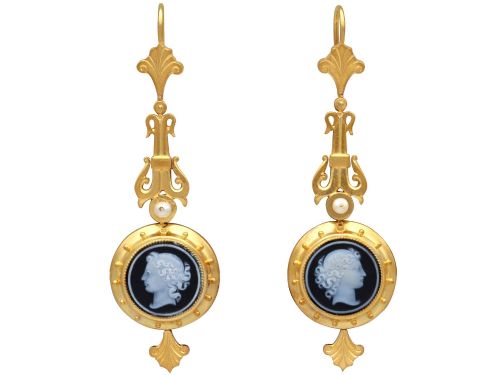
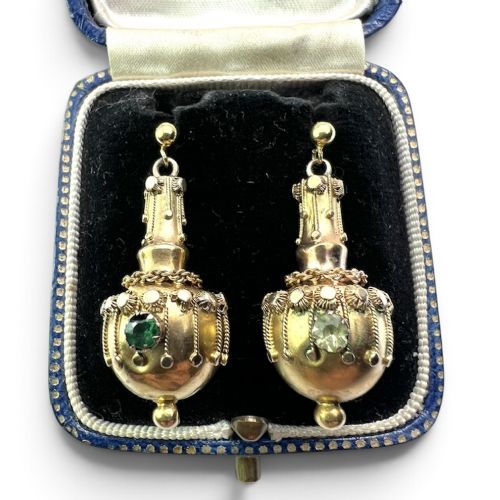
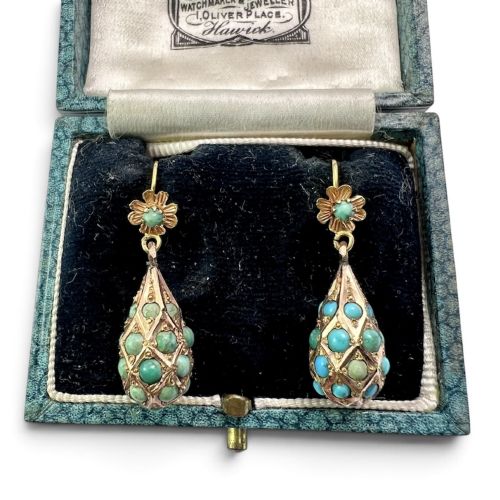
The items seen in this category comprise various forms of drop earrings and jewellery sets. Examples feature amphora shapes, dangling teardrops, foxtail tassels, and ornate dangles with distinct historic resonance.
Most specimens originate from the nineteenth century, capturing the intense fascination with antiquity that defined Victorian classical revival taste. Collectors find these jewels embody both archaeological enthusiasm and high craftsmanship.
How etruscan revival drop earrings were made
The construction relies primarily on gold, appearing as yellow gold, rose and yellow gold, 9ct gold, 15ct gold, and occasionally 18ct gold or silver gilt. These precious metals provide the rich foundation required for intricate revival work.
Maker techniques incorporate decorative elements such as turquoise stones, gemstones, shell cameos, banded agate, paste garnet, and diamonds. These materials are set into elaborate forms like puff hearts, square cross wheels, and lovers knots.
Etruscan Revival Drop Earrings Retail Price Guide 2026
Typical asking prices for etruscan revival drop earrings among the pieces listed under this phrase on Sellingantiques today, from the lower quarter to the upper quarter. They describe what is for sale here now, not the wider market.
Listings feature pieces spanning the Victorian and Edwardian periods, constructed in gold, silver gilt, turquoise, shell, and agate.
What varies in quality
The distinction between tiers of quality rests upon the weight and purity of the gold employed, with higher carat thresholds like 15ct and 18ct indicating superior manufacture. Finer pieces demonstrate greater complexity in their metalwork and stone selection.
Subtleties in design execution, such as the intricacy of foxtail tassels or the precision of amphora shapes, separate standard productions from exceptional examples. The integration of high-grade turquoise or diamonds further elevates a piece within the range.
The Etruscan Revival Drop Earrings Glossary
- Etruscan Revival
- A nineteenth-century design movement inspired by ancient Italian artefacts unearthly during archaeological excavations. This style frequently employs granular gold work and classical motifs.
- Drop Earrings
- Earrings that hang below the earlobe rather than sitting directly against it. These designs often incorporate swinging components or dangling drops.
- Foxtail Tassel
- A flexible, woven metal chain construction resembling a fox's tail, frequently used as a dangling ornament. It adds movement and texture to nineteenth-century drop earrings.
- Amphora
- A two-handled ancient jar shape utilised as a decorative motif in classical revival ornaments. In jewellery, miniature versions translate classical pottery into wearable gold forms.
- Banded Agate
- A variety of quartz showing distinct parallel layers of differing colours. Victorian jewellers shaped this material into smooth domed cabochons for earrings.
Etruscan Revival Drop Earrings: Frequently Asked Questions
What periods do these earrings come from?
The pieces originate primarily during the Victorian era, driven by the nineteenth-century passion for classical archaeology. Occasional examples extend into the Edwardian period.
This broad span captures the height of revival craftsmanship, utilising gold and gemstones to emulate ancient Mediterranean aesthetics.
How do I identify Etruscan Revival details?
Look for distinct classical motifs such as amphora shapes, lovers knots, and intricate wirework that echo ancient excavations. These elements separate revival pieces from standard Victorian designs.
The inclusion of turquoise, garnets, and banded agate set in yellow or rose gold further reinforces the archaeological theme.
What materials were used in making them?
Jewellers utilised various grades of gold, ranging from 9ct and 15ct up to 18ct, alongside silver gilt for specific metal finishes. Precious and semi-precious stones such as turquoise, diamonds, and paste garnet provide colour and contrast.
Organic materials like shell and banded agate also appear, shaped into cameos and domed cabochons.
How should I care for historic drop earrings?
Handle these delicate nineteenth-century items with care, avoiding exposure to harsh chemicals, ultrasonic cleaners, or excessive moisture. Store them individually in lined boxes to protect the gold work and mounted stones from friction.
Gentle cleaning with a soft, dry cloth preserves the metal surface and the integrity of the integrated gems.