



Etruscan Gold Earrings
These etruscan gold earrings combine archaeological revival design with nineteenth-century craftsmanship, offering dramatic drop silhouettes that anchor historic jewellery collections.
Etruscan Gold Earrings
When you search for etruscan gold earrings, you encounter historic jewels modelled on ancient Mediterranean metalwork discovered during nineteenth-century excavations. These pieces primarily date from the Victorian period, appearing alongside later Edwardian examples and mid-twentieth-century revivals.
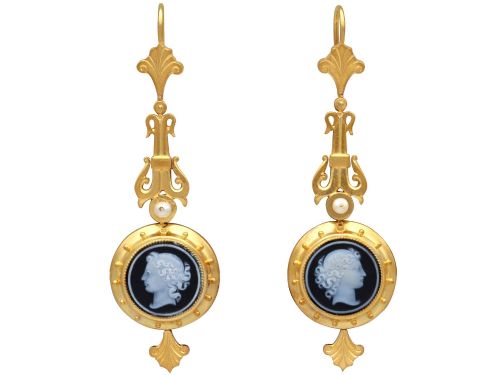
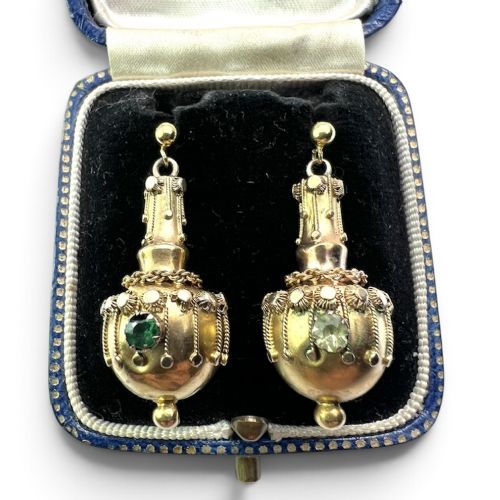
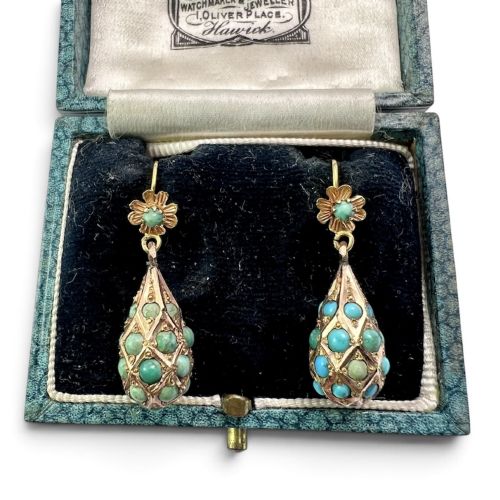
The form most frequently met on this page is the drop earring, often featuring elaborate amphora shapes, teardrops, torpedo designs, or ornate dangling elements. Many incorporate matching components such as brooches or form part of coordinated jewellery sets.
Victorian makers adopted classical motifs including foxtail tassels, lovers knots, and wheel crosses, rendering them in warm yellow and rose gold. The aesthetic relies heavily on revival styles, capturing the archaeological fascination of the nineteenth century.
How they were made
Makers fashioned these earrings predominantly from 9ct and 15ct gold, alongside higher carat standards, occasionally utilising silver gilt for structural contrast. Metalwork techniques included granulation, wirework, and repoussé to build complex dimensional surfaces.
The gold framework frequently cradles natural gemstones and organic materials such as turquoise, coral, garnet, banded agate, onyx, nephrite jade, and shell cameos. Paste stones also appear, set securely within elaborate drop mountings.
Etruscan Gold Earrings Retail Price Guide 2026
Typical asking prices for etruscan gold earrings among the pieces listed under this phrase on Sellingantiques today, from the lower quarter to the upper quarter. They describe what is for sale here now, not the wider market.
One particularly dedicated Victorian maker squeezed an entire archaeological excavation into a pair of amphora drops.
What varies in quality
Quality in these pieces rests upon the precision of the metalwork and the complexity of the revival ornamentation applied to the gold. Finer examples display meticulous wirework and balanced proportions that elevate standard drop forms into sculptural objects.
The selection of set materials also dictates the calibre of a pair, with matched natural gemstones or finely carved shells distinguishing upper-tier items from simpler gilt or paste alternatives.
The Etruscan Gold Earrings Glossary
- Etruscan Revival
- A nineteenth-century design movement inspired by ancient archaeological discoveries in Italy. It prioritised intricate goldwork, granulation, and classical motifs over contemporary fashion.
- Granulation
- A decorative technique involving the application of tiny spheres of precious metal to a surface in geometric patterns. This method defines much of the classical revival aesthetic.
- Amphora
- A two-handled ancient jar shape frequently translated into miniature pendant drops for earrings during the Victorian era. It reinforces the archaeological theme of the jewel.
- Foxtail
- A flexible, woven metal chainwork resembling the tail of a fox, often used in tassels that dangle from rigid earrings. This construction adds movement and weight to the drop.
Etruscan Gold Earrings: Frequently Asked Questions
Are these earrings comfortable for daily wear?
Many pairs possess substantial weight due to solid gold construction and dangling gemstone elements, meaning they suit occasional wear rather than continuous daily use.
Selecting lighter drop forms helps reduce strain on the earlobe during extended periods of wear.
How do I care for antique gold earrings?
These historic pieces require gentle cleaning with a soft cloth, avoiding harsh chemical dips that might damage delicate gemstones like turquoise, coral, or shell.
Stored separately in lined boxes, the gold and mounted stones remain protected from friction and physical impact.
Did all these earrings originate in the Victorian era?
The majority of pieces stem from the Victorian period, reflecting the height of archaeological revival enthusiasm, though the archive includes mid-twentieth-century hallmarked examples.
Edwardian items also appear, continuing the preference for classical gold drops and gemstone accents.
What gemstones typically accompany the gold?
Garnets, turquoise, and coral dominate the settings, alongside banded agate, nephrite jade, onyx, and shell cameos.
Paste stones and diamonds also feature, adding colour contrast and sparkle to the warm gold metalwork.