








Etched Stemware
These etched stemware pieces bring delicate motifs and brilliant clarity to the table, offering a tangible link to past dining traditions.
Etched Stemware
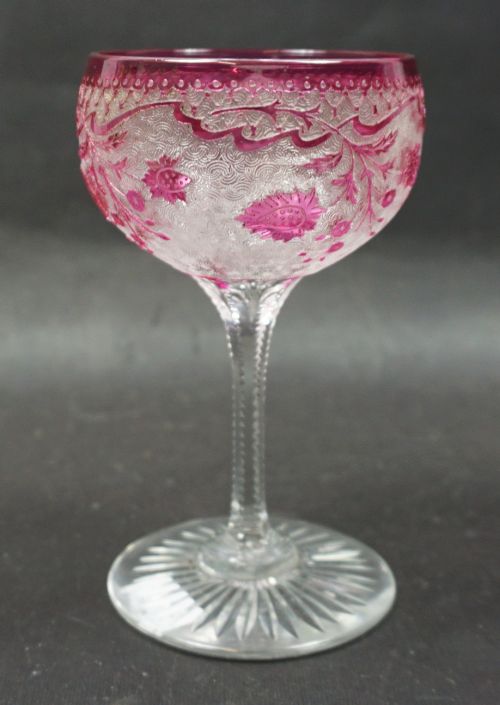
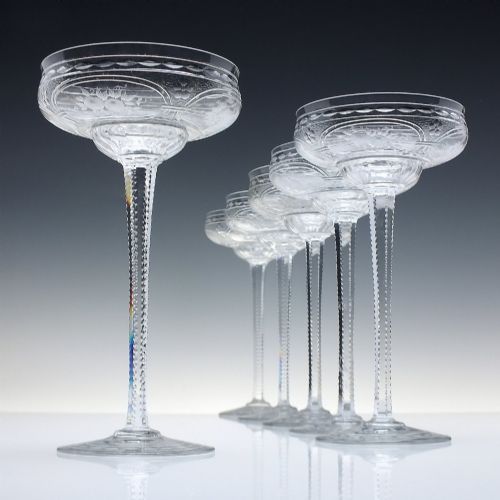
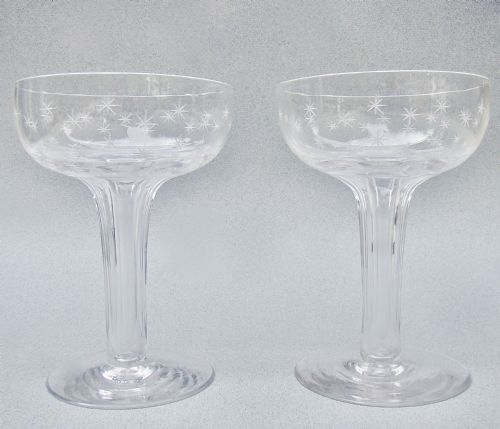
Etched stemware encompasses drinking vessels featuring surface decoration created by acid or abrasive tools, spanning periods from the Georgian era through to Art Deco and 1930s design. Buyers exploring etched stemware encounter forms ranging from heavy rummers and rinsers to tall champagne coupes, wine glasses, and chalices.
The pieces most frequently met on this page originate from the Victorian period alongside early twentieth-century European production. These domestic items showcase varied bowl shapes and stems, reflecting the social habits of their respective eras.
Materials and Techniques
The makers of these items utilised clear glass, lead crystal, lead glass, and overlay glass to achieve the necessary refractive index for decorative work. Coloured glass variants, including amber and red over crystal, appear alongside standard clear material.
Decoration was applied through hand-blowing, cutting, engraving, and acid-etching techniques to render detailed botanical scenes, hunting motifs, and geometric patterns onto the bowl surfaces.
Etched Stemware Retail Price Guide 2026
Typical asking prices for etched stemware among the pieces listed under this phrase on Sellingantiques today, from the lower quarter to the upper quarter. They describe what is for sale here now, not the wider market.
Some Victorian drinkers required hollow stems so their champagne level remained perpetually mysterious during long, formal toasts.
Assessing Quality in Etched Stemware
Quality rests upon the crispness of the engraved or etched lines and the purity of the underlying glass matrix. Superior examples display balanced proportions between the bowl, stem, and foot base, with precise execution of decorative scenes like fruiting vines or hunting subjects.
The uniformity within sets separates utilitarian production from finer suites. Matching dimensions, consistent glass thickness, and harmonious tonal qualities in coloured or overlay pieces distinguish the higher end of the range.
Baccarat·Stevens and Williams·Riihimaki·Adelbert Niemeyer
The Etched Stemware Glossary
- Etched glass
- Glass decorated by applying acid to eat away exposed portions of the surface. This technique allows for fine, detailed pictorial representations.
- Lead crystal
- Glass containing lead oxide that increases weight, brilliance, and workability for cutting and engraving. It forms the basis of many heavier historical drinking vessels.
- Rummer
- A large, sturdy drinking glass popular in the eighteenth and nineteenth centuries, often featuring a short stem and deep bowl. These frequently carry engraved or etched decoration.
- Overlay glass
- Glass made with a thin outer layer of coloured glass over a clear or contrasting interior body. Cutting through the outer layer reveals the contrasting colour underneath.
- Air twist
- A stem containing an internal spiral thread of tiny air bubbles formed during manufacture. This decorative feature appears on Georgian drinking glasses.
- Coupe
- A shallow, broad-bowled glass traditionally utilised for champagne service. The wide rim showcases surface engraving across the expanse of the glass.
Etched Stemware: Frequently Asked Questions
How do I clean etched stemware?
Hand washing in lukewarm water with mild detergent preserves the delicate surfaces of these glasses. Avoid thermal shock by keeping water temperatures consistent during washing and rinsing.
Soft cotton cloths work best for drying without applying excessive pressure to thin stems or engraved bowls. Storing them upright on stable shelves prevents rim damage.
Can I use these for daily dining?
Many buyers incorporate historical glassware into modern table settings for special occasions or quiet dinners. Their robust construction, particularly in Victorian and Georgian forms, suits careful everyday use.
Hand-blown and lead crystal items require mindful handling around modern dishwashers and crowded sinks. Treating them with respect ensures they survive for future generations.
How do I identify Georgian stemware?
Georgian pieces often display heavier glass weights, darker metal tones, and characteristic tool marks from hand-manufacturing. Forms like faceted stems and heavy rummers indicate eighteenth or early nineteenth-century origins.
Engraved motifs from this era tend towards traditional heraldic, floral, or narrative scenes executed with wheel-cut precision. Examining the foot base reveals pontil scars left by the manufacturing process.
What defines Art Deco glassware?
Art Deco pieces favour geometric precision, stylised floral motifs, and clean architectural silhouettes. French suites from this period often comprise large matching sets of drinking glasses with minimal, sharp engraving.
The glass itself can be lighter and more stylised than Victorian equivalents, aligning with modernist interior design trends of the 1930s.