



Engraved Brass Holders
These engraved brass holders span centuries and continents, offering both functional utility and intricate decorative craftsmanship for the discerning interior.
Engraved Brass Holders
Engraved brass holders encompass a diverse array of functional objects designed to contain light sources, writing implements, or botanical displays. These pieces bridge domestic utility and ornamental art across multiple historical periods and global workshops.
Buyers encountering this category will most frequently meet nineteenth-century English and Victorian examples alongside distinct international traditions such as Qajar Persian, Anglo-Indian, and Ottoman pieces. The forms range from simple desk accessories and tobacco tins to substantial cachepots and floor candlesticks.
The selection reflects both European domestic production and imported wares, including specific vessel types like inkwells, planters, and travelling pen cases. Each object demonstrates the enduring utility of brass as a durable and responsive canvas for surface decoration.
Materials and construction techniques
The primary material across these objects is brass, supplemented by related copper alloys, bell brass, and occasional bronze casting. These metals provide a stable, ductile foundation capable of holding sharp chisel work and deep surface incision.
Decoration is achieved through hand-engraving, chiselling, and occasionally casting or hand-decoration, allowing artisans to incise intricate geometric, floral, and heraldic motifs directly into the metal surface. This subtractive technique creates tonal contrast through patination within the recessed lines.
Engraved Brass Holders Retail Price Guide 2026
Typical asking prices for engraved brass holders among the pieces listed under this phrase on Sellingantiques today, from the lower quarter to the upper quarter. They describe what is for sale here now, not the wider market.
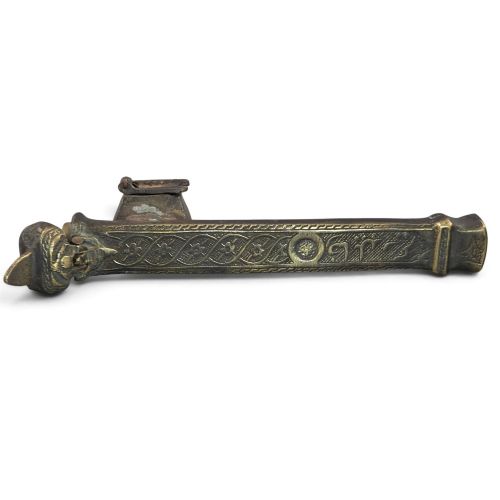
An eighteenth-century brass divit lets you imagine carrying your ink and pens securely on a horse across Armenian trade routes.
Assessing quality and execution
Quality in engraved brass holders resides in the crispness and depth of the hand-engraving rather than the mere weight of the metal. Superior pieces display confident, fluid line work where the artisan has varied the depth and rhythm of the chisel to articulate complex patterns.
Proportion and structural integrity also distinguish finer items, particularly in assembled objects like candlesticks and inkstands where components must join seamlessly. The sophistication of the regional design vocabulary, whether Mamluk revival, Victorian heraldry, or Persian calligraphy, further elevates the piece.
The Engraved Brass Holders Glossary
- Divit Qalamdan
- An Ottoman or Armenian travelling writing case featuring a fitted inkwell and a long compartment for reed pens. These portable brass containers were essential administrative tools for scribes.
- Cachepot
- An ornamental container designed to hold a flowerpot and conceal its utilitarian clay body. In brass, these vessels often feature repoussé or engraved decorative bands.
- Bell brass
- An alloy containing a higher proportion of copper and tin, traditionally utilised for casting bells. This metal yields a particularly resonant tone and a rich, golden colour when polished.
- Veneto-Saracenic
- A style of metalwork produced in the eastern Mediterranean and Venice during the late medieval and Renaissance periods. It combines Islamic metalworking techniques with European vessel forms.
- Tobacciana
- Antiques and collectibles associated with the consumption or storage of tobacco. This category includes brass tobacco tins, cigarette keepers, and desk boxes.
Engraved Brass Holders: Frequently Asked Questions
What are engraved brass holders?
Engraved brass holders are historical decorative and functional metal items designed to contain items such as candles, ink, pens, or plants. They showcase various regional engraving traditions across multiple centuries.
These pieces served practical roles in domestic, scholarly, and administrative settings while displaying the artistic styles of their makers.
How do I date an antique brass holder?
Dating relies on stylistic markers, manufacturing techniques, and any accompanying maker's marks or heraldic crests. Victorian English pieces often feature registration marks or specific domestic utility forms.
Earlier items from the eighteenth century or earlier display distinct casting flaws, hand-hammered surfaces, and regional decorative motifs unique to workshops in Persia, India, or the Levant.
How were these holders used historically?
They fulfilled specific daily requirements in homes, offices, and administrative centres. Candlesticks provided illumination, while inkwells and pen cases supported correspondence and record-keeping.
Larger vessels like cachepots and jardinières brought greenery into interior spaces, and games boxes organised leisure activities for the household.
How do I care for antique brass?
Care involves gentle dusting with a soft, dry cloth to preserve the historical patination accumulated over centuries. Aggressive cleaning or modern chemical polishes can strip away desirable age-related oxidation and soften the engraved details.
Keeping the metal in a stable environment away from excessive moisture protects the brass and any integrated fabric or secondary materials.