


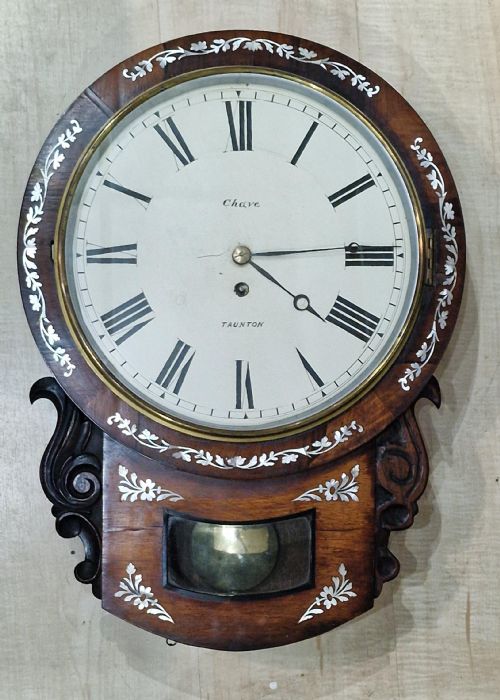


English Mahogany Drop Dial Clock
An english mahogany drop dial clock delivers reliable timekeeping enclosed in rich timber and brass, offering both architectural presence and precise historical craftsmanship.
English Mahogany Drop Dial Clock
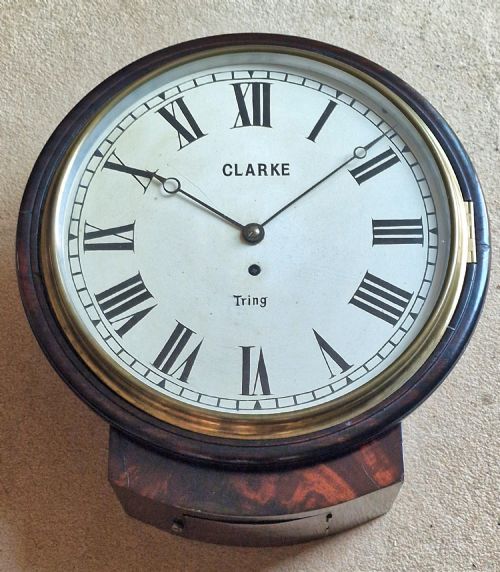
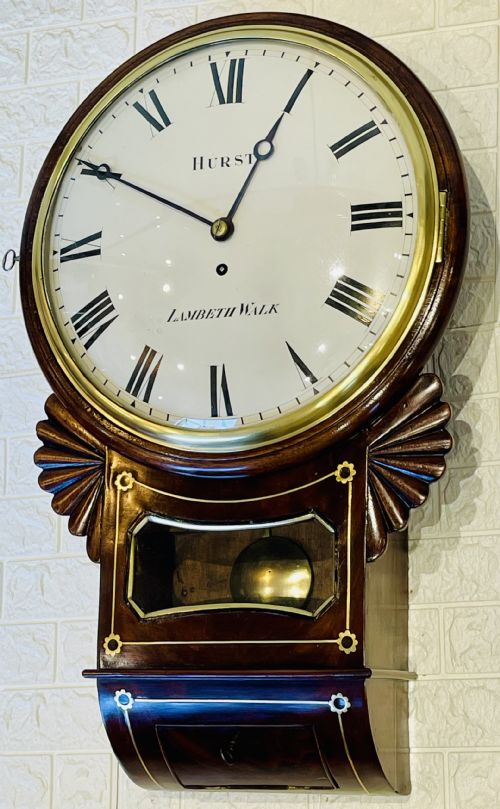
An english mahogany drop dial clock is a wall-mounted timepiece featuring an upper dial case and an extended lower trunk designed to house a pendulum. These pieces span Georgian, Regency, and Victorian periods, originating from provincial makers as well as London workshops.
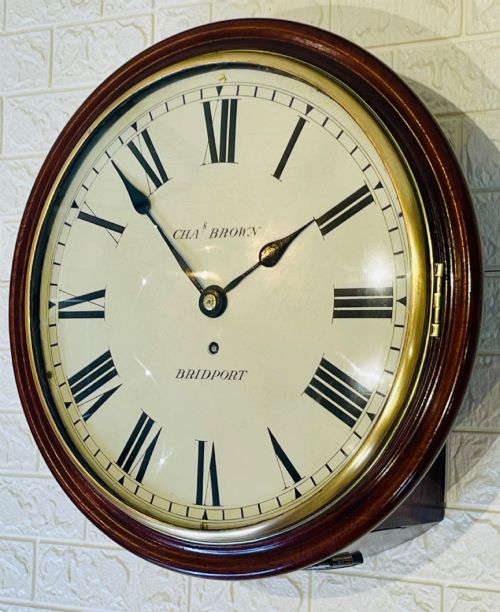
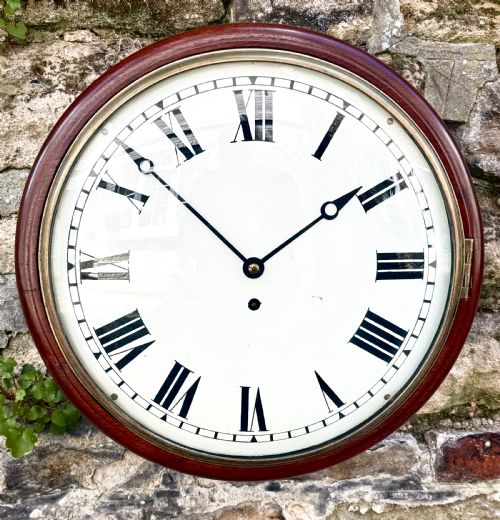
The version most commonly met on this page is the single fusee wall clock housed in a mahogany case, often displaying a rounded or convex face behind glass. Such examples range from petite eight-inch instruments to large striking variations designed for public spaces and railway platforms.
Makers inscribed their names directly onto the painted iron or wooden dials, recording origins from major cities down to country towns. Provincial examples carry distinct regional character, while London pieces frequently display refined cabinetwork and complex twin fusee movements.
How They Were Made
Cabinetmakers constructed the main housing from solid mahogany, occasionally incorporating rosewood, brass inlay, or mother of pearl to enrich the visual depth of the timber. The lower drop case provided the necessary vertical clearance for the swinging pendulum while maintaining a compact wall profile.
Movements rely on the fusee mechanism, a conical pulley that equalises the declining power of the mainspring to ensure steady timekeeping across the entire eight-day duration. Dials were formed from iron painted white, or carved from wood, then protected by a brass bezel and a heavy glass cover.
Listings feature mahogany, brass, and glass across Georgian, Regency, and Victorian periods.
What Varies In Quality
Quality rests heavily on the crispness of the timber carving, the proportion of the drop trunk relative to the dial head, and the original integrity of the brass movement. Finer examples retain untouched wooden or painted iron dials signed clearly by the maker, alongside well-preserved mahogany grain free from heavy restoration.
The complexity of the mechanism also divides the range, distinguishing simple time-only fusee movements from elaborate twin-fusee bell-striking systems. Superior execution shows in the precision of the wheel-cutting and the harmonious integration of side doors and bottom box joints.
George Clarke·Chave Taunton·Samuel Chave·Henry Lamb·John Walker·J. A. Wheatley·Kleyser of London·R. Roberts·Francis Perigal·John Thwaites·Atkins of Warwick·J.W. Enock·Camerer Cuss·James Tupman·Thomas Lindey·Anthony Furnace·Thomas Harrison
The English Mahogany Drop Dial Clock Glossary
- Fusee
- A conical pulley connected to the mainspring by a chain or cord. This device maintains equal force on the gear train as the spring unwinds.
- Drop dial
- A clock case featuring a circular dial housing at the top and a short or elongated vertical box underneath to enclose the pendulum.
- Convex dial
- A dial surface that curves outward toward the viewer. This convex shape reduces glare from interior lighting.
- Twin fusee
- A movement incorporating two separate fusee cones and gear trains. One train drives the timekeeping while the second powers the striking mechanism.
- Chisel bottom
- A lower case configuration ending in a sharp, angular termination rather than a rounded or flat base.
English Mahogany Drop Dial Clock: Frequently Asked Questions
How do I wind my fusee clock?
Use the appropriate winding key on the dial face once every eight days, turning it steadily until resistance indicates the mainspring is fully tensioned.
Avoid over-winding the mechanism, as forcing the key past the stopping point can damage the delicate chain or fusee cone.
Where should I hang a wall clock?
Mount the clock securely to a sturdy wall stud using appropriate fixings to support the weight of the mahogany case and heavy movement.
Ensure the location experiences minimal vibration from doors or heavy foot traffic so the pendulum maintains an even, steady beat.
What is the difference between a single and twin fusee?
A single fusee movement drives only the timekeeping function, requiring a single winding arbour on the dial face.
Twin fusee movements add a secondary gear train to strike a bell on the hours, requiring two winding holes on the dial.
How can I tell a Georgian clock from a Victorian one?
Georgian and early Regency examples often feature solid wood dials or simpler, highly figured mahogany cases with subtle proportions.
Victorian models frequently display bolder carved detailing, railway or station origins, and painted iron dials associated with industrial expansion.