


English Mahogany Canterbury
An english mahogany canterbury brings both division and elegance to a room, holding papers or folios with traditional grace.
English Mahogany Canterbury
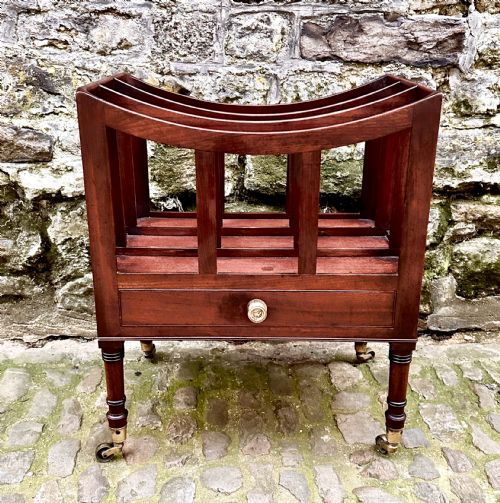
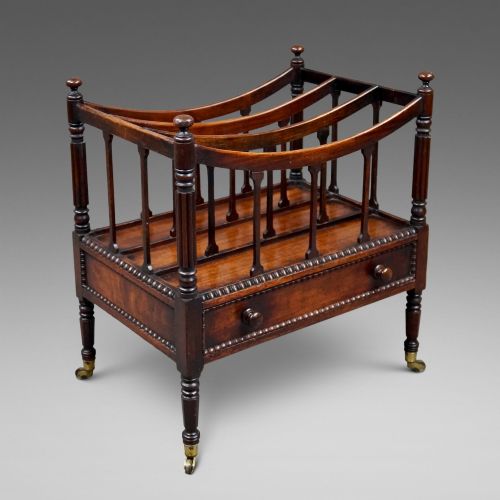
An english mahogany canterbury is a dedicated stand designed to hold newspapers, magazines, folios, or music sheets in upright divisions. Most examples encountered here date from the Georgian, Regency, and Victorian periods, manifesting as low open racks with slatted or pierced partitions.
The form frequently incorporates a small drawer beneath the divisions, resting on short turned legs fitted with castors for mobility. Alongside standard four-division magazine racks, the selection extends to folio stands, music cabinets, and waterfall bookcase hybrids.
Originating as a piece of refined domestic furniture for the sitting room or library, these items combine practical paper storage with architectural cabinetmaking. You are most likely to meet Regency and George III interpretations featuring rich timber grain and linear divisions.
Materials and construction
Makers utilised solid and veneered mahogany to construct the primary framework, selected for its deep reddish-brown tone and durability. Brass castors and hardware frequently support the base, allowing the stand to move smoothly across carpets and floorboards.
Joinery techniques relied on precise framing for the divisions, ensuring the vertical partitions could bear the weight of stacked folios or newspapers without loosening. Secondary woods and subtle turning define the legs, while linear inlays or brass details occasionally accent the main structure.
Early nineteenth-century cabinetmakers built these stands so mobility was absolute, ensuring your newspapers could follow you from the drawing room to the fireside without fuss.
Judgments of quality
The distinction between standard workshop output and top-tier cabinetmaking rests entirely on timber selection and architectural proportion. Finer pieces demonstrate superior figure in the mahogany, coupled with crisply turned supports and cleanly executed joinery at every joint.
Makers working at the highest level integrated subtle design flourishes, such as pierced fretwork on the partitions or finely dovetailed drawers beneath the rack. Pieces carrying attribution to established makers display a sharper attention to detail than anonymous utility furniture.
Gillow s·Liberty
The English Mahogany Canterbury Glossary
- Canterbury
- A low stand featuring upright divisions, built to hold music, newspapers, or folios. The name derives from the Archbishop of Canterbury, who supposedly commissioned the first such rack.
- Folio Stand
- A larger upright rack designed for holding large sheets of paper, prints, or maps. These items often feature adjustable or hinged frames.
- Regency
- A style period spanning the early nineteenth century, characterised by classical restraint, architectural lines, and occasional classical revival motifs. Furniture from this era often incorporates brass inlay and turned pillar supports.
- Waterfall
- A tiered bookcase or shelving arrangement where each successive shelf steps back from the one below. This configuration creates a cascading profile reminiscent of a waterfall.
English Mahogany Canterbury: Frequently Asked Questions
What is an english mahogany canterbury used for?
These stands were originally designed to organise sheet music, newspapers, and unbound books near a seating area or instrument. Today, they serve a similar domestic function while acting as decorative furniture in studies and living rooms.
Their open divisions keep current reading material accessible and tidy, preventing clutter on tables and desks.
How do I date an english mahogany canterbury?
Dating relies on observing the stylistic details, timber characteristics, and turning methods used on the legs and partitions. Georgian and Regency examples typically show finer timber grain and classical proportions, while Victorian pieces often appear heavier or incorporate mixed influences like Art Nouveau.
Hardware such as brass castors and the construction of any base drawer also offer reliable clues to the decade of manufacture.
Where should I place a canterbury in a room?
A canterbury sits naturally beside a sofa, armchair, or desk where reading materials accumulate. Because the piece is finished on all sides and often fitted with castors, it can also stand freely near a bookshelf or fireplace.
Ensure the timber is kept away from direct heat sources to prevent the mahogany veneer or solid panels from drying out.