

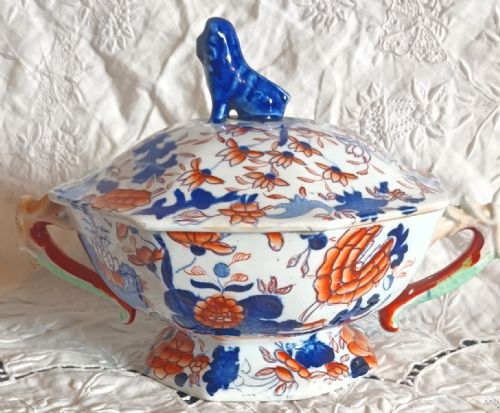


English Ironstone Tureen
These English ironstone tureen pieces are heavy, durable serving vessels built for the table, offering robust utility and striking transfer-printed or hand-painted patterns.
English Ironstone Tureen
An english ironstone tureen serves as a substantial vessel for soups, sauces, or vegetables at the dining table, combining practical weight with decorative ambition. The examples seen here belong predominantly to the nineteenth century and the Georgian period, spanning large covered bowls, vegetable tureens, and sauce tureens complete with ladles.
Makers such as Mason's dominate the forms, rendered in ironstone ceramic with distinct influences from Regency and Victorian design. Collectors will encounter specific patterns including Chinoiserie, blue and white transfer prints, Green Mandarin, and Japan Basket motifs.
How they were made
Potters formed these robust vessels using ironstone ceramic, a dense and heavy earthenware body fired at high temperatures to resist chipping. Artisans applied decoration through blue and white transfer printing or hand-painted enamel colours, occasionally enriched with gold leaf and gilt highlights beneath a protective glaze.
Moulded handles, finials, and covers were shaped separately and securely attached before the final firing to ensure the vessels could withstand heavy domestic service.
English Ironstone Tureen Retail Price Guide 2026
Typical asking prices for english ironstone tureen among the pieces listed under this phrase on Sellingantiques today, from the lower quarter to the upper quarter. They describe what is for sale here now, not the wider market.
Some tureens arrive with their original ladles still intact, ready to serve gravy after two centuries of avoiding the clumsy butter knife.
What varies in quality
Quality rests upon the crispness of the transfer print or the precision of the hand-painted enamel work, alongside the preservation of any gold leaf detailing. Pieces featuring complex multi-coloured motifs like the Green Mandarin or Japan Basket patterns demonstrate greater artistic labour than standard blue and white wares.
The survival of original matching elements, such as covers and ladles, elevates the integrity of the tureen.
Mason's
The English Ironstone Tureen Glossary
- Ironstone
- A heavy, durable ceramic body patented in the nineteenth century as a robust alternative to porcelain. It takes glazes and transfers exceptionally well.
- Transfer print
- A decoration technique where an engraved copper plate transfers a design onto paper, which is then stamped onto the ceramic body before glazing. This allowed for intricate and repeatable patterns.
- Sauce tureen
- A small lidded serving vessel specifically designed for gravies and sauces, frequently accompanied by an integrated or separate ladle.
- Chinoiserie
- A decorative style reflecting European interpretations of Chinese and East Asian artistic traditions, often featuring pagodas, exotic flora, and figures.
English Ironstone Tureen: Frequently Asked Questions
What is an English ironstone tureen used for?
These vessels were designed for serving soups, vegetables, or sauces at formal dining tables, offering both containment and heat retention during meals.
Today, they serve as striking centrepieces on sideboards or as functional tableware for large gatherings.
How can I tell Georgian pieces from Victorian ones?
Georgian and Regency examples often display bolder neoclassical forms and specific hand-painted Chinoiserie or Mandarin palettes.
Victorian pieces frequently lean towards busier transfer-printed motifs and structured geometric or floral borders.
Are ladles usually included with these tureens?
Some sauce tureens retain their original matched ladles, though many surviving pieces are separated from their serving spoons over decades of use.
A complete set with both cover and ladle holds particular appeal for collectors.