

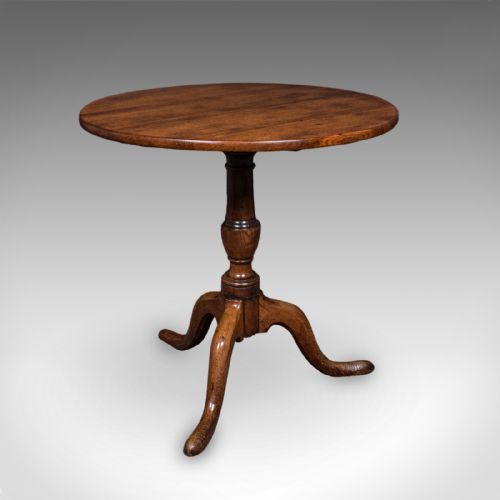


English Georgian Tilt Top
An english georgian tilt top table solves the problem of a flexible surface with a clever mechanism that tips the tabletop flat against the base when not in use.
English Georgian Tilt Top
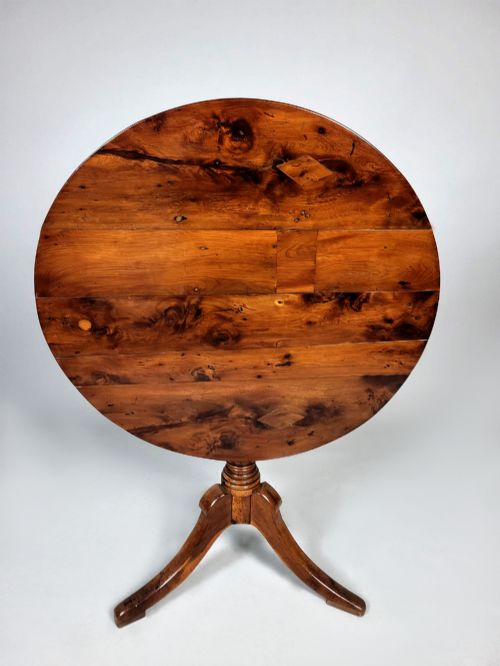
An english georgian tilt top table spans compact wine and candle stands to larger breakfast and dining boards, designed to pivot and tuck away beside a wall.
Most examples meet the eye as tripod tables standing on three slender legs, though rectangular pillar-and-base breakfast versions also appear across the selection.
Period production ranges from mid-eighteenth-century country workshops through the Regency era, with occasional twentieth-century revivals keeping the traditional silhouette alive.
Materials and construction
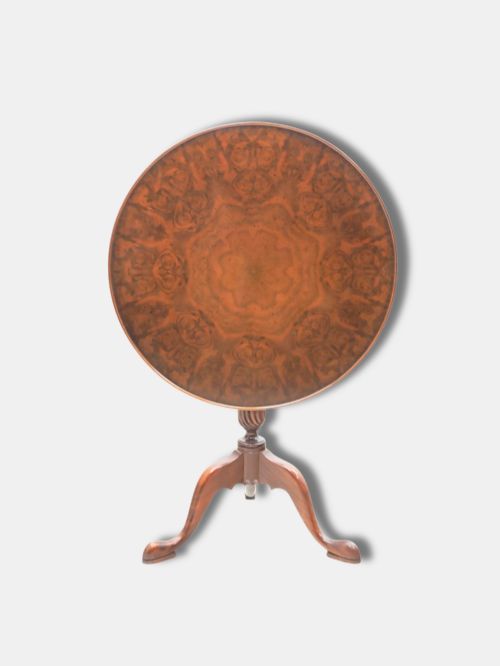
Solid mahogany and oak provide the primary structural timber for these frames, complemented by walnut, yew wood, fruitwood, and occasional burr veneer surfaces.
Clever joinery enables the tilting action, often incorporating a birdcage mechanism beneath the circular top that allows both pivoting and a full rotary turn.
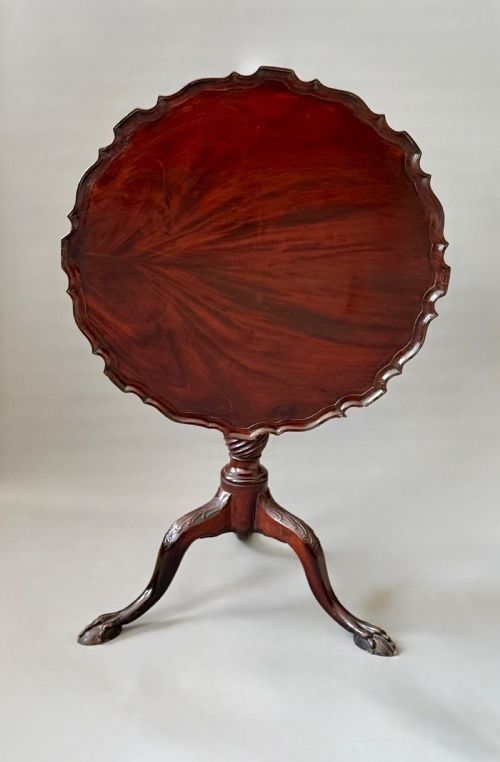
Turned pedestals descend into three splayed legs, while hand-carved pie crust edges or shaped mouldings define the perimeters of finer circular tops.
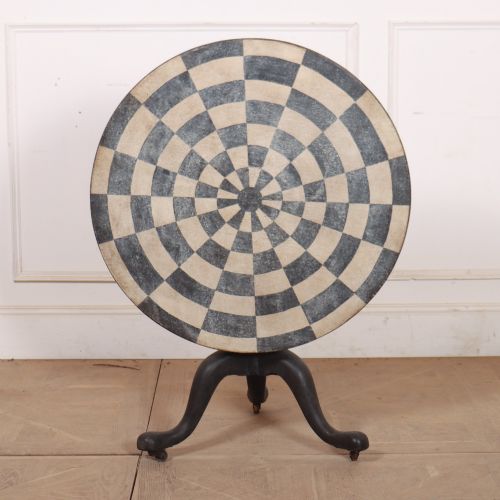
Materials represented across the selection include mahogany, oak, walnut, yew wood, fruitwood, and paint.
Judging the workmanship
The integrity of the central pivot mechanism and the snugness of the catch determine how steadily the tabletop locks into the horizontal position.
Cabinetmakers demonstrated skill through the choice of figured timber, the crispness of edge carving such as pie crust scalloping, and the balanced proportions of the pillar and legs.
The English Georgian Tilt Top Glossary
- Tilt top
- A table mechanism allowing the surface to pivot ninety degrees into a vertical position for storage.
- Tripod table
- A freestanding support resting on a central column above three diverging legs.
- Birdcage
- A timber framework beneath the tabletop that permits the surface to rotate and tilt independently of the pedestal.
- Pie crust edge
- A raised, carved moulding along the perimeter of a circular tabletop resembling pastry work.
- Snap top
- An alternative term for a tilt-top table utilising a spring catch to secure the horizontal surface.
English Georgian Tilt Top: Frequently Asked Questions
What were tilt top tables used for?
These tables served flexible roles in period interiors as tea, wine, or supper surfaces that cleared valuable floor space when tilted upright.
Households moved them beside seating areas for evening meals or entertaining before stowing them against the perimeter of the room.
How do you operate the tilt mechanism?
A small wooden catch or peg beneath the top releases the surface, allowing it to pivot smoothly on its central axis.
In birdcage designs, the upper box frame must be unlocked from the column before the table surface can drop back.
Are all these tables round?
While circular tops dominate the tripod forms, rectangular and scalloped variations appear frequently among breakfast and dining tables.
Larger pedestal formats utilise sturdy pillar supports rather than three-legged bases to sustain rectangular proportions.
How can I tell a Georgian piece from a later revival?
Eighteenth-century examples show traditional timber shrinkage, hand-cut joinery marks, and patination accumulated over generations of use.
Twentieth-century Georgian revival pieces display cleaner machine milling and uniform finishes without the wear patterns of early furniture.