


English Decorative Doorstop
An English decorative doorstop holds heavy interior doors open while bringing sculptural presence to a hallway.
English Decorative Doorstop
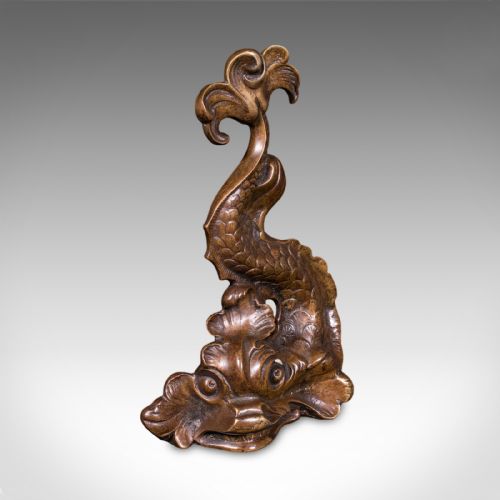
Every English decorative doorstop functions primarily as a heavy weight to keep interior doors securely positioned, moving beyond utility into decorative sculpture. These pieces take various animal and figural forms, ranging from lions and dogs to mythological dolphins and knights.
The pieces on this page span the Regency, Victorian, and Edwardian periods, with Victorian examples appearing most frequently. Makers rendered these door keepers in substantial metallic formats suited to daily domestic service in country houses and town residences.
Materials and construction
Foundry workers cast these heavy objects primarily in iron, brass, and bronze, sometimes incorporating lead for added weight. Many cast iron examples feature painted surfaces or gilt bronze finishes to enhance their visual detail.
Moulds captured intricate figural elements such as animal coats, heraldic stances, and neoclassical motifs. The resulting metal castings provided the necessary density to hold large interior doors without sliding.
Listings feature items cast in iron, brass, and bronze across Regency, Victorian, and Edwardian periods.
Evaluating quality and design
Weight distribution and overall metal mass also dictate the standard of a piece, as heavier castings manage larger doors with greater stability. Original surface finishes, whether patinated brass or early painted coats, preserve the integrity of the object.
The English Decorative Doorstop Glossary
- Door porter
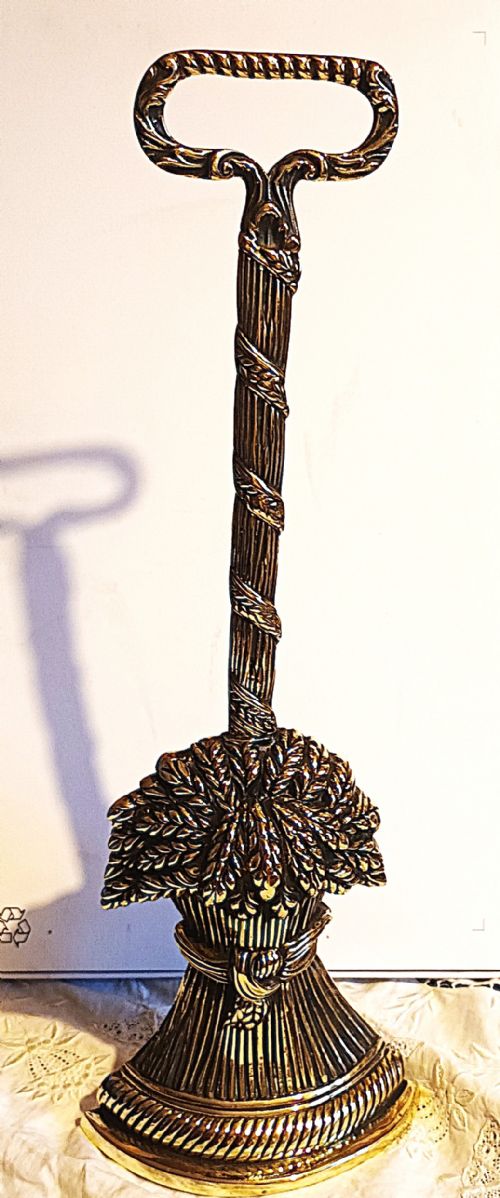
- An alternative term for a heavy doorstop designed with a carrying handle at the top. These tall pieces were lifted easily from room to room.
- Regency
- A stylistic period spanning the early nineteenth century defined by classical restraint and neoclassical motifs. Pieces from this era often feature marine creatures and refined classical proportions.
- Victorian Gothic Revival
- A nineteenth-century design movement inspired by medieval architecture and heraldry. Doorstops from this style frequently incorporate knights and rampants beasts.
- Gilt bronze
- Metal coated with a thin layer of gold to give a rich, reflective surface finish. This treatment elevates the decorative status of utilitarian objects.
English Decorative Doorstop: Frequently Asked Questions
How heavy are these doorstops?
These pieces possess substantial weight, typically cast in thick iron or brass to hold heavy interior doors against draughts. Their mass ensures they remain stationary during daily use.
Smaller examples exist for lighter doors, but the majority rely on heavy metal construction to perform their practical function effectively.
Where should I place a doorstop?
These objects suit grand hallways, studies, and drawing rooms where interior doors require propping open. Their sculptural forms function as decorative ornaments when not actively holding a door.
Position them close to the base of the door where the integrated handle or top loop allows for straightforward placement and removal.
How do I care for cast metal?
Maintain brass and bronze surfaces with a soft dry cloth to remove dust without disturbing the natural patina. Avoid harsh chemical cleaners that strip historical finishes.
Cast iron pieces benefit from occasional light dusting and protection from damp environments to prevent surface oxidation.
Are pairs common for doorstops?
Foundries occasionally produced matching pairs to frame double doors symmetrically within large reception rooms. Single doorstops represent the more common survival from domestic settings.
Matching pairs usually depict heraldic animals or domestic dogs designed to sit at opposite sides of a grand threshold.