
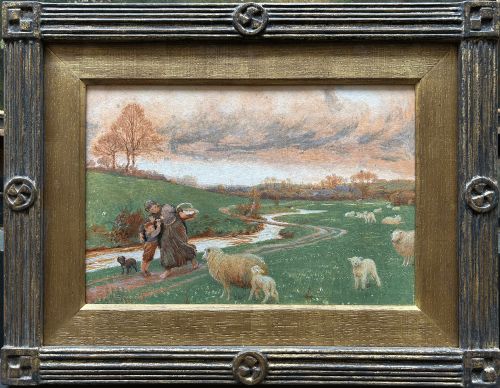


English Countryside Watercolour Picture
An english countryside watercolour picture captures the quiet charm of rural life through delicate pigments on paper, offering a direct window into bygone pastoral scenes.
English Countryside Watercolour Picture
An english countryside watercolour picture typically portrays pastoral views, riversides, and rural cottages rendered by British artists working between the Victorian era and the mid-twentieth century. These artworks frequently record specific locations across Yorkshire, Dorset, Sussex, and other regional landscapes using traditional paper supports.
The pieces on this page span several decades, encompassing late nineteenth-century Victorian idylls alongside early twentieth-century Edwardian pastoral scenes and later works up to the 1930s. Buyers encounter framed paintings depicting agricultural labour, river navigation, and quiet village life observed directly from nature.
How they were made
Artists applied watercolour pigment onto paper using washes and fine brushwork to build translucent layers of colour that capture natural light. Many surviving examples retain their original wood and glass frames, which protect the delicate paper surface from atmospheric moisture.
Makers occasionally incorporated gold leaf within the framing or presentation to enhance the visual depth of the composition. The technique relies on the reflective quality of the white paper showing through transparent washes of watercolour paint.
Listings feature watercolours spanning from the Victorian period through the 1950s, executed on paper supports with original wood and glass frames.
What varies in quality
Quality in an english countryside watercolour picture depends on the sureness of the brushwork and the artist's ability to render atmospheric light and topographical detail convincingly. Stronger compositions demonstrate a sophisticated command of tone, where pigment density creates a genuine sense of distance and weather.
The preservation of the paper support and the vibrancy of the original watercolour pigments heavily influence the visual impact of the finished work. Pieces that have remained protected behind glass without excessive fading retain the subtle tonal shifts intended by the painter.
Frederick Walker·Alfred George Morgan·Charles Gregory·Henry Charles Fox·Cuthbert Crossley·Fred Lawson·Arthur Tucker·Frederick Septimus Lewis·James Orrock·Robert Thorne Waite·Henry Bailey·Robert Winchester Fraser·George Arthur Fripp·John Edward Bale·Basil Bradley·Rowland Henry Hill·William Bradley·Arthur Claude Strachan·George Hamilton Constantine·Thomas Nicholson Tyndale·Claude Muncaster·Charles Branwhite·Henry John Kinnaird·William Stephen Coleman·James Stephen Gresley
The English Countryside Watercolour Picture Glossary
- Watercolour pigment
- The finely ground colour substance mixed with a water-soluble binder used by artists to paint on paper. This medium allows for transparent washes that capture luminous effects.
- Topographical landscape
- A painting that depicts an actual identifiable geographical location with spatial accuracy. Artists often inscribed the specific place name directly onto the mount or backing.
- Victorian pastoral
- A nineteenth-century artistic style focusing on idealized rural scenes, agricultural labour, and tranquil countryside settings. These works reflect contemporary romanticized views of rural Britain.
- British Impressionism
- A painting approach adopted by British artists influenced by modern ideas of light and loose brushwork. Works in this style prioritize the immediate visual impression of outdoor scenes.
English Countryside Watercolour Picture: Frequently Asked Questions
How do I date an english countryside watercolour picture?
Dating relies on signature styles, artist biographical dates, and period framing techniques recorded on the piece. Many works include handwritten inscriptions naming the location and year on the reverse or mount.
Changes in artistic movements from Victorian pastoral to early twentieth-century British Impressionism also provide reliable chronological markers for these paper works.
Where were these landscape watercolours typically painted?
Artists travelled across rural counties including Yorkshire, Dorset, Sussex, and Devon to capture local farms, rivers, and coastal villages. Many compositions record specific regional landmarks such as Bolton Abbey or the River Esk.
Painters often worked directly outdoors to record the changing light of haymaking season and rural daily life.
How should I frame and display watercolour paintings?
Watercolour on paper requires protection behind glass to prevent atmospheric damage and dust accumulation over time. Acid-free mounts prevent chemical discolouration of the paper support.
Displaying these pictures away from direct sunlight preserves the fugitive pigments used by nineteenth and twentieth-century painters.
What subjects appear most often in these rural paintings?
Common motifs include farmworkers, haymaking scenes, grazing cattle, and quiet country cottages nestled beside rivers or woodlands. Artists focused heavily on agricultural labour and traditional rural architecture.
These topographical subjects reflect a growing artistic interest in preserving scenes of traditional British countryside life.