



English Country Life Art
English country life art captures rural scenes and flora through historical paintings, offering a direct window into past domestic and agrarian routines.
English Country Life Art
English country life art encompasses paintings and fine art depicting rural subjects, cottage interiors, landscapes, and natural studies. Buyers exploring English country life art often encounter watercolours, bodycolour, and oil paintings originating from the eighteenth, nineteenth, and early twentieth centuries.
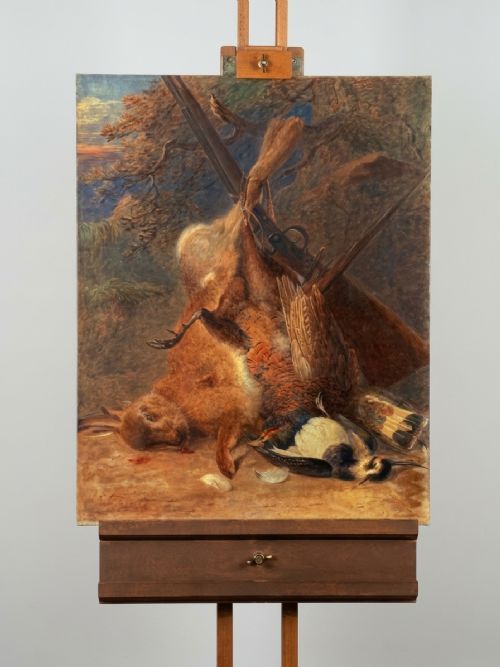
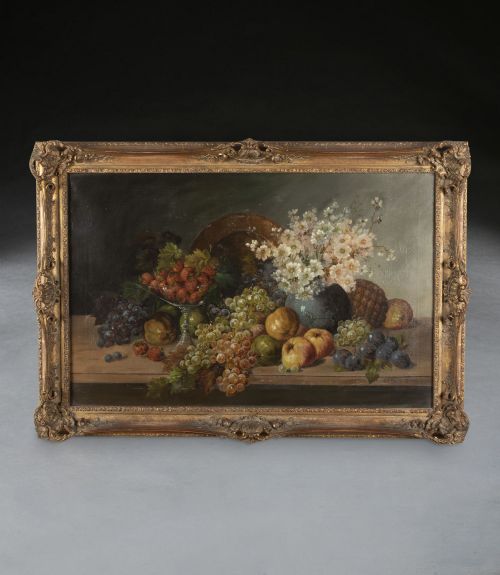
The objects on this page range from detailed botanical watercolours and still-life flower studies to genre scenes involving children at fairs and traditional plough teams. Victorian and Edwardian examples sit alongside mid-century British works, showing how artists recorded the countryside across successive eras.
The most frequent pieces meeting this search phrase are watercolours on paper and oil paintings on canvas depicting flowers, game, or rural landscapes. These works reflect the enduring appeal of agrarian subjects and domestic tranquility in British visual culture.
Materials and techniques
Artists created these works primarily using oil on canvas or watercolour and bodycolour on paper, often framing the finished pieces in wood and gilt composition frames. The application of bodycolour alongside watercolour allowed painters to build opaque highlights and rich texture within botanical and animal studies.
Oil paintings from the eighteenth and nineteenth centuries utilise layered pigments on stretched canvas to achieve depth in genre scenes and still-life compositions. Watercolour paintings rely on transparent washes of pigment on paper support, sometimes enhanced with gum arabic for vibrancy.
Framing materials such as gilt wood and gilt composition enhance the presentation of these paintings, matching the aesthetic standards of their respective periods. The physical support ranges from heavy canvas to delicate paper sheets preserved behind glass.
Several paintings include curious details like birds' nests on mossy banks and pansies peering from Victorian jugs.
Assessing quality and execution
Quality in these paintings rests upon the precision of brushwork, anatomical accuracy in animal and human subjects, and the handling of light and shadow. Superior works display confident draughtsmanship and careful composition, whereas lesser examples show rigid lines or muddy colour mixing.
The distinction between standard works and finer pieces involves the artist's ability to render textures, such as the soft plumage of game, the translucent petals of summer flowers, or the atmospheric depth of a countryside landscape. Original framing and good preservation of the paper or canvas surface also elevate the standing of a piece.
George Sydney Shepherd·Benjamin Blake·Thomas Ivester Lloyd·Edward Killingworth Johnson·Marion Broom·Edith Alice Andrews·Henry Charles Bryant·Henry Singleton·George Morland·John Sherrin·Amy Reeve-Fowkes·Charles James Adams
The English Country Life Art Glossary
- Bodycolour
- Watercolour paint rendered opaque by the addition of a white pigment such as chalk, creating solid areas of colour. This technique appears frequently in nineteenth-century botanical and animal watercolours.
- Genre scene
- A painting depicting aspects of everyday life by portraying ordinary people engaged in common activities. Examples include children at a fair or domestic cottage interiors.
- Gilt composition
- A moulded material made from whiting and glue, often gilded with metal leaf to imitate carved gold leaf frames. It provides ornate decoration for traditional oil paintings and watercolours.
- Still life
- A work of art depicting mostly inanimate subject matter, typically commonplace objects or natural items such as flowers, fruit, and game. These compositions test the artist's skill in rendering light, form, and texture.
- Watercolour
- A painting method in which the paints are made of pigments suspended in a water-based solution. The transparency of the medium allows light to reflect from the white paper beneath.
English Country Life Art: Frequently Asked Questions
What subjects appear in English country life art?
The works depict a range of rural subjects including flower studies, still lifes of game, countryside landscapes, and genre scenes of village life.
Artists across the eighteenth, nineteenth, and twentieth centuries recorded cottage interiors, farming teams, and natural specimens from the British countryside.
How should I display these paintings at home?
Watercolours require protection from direct sunlight to prevent fading of the pigments and paper support. Framing them behind glass with conservation-grade mounts preserves their condition for daily enjoyment.
Oil paintings on canvas tolerate ambient indoor light better but benefit from stable humidity levels away from direct heat sources.
How do I identify a Victorian watercolour?
Victorian watercolours often combine transparent washes with bodycolour to create detailed botanical or figurative studies. They frequently feature signature styles of naturalism and precise draughtsmanship characteristic of the nineteenth century.
Signatures, framing materials, and paper watermarks can help confirm the period of creation.
What is the difference between oil and watercolour paintings?
Oil paintings use pigments bound in drying oils applied to stretched canvas or wooden panels, allowing for rich textures and deep colour blending. Watercolour uses water-soluble media on paper, producing lighter, translucent effects.
Oils generally require sturdy frames without glass, while works on paper need glass protection.