

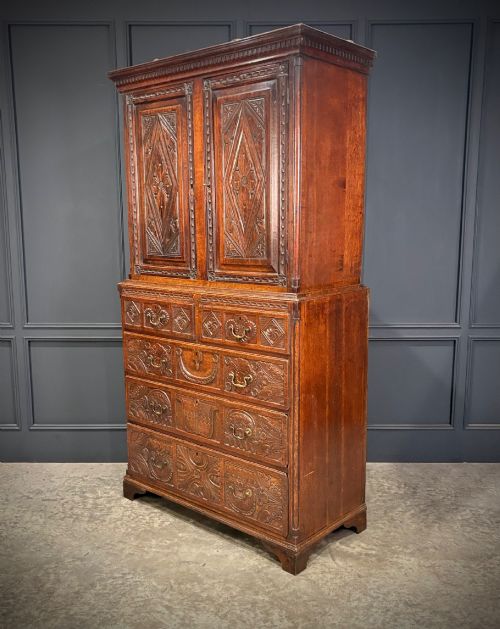


English Country Armoire
An English country armoire is a robust storage piece offering deep proportions and honest rural character, ideal for grounding a traditional bedroom.
English Country Armoire
When you search for an english country armoire, you are looking at substantial storage furniture built in rural workshops during the eighteenth and nineteenth centuries. These pieces encompass housekeepers cupboards, linen presses, wardrobes, and livery cupboards originating from English country houses and farmhouses.
The versions you are most likely to meet on this page date predominantly from the Georgian and nineteenth-century periods. They are constructed in solid oak or pine, often displaying original paint surfaces or later green finishes.
Function governed the form of an english country armoire, resulting in practical designs featuring panelled doors, deep internal shelving, and hanging space for domestic textiles and garments. Their scale reflects the rural domestic requirements of larger country properties.
How they were made
Makers constructed each english country armoire using solid regional timbers such as oak and pine, joined with traditional framing and panel techniques to withstand seasonal humidity shifts. Carpenters utilised pegged mortise and tenon joints to secure the structural carcasses.
Surface finishes range from the natural grain of waxed oak to applied coats of paint, with some examples displaying later decorative schemes. Iron and brass hardware, including butterfly hinges and escutcheons, secured the heavy timber doors.
English Country Armoire Retail Price Guide 2026
Typical asking prices for english country armoire among the pieces listed under this phrase on Sellingantiques today, from the lower quarter to the upper quarter. They describe what is for sale here now, not the wider market.
Many an old farmhouse cupboard retains faint chalk tallies on the inside of the door, where generations recorded household stores and linen counts.
What varies in quality
The distinction between standard and superior pieces rests upon the integrity of the original timber and the survival of early or untouched surface finishes. Oak examples from the eighteenth century generally display heavier timber selection and more deliberate hand-carved detail than later pine counterparts.
Proportion and architectural balance dictate the visual success of an english country armoire, where cornices and panel configurations remain well-proportioned to the overall mass of the carcass. Alterations to internal shelving or replaced hardware influence the degree of historical preservation.
The English Country Armoire Glossary
- Housekeepers Cupboard
- A large storage cabinet traditionally used for housing household linen, dry goods, and domestic stores. These pieces typically feature upper cupboard doors and lower banks of drawers.
- Linen Press
- A tall piece of furniture designed for storing folded linen, featuring sliding trays or shelves behind the upper doors. Below the main compartment, drawers provide additional storage.
- Livery Cupboard
- An early form of food and household storage cupboard originally ventilated through turned spindles or pierced panels. By the nineteenth century, the term applied more broadly to functional storage furniture.
- Gothic Revival
- An architectural and decorative style popular during the nineteenth century that reintroduced pointed arches, tracery, and medieval motifs. This aesthetic influenced the panel design and proportions of certain wardrobes.
- Escutcheon
- A protective metal plate surrounding a keyhole, frequently cast in brass or iron. It serves both a functional role and a decorative purpose on heavy cupboard doors.
English Country Armoire: Frequently Asked Questions
What is an english country armoire?
An english country armoire is a large freestanding storage piece built in rural regions, encompassing forms like housekeepers cupboards and linen presses.
These pieces were constructed to hold domestic textiles, garments, and household supplies in traditional properties.
How old are these cupboards?
The pieces listed on this page primarily date from the eighteenth and nineteenth centuries, spanning the Georgian period and the Victorian era.
Construction methods and timber selection help indicate whether a specific example originates from an earlier rural workshop or a later nineteenth-century period.
What woods were used?
Makers relied on durable regional hardwoods and softwoods, predominantly selecting solid oak and pine for the main framework and panels.
Some surfaces were left in the natural waxed timber state, while others received painted finishes that developed unique patinas over centuries of domestic use.
How do I care for antique pine?
Maintain antique pine and oak furniture by placing it away from direct heat sources and sudden temperature fluctuations that cause timber to split.
Apply traditional beeswax periodically to nourish the dry wood and preserve the surface finish without sealing the historic pores.