





English Coastal View Painting
An english coastal view painting captures the shifting moods of the shore, from Yorkshire fishing ports to southern piers.
English Coastal View Painting
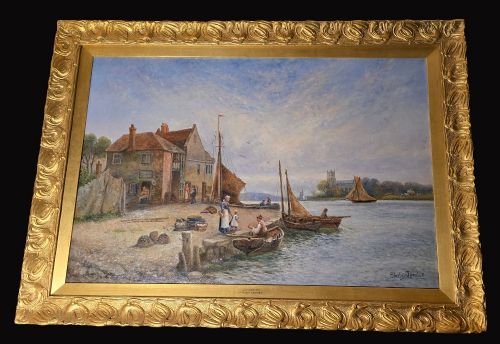
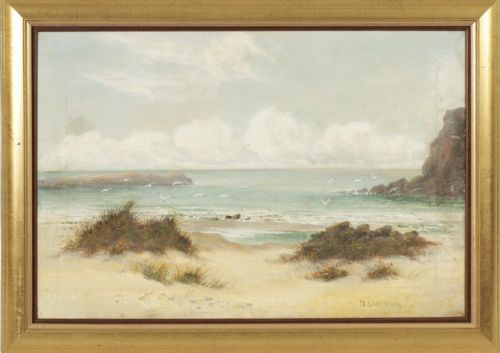
An english coastal view painting depicts maritime landscapes and seaside scenes along the British coastline. These works record historic ports, clifftops, and piers from the nineteenth and twentieth centuries.
Buyers frequently encounter oils on canvas or board alongside delicate watercolour paintings on paper. Subjects range from busy Yorkshire harbours like Whitby and Scarborough to quiet southern cliffs in Kent and Dorset.
The pieces on offer span the Victorian era through the Edwardian period and into mid-century impressionism. Each work documents the topography and atmosphere of the British seaside through the specific lens of its period.
Materials and technique
Artists painted these coastal scenes using oil on canvas, oil on board, and watercolour pigment on paper. Oils allowed for rich, layered applications to capture the heavy sea air and coastal light.
Watercolour paintings rely on fluid washes and precise brushwork to render open skies and churning coastal waters. Supports include traditional wood panels, stretched canvas, and heavy art paper.
English Coastal View Painting Retail Price Guide 2026
Typical asking prices for english coastal view painting among the pieces listed under this phrase on Sellingantiques today, from the lower quarter to the upper quarter. They describe what is for sale here now, not the wider market.
The listings show works executed in oil and watercolour across the Victorian, Edwardian, and mid-century periods.
What separates the best from the rest
Quality rests upon the artist's ability to handle natural light and atmospheric moisture specific to the British coast. Stronger works demonstrate confident brushwork that conveys the movement of the sea and the texture of distant cliffs.
Top examples often feature identifiable topography with specific historical details, such as named Yorkshire piers or Whitby landmarks. Weaker pieces rely on generic compositions with less attention to local architectural or geological character.
William J B Jenkins·Frederick William Booty·Harry Pennell·Alfred Henry Vickers·Stephen John Batchelder·Albert Robert Quinton·William Sidney Cooper·Daniel Sherrin·R. J. S. Bertram·A D Bell
The English Coastal View Painting Glossary
- Topographical
- Depicting a specific, recognisable real-world location rather than an imagined landscape. This accuracy helps date and place coastal scenes precisely.
- Board
- A rigid wooden or composite flat support used by painters instead of stretched canvas. Artists often favoured boards for smaller plein-air coastal studies.
- Impressionism
- A style focusing on the accurate depiction of light and its shifting qualities rather than strict fine detail. Mid-century examples apply this to British coastal subjects with looser brushwork.
- Watercolour
- A paint consisting of colour pigments suspended in a water-based solution applied to paper. It creates transparent washes well-suited to bright seaside skies.
English Coastal View Painting: Frequently Asked Questions
How do I date an english coastal view painting?
Dating relies on costume, architectural clues in the townscapes, and the framing style typical of the nineteenth or twentieth century. Signatures and exhibition labels on the reverse also help establish a precise period.
Changes in coastal infrastructure, such as the presence or absence of Victorian piers, provide reliable chronological markers for these shoreline scenes.
Where were these coastal scenes typically painted?
Artists worked across various British shores, with particular concentrations around the dramatic cliffs and historic harbours of Yorkshire. Popular locations also include the Kent coastline and the sandy beaches of Dorset.
Many painters travelled specifically to capture busy fishing ports, notable abbeys, and popular pleasure piers frequented by holidaymakers.
Are watercolours as durable as oil paintings?
Watercolour paintings require protection behind glass to prevent fading and damage from moisture and direct sunlight. When properly framed and kept away from damp conditions, they remain stable over generations.
Oil paintings on canvas or board are generally more robust but still benefit from stable indoor environments without extreme temperature shifts.
What is the difference between board and canvas supports?
Canvas offers slight flexibility and a woven texture that interacts with thicker oil paint applications. Board provides a completely rigid surface often used for quicker plein-air studies painted outdoors by the sea.
Both supports were widely used by British artists throughout the nineteenth and twentieth centuries depending on studio preference.