



English Breakfront Furniture
English breakfront furniture brings architectural presence to a room, offering bookcases, side cabinets and credenzas with projecting central sections.
English Breakfront Furniture
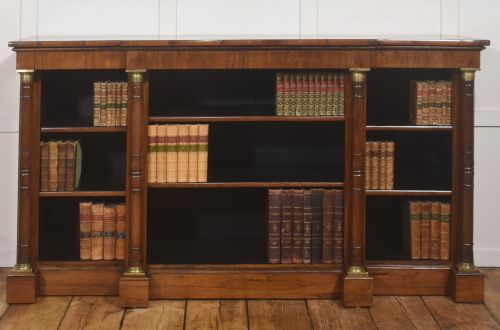
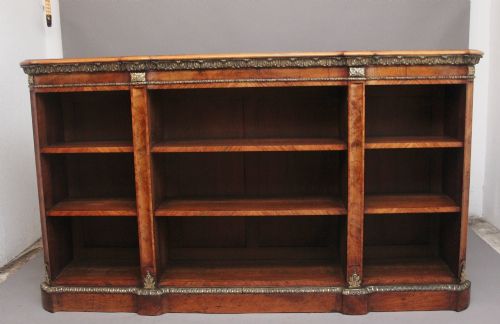
English breakfront furniture spans the Regency and Victorian eras alongside nineteenth century country house pieces, dominated by large library bookcases and credenzas. These forms showcase distinctive projecting central sections paired with recessed wings, creating depth and shadow across a wall.
The selection here ranges from open rosewood bookcases mounted in brass to figured walnut credenzas and Gothic wardrobes. Side cabinets and console tables also appear, offering varied storage and display formats for period interiors.
Materials and construction
Cabinetmakers utilised rich timbers including mahogany, rosewood, walnut and coromandel, often enhanced by burr walnut veneers or satinwood details. Marquetry inlay, hand painting and ormolu mounts add decorative contrast to the primary wood grains.
Brass detailing appears on Regency rosewood pieces, while glass doors protect library shelving. Construction methods reflect nineteenth century workshop practices, pairing solid carcases with carefully selected decorative veneers.
English Breakfront Furniture Retail Price Guide 2026
Typical asking prices for english breakfront furniture among the pieces listed under this phrase on Sellingantiques today, from the lower quarter to the upper quarter. They describe what is for sale here now, not the wider market.
Housekeepers kept their linen and stores behind painted cupboard doors while the library shelves held leather bound volumes in the grand rooms.
Judging quality
Quality rests in the selection of timber figures and the crispness of brass mounts, ormolu details and marquetry work. Finer examples display balanced proportions across the projecting breakfront sections and refined execution of stylistic details like Gothic tracery.
The integrity of original glass, fitted shelving and polished surfaces distinguishes superior cabinetwork from simpler utility pieces. Maker attributions further elevate pieces where documented workshop standards apply.
Johnstone and Jeanes·Lamb of Manchester
The English Breakfront Furniture Glossary
- Breakfront
- A cabinet form where the central section projects forward from the flanking wings. This architectural arrangement creates visual depth and breaks the flatness of a long wall.
- Ormolu
- Gilded bronze used for decorative mounts on nineteenth century furniture. It provides metallic contrast against dark timbers like walnut and mahogany.
- Marquetry
- Fitted wood veneers arranged to form decorative patterns or pictures on furniture surfaces. Craftsmen select contrasting timbers to achieve tonal variation.
- Credenza
- A low side cabinet designed for display and storage, often featuring glass doors or central cupboards. The form gained prominence during the Victorian era.
- Coromandel
- A dense, dark cabinet wood with distinctive contrasting graining imported from Asia. Makers utilised it for high status nineteenth century pieces.
English Breakfront Furniture: Frequently Asked Questions
Which woods were used?
Makers favoured dense hardwoods such as mahogany, rosewood and walnut for their rich grain patterns and structural stability. Decorative veneers like burr walnut and satinwood added surface pattern.
Secondary timbers were chosen to support the weight of extensive library shelving and glazed doors.
How do I style a breakfront bookcase?
These large library bookcases anchor a principal room, functioning as the primary architectural focus. Their shelved interiors suit book collections and curated display objects.
Position them against substantial wall space where the projecting central section and recessed wings can be viewed without obstruction.
How are Regency and Victorian pieces distinguished?
Regency examples frequently combine rosewood with brass mounts and simpler architectural lines. Victorian pieces often introduce figured walnut, marquetry inlay and heavier proportions.
Construction details and decorative vocabulary align each piece with the prevailing taste of its manufacturing decade.