


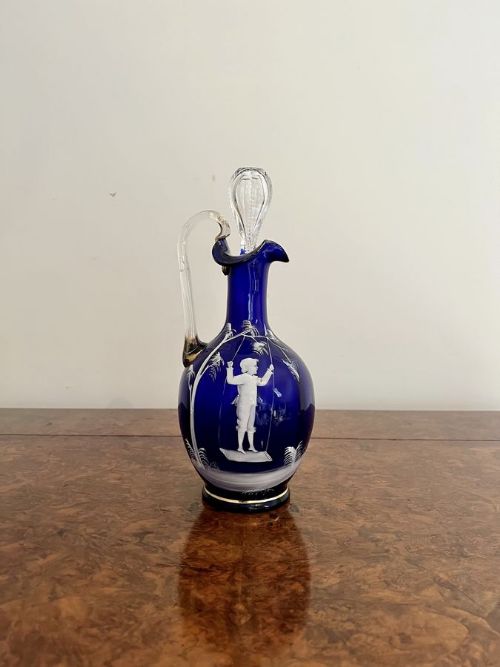

Enamelled Liquor Glasses
These enamelled liquor glasses and associated vessels combine spirited decoration with functional glassware, offering a colourful way to serve spirits.
Enamelled Liquor Glasses
Enamelled liquor glasses and related serving vessels appear in various forms, from complete decanter sets to individual flasks and stands. Buyers browsing this selection encounter pieces designed for holding spirits like gin, schnapps, and whisky, often accompanied by matching glasses.
The objects span multiple eras, with strong representation from the Art Deco period alongside Victorian and earlier examples. Forms range from Czech geometric crystal sets to Scottish whisky decanters and Dutch gin bottles.
Continental and British workshops produced these wares, utilising styles that stretch from Georgian through to folk art traditions. A buyer typically finds either matching sets intended for display and service or standalone flasks meant for personal carriage.
How they were made
Makers shaped glass and lead crystal through blowing and moulding before applying surface decoration. Clear, frosted, cranberry, and blue glass served as the primary canvases for subsequent ornamentation.
Artisans applied polychrome enamel paints by hand to create geometric patterns, pictorial scenes, and folk motifs. Certain pieces integrated metal elements such as chrome, brass, and sterling silver mountings to complete the objects.
Enamelled Liquor Glasses Retail Price Guide 2026
Typical asking prices for enamelled liquor glasses among the pieces listed under this phrase on Sellingantiques today, from the lower quarter to the upper quarter. They describe what is for sale here now, not the wider market.
Listings feature glass vessels from the eighteenth, nineteenth, and twentieth centuries, incorporating Art Deco, Victorian, and Georgian styles.
What varies in quality
The precision and complexity of the hand painting separate standard examples from finer work. Crisp geometric lines on Art Deco pieces or detailed polychrome brushwork on folk art vessels indicate skilled execution.
The quality of the underlying glass medium also plays a role, with heavy lead crystal and rich coloured glass such as cranberry providing a more substantial object than standard clear glass.
Karl Palda·Mosey
The Enamelled Liquor Glasses Glossary
- Enamel
- A decorative vitreous substance fused to the surface of glass through firing. It provides opaque or translucent colour to the exterior of the vessel.
- Lead crystal
- A type of glass containing metallic oxide that increases weight, clarity, and brilliance. It forms the heavy base for many twentieth-century sets.
- Cranberry glass
- Transparent pinkish-red glass created by adding gold to the molten batch during production. It appears frequently in Victorian barware.
- Polychrome
- Decoration utilising multiple distinct colours painted onto the surface. This technique brings pictorial depth to folk art and continental flasks.
- Decanter set
- A matched grouping consisting of a serving vessel and several companion drinking glasses. These assemblies often rest on a dedicated tray or stand.
Enamelled Liquor Glasses: Frequently Asked Questions
What are enamelled liquor glasses?
These are drinking vessels and serving bottles decorated with fused glass paints or enamel. They were produced across Europe for serving spirits.
Collectors find them in various historical styles, ranging from Georgian flasks to geometric Art Deco sets.
How were these glasses used?
They served alcoholic drinks such as gin, schnapps, and whisky at home or during travel. Sets often included matching tumblers or cordials for sharing.
Smaller flasks were designed for personal carriage in pockets or fitted cases.
How do I clean antique enamelled glass?
Wash pieces gently by hand using tepid water and mild detergent. Avoid soaking or abrasive cloths to protect the delicate enamel decoration.
Harsh chemicals and dishwashers can permanently damage the historic painted surfaces.
How do I date an enamelled liquor set?
Examine the silhouette, glass colour, and decorative style for period indicators. Art Deco pieces show sharp geometric patterns from the early twentieth century.
Victorian and Georgian items often feature polychrome folk motifs or rich cranberry tones characteristic of earlier manufacturing.