


Enamelled Demitasse Spoons
These enamelled demitasse spoons bring bright colour and fine metals to the table, offering a glimpse into early twentieth-century design.
Enamelled Demitasse Spoons
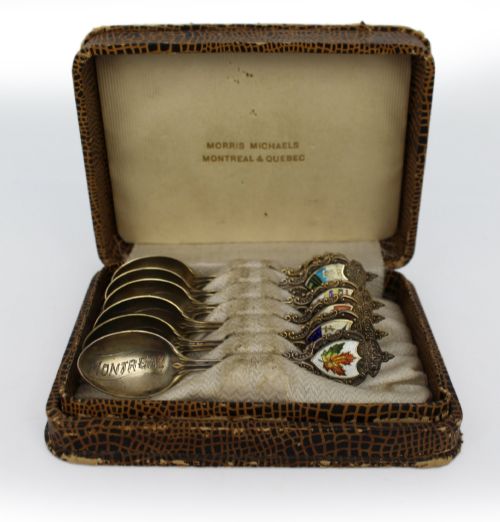
When you search for enamelled demitasse spoons, you are looking at small coffee and teaspoons produced primarily across the late nineteenth and early twentieth centuries. These pieces combine miniature proportions with vitreous decoration, often supplied in fitted presentation cases for formal dining.
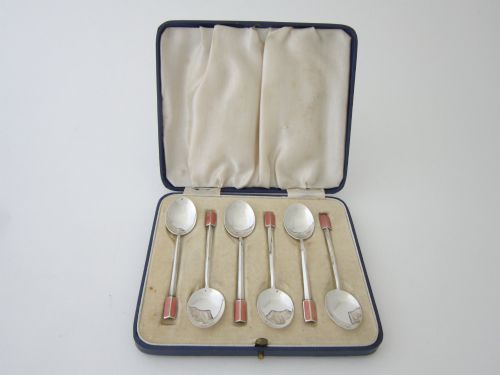
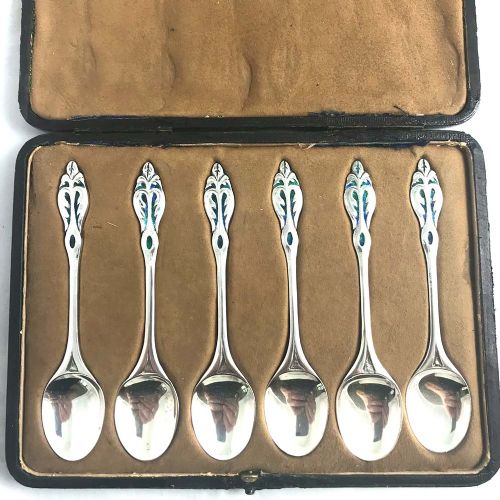
The versions you are most likely to meet on this page hail from the Art Deco period, alongside earlier Arts and Crafts and Imperial Russian examples. They frequently appear in sets of six, sometimes accompanied by silver-mounted porcelain coffee cans and saucers.
How They Were Made
Makers fashioned the bases of these spoons from sterling silver, solid silver, and silver gilt, employing techniques that fused powdered glass directly onto the metal surface under high heat.
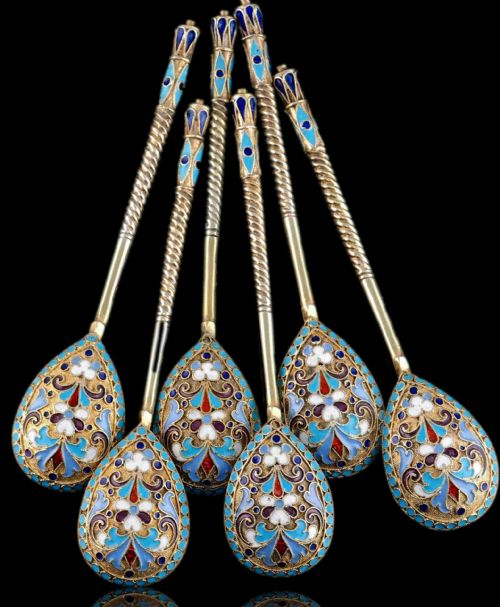
Vitreous enamel provides the vibrant colour fields, while specific styles utilise cloisonne wirework to segment the different coloured enamels into intricate geometric or floral patterns.
The periods represented span from the nineteenth century through the Art Deco era of the 1940s.
What Varies in Quality
Quality rests in the precision of the enamel work and the weight of the silver beneath, where tighter cloisonne compartments and heavier gauge silver elevate a piece.
The presence of an original fitted velvet-lined case and unified sets by known retailers or makers distinguishes ordinary utility items from superior collector pieces.
Dmitrii Nikolaevich Nikolaev·David Andersen·Vasily Agafonov·Liberty and Co·Harrods London
The Enamelled Demitasse Spoons Glossary
- Demitasse
- A small cup used for serving Turkish coffee or espresso, which determines the diminutive scale of these spoons. They measure significantly smaller than standard teaspoons.
- Vitreous enamel
- A material made by fusing powdered glass to a metallic substrate by firing. This creates a glossy, durable coloured coating that resists tarnishing.
- Cloisonne
- An ancient technique for decorating metalwork objects, in which thin wires are soldered to the metal base to form compartments that hold enamel paste.
- Silver gilt
- Silver that has been coated with a thin layer of gold on its surface. This gives the metal a warm golden appearance while retaining a silver core.
Enamelled Demitasse Spoons: Frequently Asked Questions
What are demitasse spoons used for?
These miniature spoons were designed specifically for stirring sugar into small cups of strong black coffee or espresso after dinner.
Because of their small scale, they were also utilised for serving condiments or simply displayed within fitted presentation boxes.
How do I identify Art Deco spoons?
Art Deco pieces display geometric motifs, sharp lines, and stylised patterns that reflect the design trends of the 1920s and 1930s.
They often feature bright, contrasting enamel colours applied to clean silver surfaces without the curving organic lines of earlier periods.
Are Russian enamel spoons different?
Russian spoons from the late nineteenth century frequently showcase traditional cloisonne techniques with intricate multi-coloured wire patterns on solid silver.
These pieces often carry Cyrillic maker marks and Imperial assay stamps denoting the purity of the silver.
Why do they come in sets?
Makers retailed these spoons in matched sets of six, housed in velvet-lined boxes designed to protect the delicate enamel surfaces.
Complete cased sets were popular wedding gifts and prized possessions for formal entertaining in middle-class and aristocratic homes.