


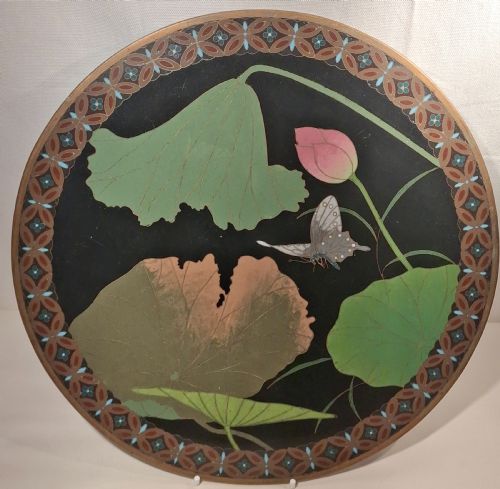

Enameled Copper Wall Charger
An enameled copper wall charger brings rich colour and meticulous metalwork into a room, offering a striking focal point for any interior.
Enameled Copper Wall Charger
An enameled copper wall charger is a decorative dish or plaque designed to be hung or displayed, created with vitreous enamel fused onto a metal base. These pieces span from the late Edo period through the Meiji period, alongside later Arts and Crafts interpretations.
The objects take the form of large chargers, plaques, and decorative plates, often featuring intricate pictorial subjects such as dragons, koi, phoenixes, and Mount Fuji. Most examples encountered here originate from Japanese workshops employing traditional cloisonne techniques.
How they were made
The foundation of an enameled copper wall charger relies on a beaten copper body, shaped into a wide plate or plaque. Artisans then applied fine brass wire to outline the complex motifs, creating individual cells for the coloured glass paste.
Vitreous enamel powders were packed into these wire compartments and fired in a kiln to vitrify the surface into a smooth, glossy finish. Subsequent grinding and polishing revealed the metallic network beneath the translucent colours.
Shrimps and leaping koi swim permanently across the copper surfaces of these nineteenth-century decorative plates.
What varies in quality
Quality in an enameled copper wall charger rests upon the precision of the wirework and the complexity of the pictorial subject. Masterpieces display microscopic cell work and deeply detailed creatures like dragons or leaping koi with subtle tonal gradations.
The ambition of the composition distinguishes standard decorative plates from exceptional plaques. Scale also plays a part, with larger chargers requiring superior technical control during the high-temperature firing process to prevent warping or cracking of the enamel.
The Enameled Copper Wall Charger Glossary
- Cloisonne Enamel
- A technique where metal wires are soldered to a metal base to form compartments, which are then filled with enamel paste and fired. This method allows for intricate pictorial designs bounded by delicate metallic lines.
- Vitreous Enamel
- A material made by fusing powdered glass to a substrate by firing, usually between seven hundred and nine hundred degrees Celsius. The resulting compound is smooth, durable, and resistant to fading.
- Charger
- A large decorative plate traditionally used for formal display rather than for serving food. In this context, it serves as a substantial canvas for detailed metal and glass artistry.
- Edo Period
- The period in Japanese history spanning from sixteen hundred and three to eighteen sixty-eight. Early chargers originating from the late phase of this era display foundational styles that influenced later Meiji output.
Enameled Copper Wall Charger: Frequently Asked Questions
How do I hang a wall charger safely?
Displaying an enameled copper wall charger requires a specialised, coated wire display hanger that supports the rim securely without scratching the metal or enamel.
Ensure the wall fixing is anchored firmly into a stud or uses a rated plaster plug to bear the substantial weight of the copper and glass plaque.
How should I clean my enameled charger?
Dust the surface gently with a soft, dry microfibre cloth to remove everyday particles without disturbing the delicate brass wire outlines.
Avoid liquid cleaners, chemical polishes, or abrasive cloths, as these can permanently damage or dull the vitreous enamel finish.
What subjects appear on these chargers?
Common motifs include mythological creatures such as dragons and ho-o birds, alongside natural subjects like koi fish, shrimp, owls, and Mount Fuji.
Some pieces incorporate cultural elements like samurai figures, mon crests, and tendril patterns executed in multi-coloured enamel.
Are these chargers signed by makers?
Certain pieces feature artist signatures or workshop marks integrated into the enamel design on the front or reverse.
Unsigned chargers are equally common, as many high-grade decorative plaques produced for export left workshops without explicit maker ciphers.