

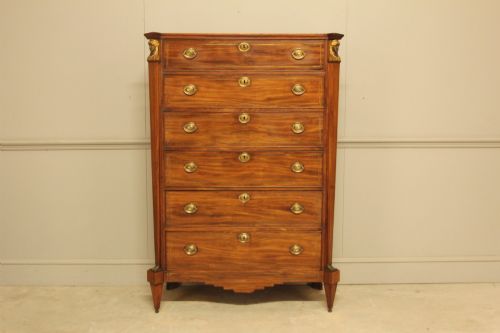




Empire Tall Chest
An empire tall chest offers commanding vertical presence and deep storage, bringing disciplined French classical proportion straight into your bedroom.
Empire Tall Chest
When you hunt for an empire tall chest, you are looking at substantial vertical storage units originating largely from nineteenth-century France. These pieces deliver disciplined classical proportions designed to maximise floor space while offering multiple deep drawers for garments or linen.
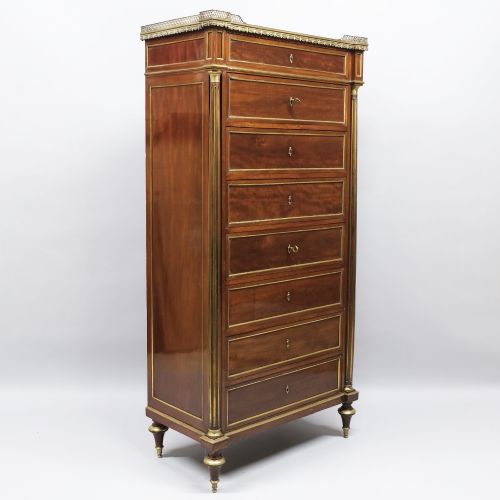
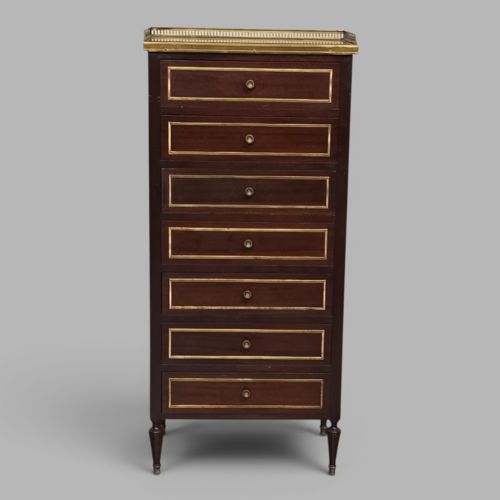
The versions you meet most frequently on this page belong to the French Empire and Neo Classical traditions, often built as tall chests or semainiers. They combine architectural dignity with practical depth, standing tall against the wall with formal restraint.
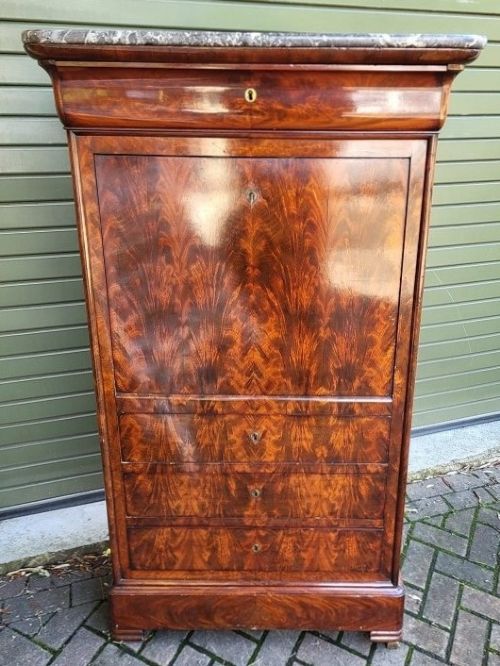
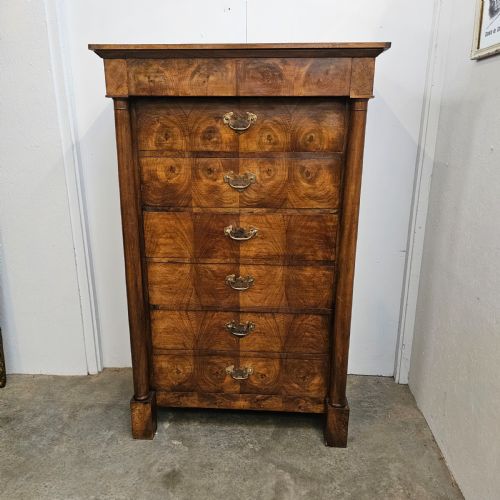
Makers shaped these forms using rich timbers like mahogany and walnut, frequently elevating the design with striking bookmatched veneers. Their tall profiles anchor a room without swallowing the floor plan.
Materials and Construction
Cabinetmakers constructed these tall chests using solid timber carcasses faced with carefully selected veneers of mahogany and walnut. Workshops often employed bookmatching techniques to mirror the grain patterns across the drawer fronts, creating symmetrical visual movement.
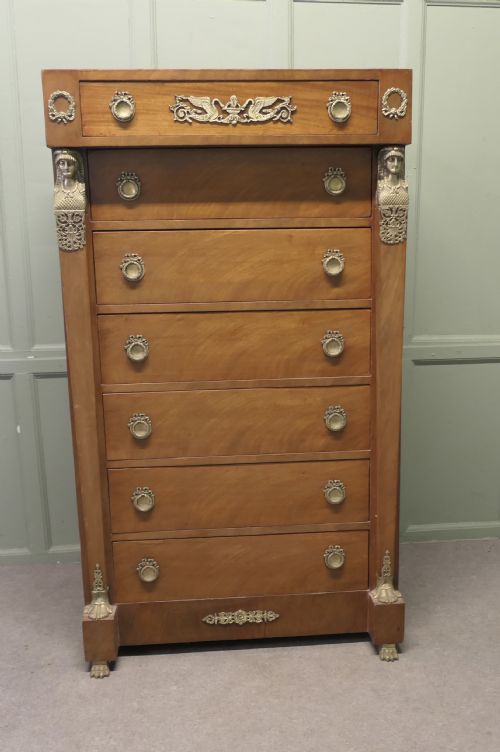
The exteriors frequently incorporate cast brass and ormolu mounts that accent the key architectural lines of the piece. These metal garnishments provide sharp contrast against the dark wood surfaces, typical of the French Empire style.
Empire Tall Chest Retail Price Guide 2026
Typical asking prices for empire tall chest among the pieces listed under this phrase on Sellingantiques today, from the lower quarter to the upper quarter. They describe what is for sale here now, not the wider market.
Current listings demonstrate a strong reliance on nineteenth-century French cabinetmaking, featuring both mahogany and walnut timbers alongside traditional ormolu mounts.
Assessing Quality
Quality reveals itself in the precision of the veneer work and the crispness of the cast bronze or ormolu mounts. Superior examples display seamless grain continuity across multiple drawers alongside heavy, well-defined metalwork that sits flush against the timber.
Construction integrity distinguishes finer pieces from ordinary ones, particularly in how drawer linings and internal frames handle the weight of the timber. The best workshops ensured that every structural joint and decorative element maintained strict classical symmetry.
The Empire Tall Chest Glossary
- Semainier
- A tall, slender chest traditionally featuring seven drawers, one for each day of the week. This form offers generous vertical storage with a minimal footprint.
- Ormolu
- Gilded bronze used for decorative mounts and accents on furniture. It adds bright metallic highlights to the dark mahogany and walnut carcasses.
- Bookmatched
- A method of arranging veneer sheets so that adjoining surfaces mirror each other. This technique creates complex, symmetrical patterns across drawer fronts.
- Cartonnier
- A specialised tall cabinet originally designed for holding papers and documents. These pieces share the vertical stature of the standard tall chest.
Empire Tall Chest: Frequently Asked Questions
What is an empire tall chest used for?
These tall chests provide ample vertical storage for clothing and linens while taking up minimal floor space in a bedroom or dressing room.
Their deep drawers accommodate substantial items, making them both a striking decorative focal point and a highly practical piece of furniture.
How do I identify a French Empire tall chest?
Look for severe architectural lines, dark timbers like mahogany or walnut, and distinct classical ormolu mounts. These pieces emphasise vertical proportion and often feature symmetrical bookmatched grain patterns.
The inclusion of specific regional forms like the semainier further points to French nineteenth-century origins.
Where should I place a tall chest in my home?
A tall chest works best against a solid wall in a bedroom, hallway, or dressing area where its vertical height can anchor the space.
Ensure there is sufficient clearance in front of the piece for the drawers to open fully without obstructing walkways.
How do I care for walnut and mahogany surfaces?
Dust the timber regularly with a soft, dry cloth to prevent surface grit from accumulating on the polish. Avoid placing the chest in direct sunlight or near heat sources to protect the veneers from drying out.