


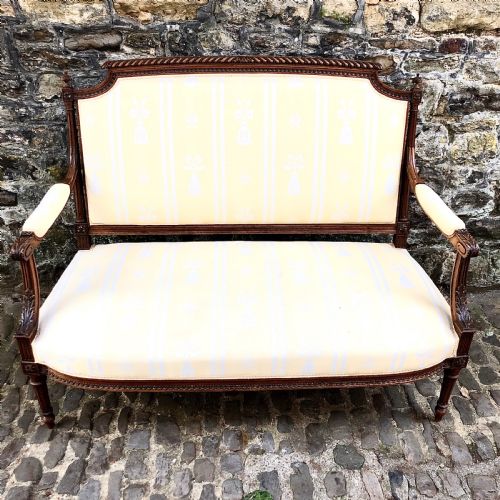


Empire Style Settee
An empire style settee brings architectural grandeur and classical symmetry into a room through rich mahogany, giltwood, and gleaming ormolu mounts.
Empire Style Settee
An empire style settee is a formal seating piece defined by classical neoclassical lines, scroll ends, and substantial frames. When you search for this phrase, you find heavy timber frames shaped by continental European cabinetmakers, with French and Swedish interpretations appearing most frequently.
The pieces on this page span the nineteenth century, including specific periods like the Regency era, the 1850s, and the Second Empire. Forms range from standalone salon sofas to multi-piece salon suites accompanied by matching chairs.
You encounter both French Empire revival models decorated with ornate ormolu and simpler birch or walnut Swedish and continental variations. Each version relies on strong architectural silhouettes derived from classical antiquity.
How they were made
Cabinetmakers constructed the structural frames of these settees using dense hardwoods such as mahogany, walnut, and birch, often incorporating carved wooden details. Gesso provides the smooth base layer for gilded surfaces on Swedish and continental examples.
Metalwork played a defining role in the ornamentation, with cast ormolu mounts applied directly to mahogany surfaces to create sharp classical contrasts. Upholstery fabrics, including silk, covered the sprung or padded seats to complete the finished furniture.
Empire Style Settee Retail Price Guide 2026
Typical asking prices for empire style settee among the pieces listed under this phrase on Sellingantiques today, from the lower quarter to the upper quarter. They describe what is for sale here now, not the wider market.
French Empire revival models appear alongside Swedish birch variants and Italian neoclassical designs.
What varies in quality
The refinement of the carved wooden frame and the crispness of the applied ormolu mounts separate standard production from superior examples. Better workshops employed skilled bronze-casters and cabinetmakers whose work retained sharp definition in both timber and metal.
The choice of primary timber also dictates the tier of the piece, with figured mahogany and finely gilt surfaces representing the more ambitious end of nineteenth-century production. Coarser execution appears in simpler provincial pieces lacking cast metal decoration.
The Empire Style Settee Glossary
- Ormolu
- Gilded bronze used for decorative mounts on furniture. This technique involves applying a mercury and gold amalgam to cast brass or bronze.
- Giltwood
- Timber coated with a thin layer of gold leaf over a prepared gesso ground. It creates a brilliant reflective surface on classical frames.
- Neoclassical
- The dominant artistic movement of the late eighteenth and nineteenth centuries that revived the forms of ancient Greece and Rome. Empire style sits directly within this broader design tradition.
- Scroll end
- A rolled or curved wooden arm termination that mirrors ancient scroll designs. It gives these settees their characteristic silhouette.
- Salon suite
- A matched set of seating furniture, typically comprising a settee and several armchairs. These groups were designed for formal reception rooms.
Empire Style Settee: Frequently Asked Questions
What is an empire style settee?
An empire style settee is a nineteenth-century seating piece influenced by the classical designs of the Napoleonic era and neoclassical revival periods. These pieces feature strong architectural lines, exposed timber frames, and often incorporate scroll arms and metal mounts.
They were built in workshops across France, Sweden, Italy, and the Netherlands. The form serves as both a functional seat and a striking visual anchor in a room.
How do I use a settee in a modern room?
These settees work well in drawing rooms, hallways, or large bedrooms where their formal presence can be appreciated. Their relatively compact length compared to modern three-seater sofas makes them useful for tighter architectural spaces.
Pair them with understated contemporary furnishings to let the classical mahogany or giltwood frame stand out. Positioning them against a plain wall highlights their distinct silhouette.
How do I tell French and Swedish pieces apart?
French empire pieces typically lean towards dark polished mahogany accented with bright ormolu mounts and deep upholstery. They project a sense of heavy imperial grandeur.
Swedish empire pieces frequently utilise lighter birch timbers or painted and giltwood surfaces. They tend to exhibit a brighter, more restrained neoclassical aesthetic.
What is a salon suite?
A salon suite is a coordinated group of reception room furniture containing a settee alongside matching armchairs. These suites were manufactured as a unified set to ensure decorative harmony in formal entertaining spaces.
Finding a complete suite means the timber selection, carving style, and proportions match across every single chair and sofa.