


Empire Style Occasional Table
An empire style occasional table brings architectural presence and classical proportion to a room, offering a sturdy surface framed by rich timbers and bronze mounts.
Empire Style Occasional Table
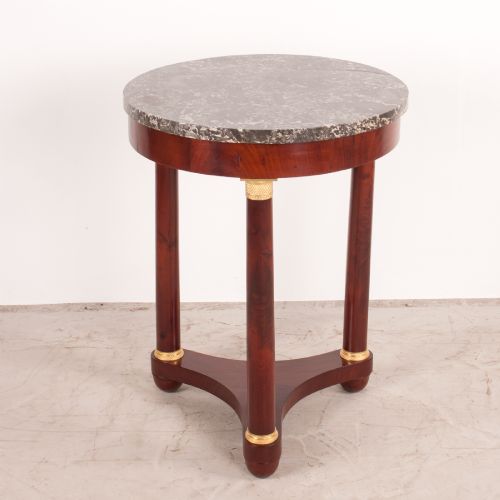
When searching for an empire style occasional table, you encounter round guéridons, rectangular sofa tables, and low coffee tables produced from the nineteenth century into the twentieth. The most common form on this page is the French mahogany or kingwood guéridon, featuring a circular marble top supported by a central column or three sweeping legs.
These pieces draw heavily upon Neoclassical and French Empire vocabulary, occasionally crossing into Biedermeier or Regency interpretations. They serve as versatile accents in sitting rooms and hallways, functioning as lamp tables or display surfaces for decorative objects.
Origins span French workshops and later revival periods, bringing distinct regional interpretations to the classical template. You find both strict nineteenth-century examples and later twentieth-century revivals sharing the same floor plans.
Materials and construction methods
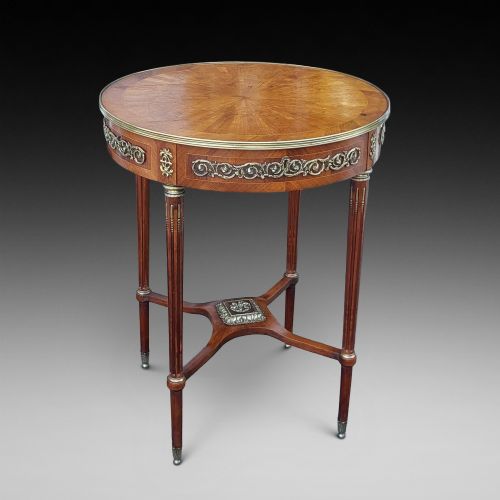
Cabinetmakers built these tables using dense hardwoods such as mahogany, walnut, and kingwood, frequently applying veneers over secondary timbers. Ebonised wood and exotic veneers like Karelian birch add deep contrast to the primary surfaces.
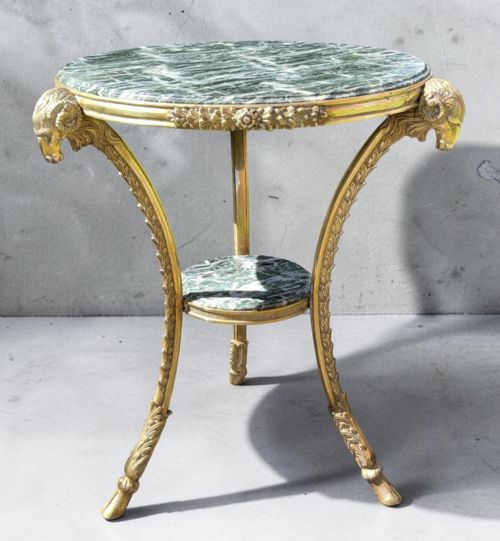
Heavy slabs of white or black marble form inset tops on many pieces, while others utilise polished timber or canework. Cast brass, ormolu, and gilt bronze mounts define the structural junctions, framing aprons and capitals with classical motifs.
Several tables rely on fierce cast rams' heads and swans to hold up your afternoon tea.
Assessing quality and execution
Superior examples distinguish themselves through the crispness of their cast bronze mounts and the depth of figure in the mahogany or birch veneers. Lesser pieces rely on stamped sheet brass and plain secondary timbers with minimal attention to grain continuity.
The integration of the marble top into the wooden frame indicates the maker's standard of precision, as does the stability of the central column or leg assembly. Finer tables exhibit hand-chased surface details on their ormolu elements rather than uniform factory casting.
The Empire Style Occasional Table Glossary
- Guéridon
- A small French table, typically round and supported by a single central pillar or three legs. These forms dominate the selection of nineteenth-century occasional tables.
- Ormolu
- Gilt bronze mounted onto furniture and decorative objects. The technique involves applying a gold amalgam to bronze before firing.
- Biedermeier
- A Central European style dating from the early nineteenth century favouring clean lines and blonde woods over excessive ornamentation. It represents a domestic adaptation of Empire design.
- Karelian birch
- A decorative timber featuring distinctive swirling knot patterns that create a mottled golden appearance. Makers utilised it for high-status Scandinavian and northern European cabinetwork.
Empire Style Occasional Table: Frequently Asked Questions
Where should I place an empire style occasional table?
These tables suit hallways as central display surfaces or sit comfortably beside armchairs as lamp tables. Their compact footprints allow them to anchor awkward corners without crowding the floor.
Ensure the height matches your surrounding seating or display requirements, particularly when pairing circular guéridons with low modern sofas.
How do I care for the marble top?
Wipe marble surfaces regularly with a soft, damp cloth and neutral soap to prevent staining from acidic liquids. Avoid harsh chemical cleaners that strip the polished finish.
Use coasters under glasses and protect the stone from direct impact to prevent chipping along the vulnerable bevelled edges.
How do I distinguish a nineteenth-century piece from a revival?
Examine the secondary timbers inside the frame, the wear patterns on the underside, and the hand-cut fixings holding the marble or top in place. Revival pieces often display machine-tooled screws and modern adhesives.
Check the patination on the mahogany or walnut for natural oxidation that accumulates through decades of handling.
What maintenance do the timber frames need?
Feed polished mahogany and kingwood surfaces occasionally with traditional beeswax to nourish the wood and maintain its deep lustre. Avoid silicone polishes that build up sticky residues.
Keep the tables away from direct heat sources and strong sunlight to prevent the timber veneers from drying out and lifting.