
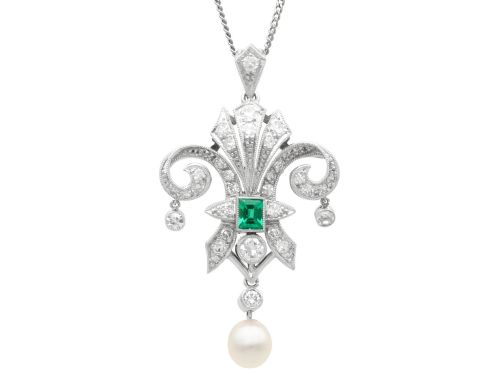
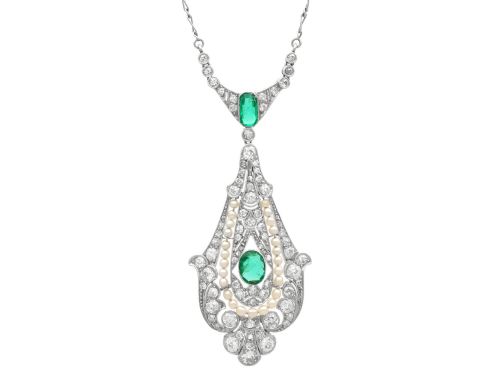


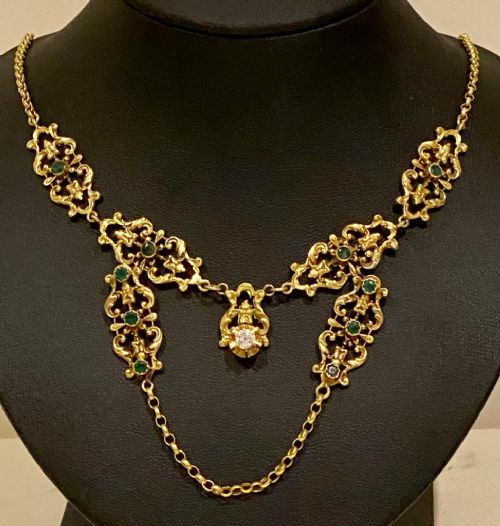
Emerald and Diamond Necklace
An emerald and diamond necklace brings together vibrant green beryl and brilliant stones, offering historic charm and enduring design.
Emerald and Diamond Necklace
When you search for an emerald and diamond necklace, you encounter fine jewellery spanning multiple historical periods including Victorian, Edwardian, Art Deco, and Mid-Century Modern. These items manifest as pendants, drop neckchains, multi-strand pearl arrangements with gem-set clasps, and convertible brooch pendants.
The materials paired with these central gemstones range across platinum, yellow gold, white gold, and lesser-seen gold purities, alongside complementary pearls, sapphires, aquamarines, and tourmalines. The assortment draws upon French origins and various workshop traditions from the nineteenth and twentieth centuries.
Materials and Construction
Metals such as platinum, 18ct yellow gold, 15ct gold, and white gold form the structural mounts and chains for these jewelled creations. Platinum provides durable, fine settings popular in Art Deco pieces, while various carats of yellow and white gold anchor Victorian and vintage designs.
Gemstone setting techniques combine claw mounts, bezel settings, and cluster arrangements to secure emeralds alongside brilliant-cut and supporting diamonds. Multi-strand pearl elements integrate directly with gold and platinum clasps set with smaller accent stones.
An unexpected elephant cluster pendant makes an appearance among the traditional floral and geometric designs.
Distinctions in Quality
Quality differentiates through the origin and clarity characteristics of the emeralds, such as specified no-oil treatments or Columbian provenance, balanced against the weight and cut proportions of the accompanying diamonds. Metalwork finesse also dictates distinction, separating standard production mounts from intricate handcrafted lavaliere structures.
The overall integrity of period survival, from well-preserved platinum settings to intact multi-strand pearl formations, defines the upper tier of these pieces. Articulation in drop components and the secure integration of clasps further separate simpler commercial iterations from finer masterworks.
C'est Laudier
The Emerald and Diamond Necklace Glossary
- Art Deco
- A design style emerging in the 1920s and 1930s characterised by geometric lines, stylised motifs, and frequent use of platinum alongside diamonds and emeralds. It marked a sharp departure from earlier flowing organic aesthetic movements.
- Lavaliere
- A pendant necklace featuring a central dangling stone or ornament suspended from a finer chain structure. This style gained notable popularity during the Victorian and Edwardian eras.
- Brooch Pendant
- A versatile item designed with a pin mechanism on the reverse alongside a concealed loop, allowing the wearer to use it either pinned to clothing or suspended from a neckchain.
- Columbian Emerald
- An emerald originating from the mines of Colombia, historically renowned for yielding stones with a particularly vivid and deep green hue. Collectors often prize these for their specific mineral composition and clarity characteristics.
- No Oil
- A designation indicating that an emerald has undergone no clarity enhancement treatments using oils or resins. Such stones are uncommon and highly valued by collectors.
Emerald and Diamond Necklace: Frequently Asked Questions
How do I care for antique emerald jewellery?
Emeralds are softer and more brittle than diamonds, requiring careful handling and protection from harsh chemicals, ultrasonic cleaners, and sudden temperature changes. Store each piece individually in a soft pouch to prevent scratching from harder stones.
Have settings checked periodically by a professional jeweller to ensure the claws holding the emeralds and diamonds remain secure. Gentle cleaning with a soft, damp cloth is safer than soaking gem-set pieces in liquid solutions.
What periods do these necklaces come from?
The pieces span from the nineteenth century through the mid-twentieth century, encompassing Victorian, Edwardian, Art Deco, and Mid-Century Modern eras. Each period brings distinct metal choices, stone cuts, and mounting styles.
Victorian and Edwardian examples often feature warmer yellow gold tones and intricate cluster work, while Art Deco pieces favour platinum and geometric arrangements. Mid-century items showcase bolder designs and varied gold purities.
Are all emeralds treated with oil?
Not all emeralds undergo treatment, though oiling or resin impregnation is a common industry practice used to fill surface-reaching fractures and improve clarity. Untreated stones, sometimes documented as no-oil, occur less frequently and command greater interest from collectors.
Certificate documentation from gemological laboratories often details whether a specific emerald has received enhancement treatments. Examining these reports helps clarify the natural state of the stone.
Can a brooch pendant be worn daily?
Convertible pieces featuring pin mechanisms and loops require careful usage to ensure the security of both the fastening pin and the suspension bail. Daily wear is possible if the mountings are sturdy, but fragile antique settings benefit from occasional rotation.
Checking the pin safety catch and the suspension loop before each wear prevents accidental loss. Storing the piece securely when not being worn protects the delicate gold or platinum work.