



Embroidered Fireplace Guard
An embroidered fireplace guard sits before the hearth to block the fierce heat of a coal fire while framing a hand-worked panel of needlework or silk.
Embroidered Fireplace Guard
When you search for an embroidered fireplace guard, you are looking at functional interior furnishings designed to protect occupants from the intense glare and warmth of open fires. These pieces typically take the form of upright screens framed in timber or metal, holding a textile centre worked by hand.
The versions you are most likely to meet on this page span the Georgian, Victorian, and Edwardian periods, appearing as pole screens, cheval screens, or table-combination pieces. They utilise timber frames of mahogany, rosewood, walnut, or giltwood alongside brass and glass elements.
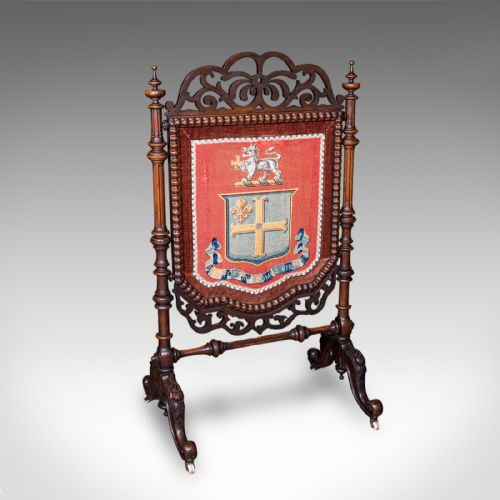
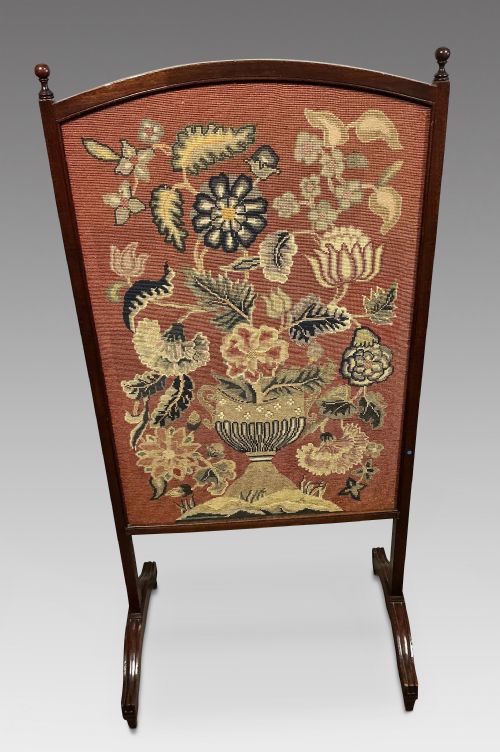
Makers shaped these guards to stand securely near hearths across British homes, employing textiles such as wool, silk, and needlepoint to depict armorial bearings, coats of arms like the Clan Maclellan, and tapestry motifs including parrots.
Materials and Construction
Timber frames form the structural backbone of these pieces, utilising dense hardwoods like mahogany, rosewood, and walnut, alongside carved giltwood and polished brass. Joinery techniques secure the upright supports, bases, and adjustable mechanisms that allow the panel to shift height or angle.
The textile panels rely on meticulous hand-stitching, featuring needlepoint, wool work, and silk embroidery stretched tightly within the wooden or metal rebate. Glass occasionally protects delicate needlework surfaces from soot, ash, and ambient moisture.
Distinctions in Quality
The calibre of an embroidered fireplace guard rests heavily upon the finesse of the needlework and the selection of timber used for the frame. Finely detailed wool or silk tapestry work executed with tight, uniform stitches denotes superior workshop production compared to looser, simpler domestic embroidery.
Structural complexity also dictates standing; adjustable mechanisms, carved details, and refined inlays on dense rosewood or mahogany demonstrate higher craftsmanship than fixed, plain frames. The integration of functional dual-purpose designs, such as metamorphic occasional tables, further separates standard production from exceptional examples.
The Embroidered Fireplace Guard Glossary
- Pole screen
- A vertical standing screen featuring a sliding embroidered panel mounted on a central wooden pole with a tripod or weighted base. This design allowed occupants to adjust the height of the shield to block heat at seated eye level.
- Cheval screen
- A self-standing firescreen supported by two side pillars and feet, holding a wide rectangular embroidered panel between them. The frame allows the panel to swing or tilt on horizontal pivots.
- Needlepoint
- A form of counted-thread embroidery stitched over canvas mesh to create dense, durable pictorial surfaces. It forms the primary decorative medium for historic fire screens.
- Giltwood
- Timber coated with a thin layer of gold leaf over a prepared gesso ground. It appears on decorative frames from the Georgian era.
- Armorial panel
- An embroidered textile depicting a specific family crest, coat of arms, or heraldic insignia. These bespoke panels often record ancestral lineage.
Embroidered Fireplace Guard: Frequently Asked Questions
What is an embroidered fireplace guard?
An embroidered fireplace guard is a decorative screen placed in front of a hearth to shield room occupants from intense fire heat. It combines a supportive wooden or metal frame with a hand-stitched textile panel.
These furnishings served both practical and aesthetic roles in historic reception rooms, preventing sunburn while displaying fine needlework skills.
How were pole screens used?
Pole screens stood near the fireplace, allowing a person to slide the embroidered panel up or down the central shaft. This directed the shade precisely where needed against the radiant heat.
Occupants adjusted the panel height depending on whether they sat close to the hearth or further back in the room.
What woods are typical for these screens?
Frames commonly utilise dense cabinet timbers such as mahogany, rosewood, and walnut. Giltwood and brass also appear on specific decorative examples.
These materials provided the structural weight needed to keep the upright frames stable on uneven floorboards near the fireplace.
How do I identify a Victorian fire screen?
Victorian examples often feature heavier walnut or rosewood frames, intricate carved details, and deep needlepoint tapestries. They frequently take the form of cheval screens or adjustable pole screens.
Stylistic cues lean towards elaborate floral designs or detailed needlework panels mounted within sturdy Victorian joinery.