





Edwardian Walnut Nursing Chair
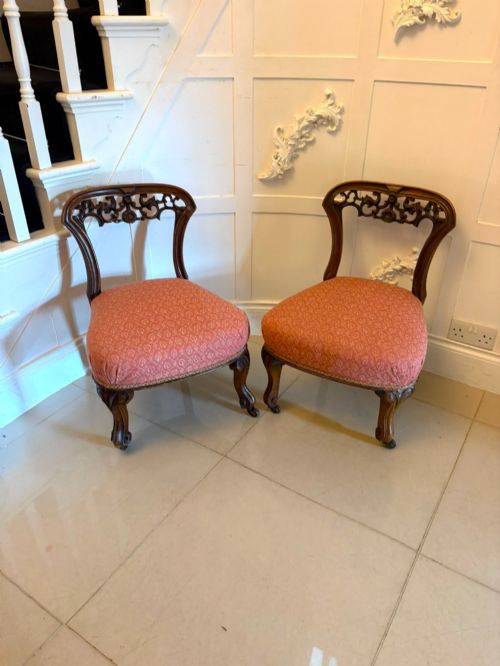
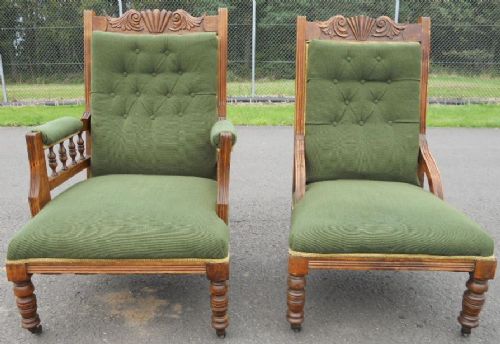
These edwardian walnut nursing chair examples offer low seats and button-backed comfort, perfect for low firesides and bedroom dressing.
Edwardian Walnut Nursing Chair
An edwardian walnut nursing chair provides a low seat designed for comfort during nursery work or dressing, appearing frequently alongside Victorian equivalents on this page. These pieces span the nineteenth and early twentieth centuries, drawing on Victorian, Edwardian, and Aesthetic Movement styles.
The forms vary across armchairs, side chairs, and occasional chairs, alongside rarer slipper chairs and rocking chairs. Walnut frames dominate the selection, shaped with carved details or plain polished surfaces.
How They Were Made
Frames are constructed from walnut, occasionally burr walnut, shaped into structural curves and supported by brass castors or ceramic castors. Wood is carved with decorative flourishes, particularly on the crest rails and front legs.
Upholstery relies on traditional textiles, including velvet and various fabrics, often featuring button-backed padding secured with deep tufting. Internal stuffing utilises period stuffing materials held by webbing and coil springs.
Edwardian Walnut Nursing Chair Retail Price Guide 2026
Typical asking prices for edwardian walnut nursing chair among the pieces listed under this phrase on Sellingantiques today, from the lower quarter to the upper quarter. They describe what is for sale here now, not the wider market.
Low seats allowed Victorian women to tend infants without their voluminous skirts catching on chair arms.
What Varies in Quality
The crispness of the wood carving separates standard frames from finer items, particularly where floral motifs or scrollwork decorate the walnut crest. Grain figure also plays a part, with figured walnut and burr walnut commanding greater visual presence than plain timber.
Upholstery integrity defines the standard of survival, distinguishing pieces retaining original textile coverings from those with later re-coverings. Frame stability and the retention of original brass or ceramic castors complete the assessment of execution.
The Edwardian Walnut Nursing Chair Glossary
- Nursing chair
- A low-seated chair historically used by women for nursing infants or dressing, featuring an upright back and no arms to accommodate voluminous skirts. The low posture also suited bedside tasks.
- Button back
- An upholstery technique where buttons are pulled deep into the padding at regular intervals, creating diamond-shaped tufts that secure the filling and shape the textile surface. This method adds both tension and visual texture to the backrest.
- Burr walnut
- Timber sliced from the wart-like growths on walnut trees, revealing intricate, swirling grain patterns. Cabinet makers prized this veneer for high-status panels and prominent chair frames.
- Castor
- A small wheel fitted to the base of chair legs to ease movement across carpets and floorboards. These wheels commonly incorporate brass fixings and ceramic bodies.
- Aesthetic Movement
- A late nineteenth-century design current that prioritised visual beauty over moral narrative, favouring refined forms and Japanese-influenced motifs. Pieces from this circle often display pared-back elegance.
Edwardian Walnut Nursing Chair: Frequently Asked Questions
How do I spot an Edwardian piece?
Edwardian seating tends to display lighter proportions and softer decorative carving compared to heavier mid-Victorian counterparts. Walnut framing from this era often retains a clear, warm polish.
Stylistic cues draw on earlier revivals while maintaining the simplified elegance typical of the early twentieth century.
Where were these chairs placed?
Original placement centred on bedrooms, nurseries, and dressing rooms where low seating facilitated personal care. Their compact size also suited intimate fireside corners.
Today, they function well as accent seating in living spaces or bedrooms.
Are original textiles common?
Surviving textiles include velvet and period fabric, though many examples have undergone reupholstery to ensure structural usability. Original upholstery remains a notable feature when preserved intact.
Subsequent re-covering often respects the original button-backed aesthetic.