

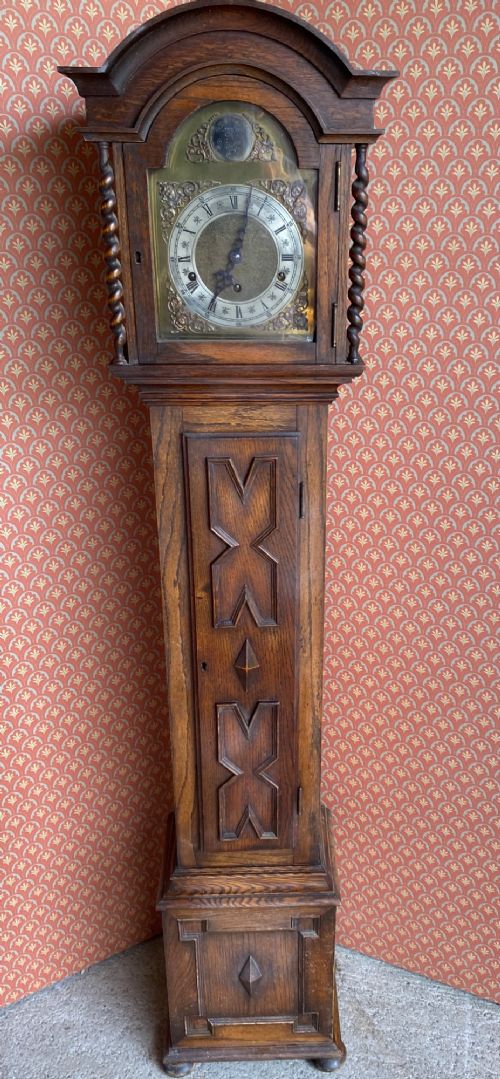
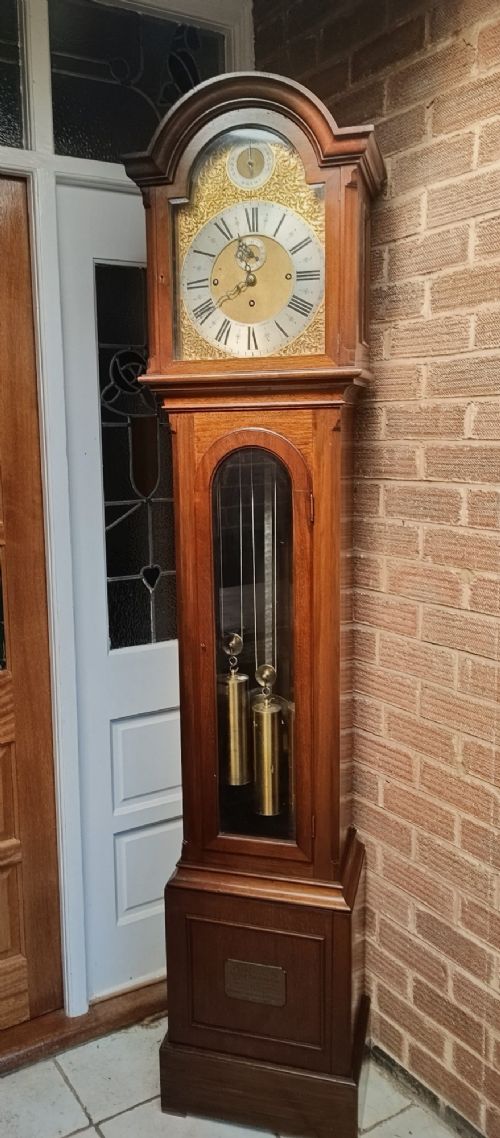
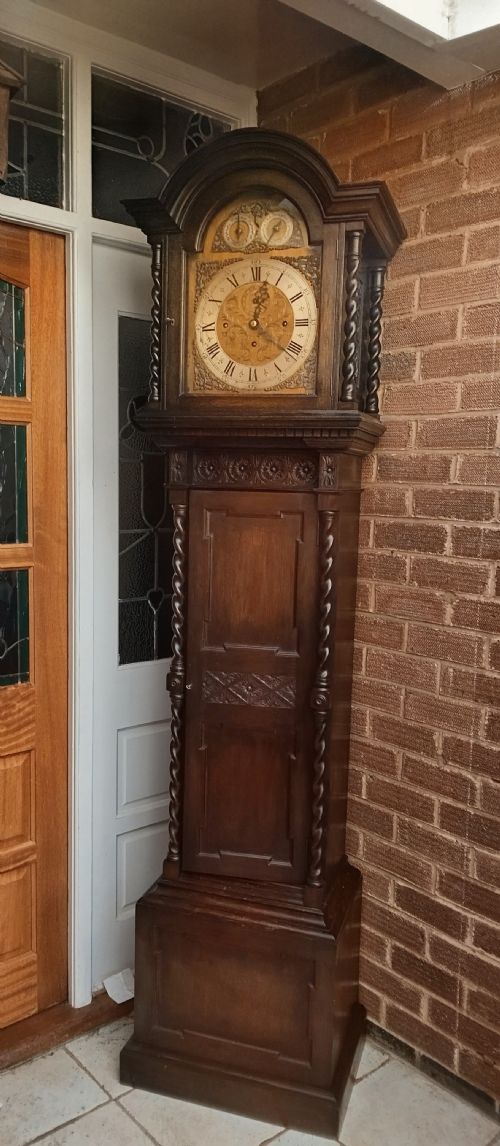


Edwardian Oak Floor Clock
An edwardian oak floor clock brings domestic weight and measured time into a room, combining architectural timber with intricate chime movements.
Edwardian Oak Floor Clock
When you search for an edwardian oak floor clock, you encounter tall timepieces spanning periods from the Edwardian years back to the Georgian era, alongside later interpretations. These upright cases house longcase and grandmother mechanisms designed to mark the hours with deep resonance and visible dials.
The most frequent examples on this page are compact grandmother clocks and tall longcase models constructed in oak. They combine traditional British styles with chiming or musical movements requiring regular weight winding.
Materials and construction
Cabinetmakers built these tall cases predominantly using solid oak, frequently augmented by brass dials, bezels, and glass door panels to protect the pendulum. Selected pieces incorporate burr mahogany veneers to add contrast to the timber grain.
Internal mechanics rely on heavy brass gear trains driven by suspended weights, powering striking mechanisms and musical tunes across multiple bells or tubular gongs.
Edwardian Oak Floor Clock Retail Price Guide 2026
Typical asking prices for edwardian oak floor clock among the pieces listed under this phrase on Sellingantiques today, from the lower quarter to the upper quarter. They describe what is for sale here now, not the wider market.
The collection spans longcase and grandmother clock forms with mechanical weight-driven systems.
Judging quality and craftsmanship
Quality rests in the precision of the clockwork movement and the weight of the timber casework, separating standard factory assembly from specialised maker production. Superior examples feature multi-bell musical capability and robust chiming trains.
Proportion and dial execution dictate the standing of a piece, where crisp brass ornamentation and balanced case dimensions indicate high workshop standards.
Elliott·Mappin & Webb London·Harrods
The Edwardian Oak Floor Clock Glossary
- Grandmother clock
- A smaller version of the traditional longcase clock, typically standing under six feet tall. These reduced proportions suit domestic spaces with lower ceilings.
- Longcase clock
- A tall pendulum clock enclosed in a wooden case that rests upon the floor. Often called a grandfather clock, it relies on hanging weights for power.
- Quarter chiming
- A movement feature that plays a sequence of notes every fifteen minutes before striking the full hour. It adds melodic complexity to the timekeeping.
- Regulator
- A precision pendulum clock designed for exceptional accuracy. These movements often include specialised dials and temperature compensation.
Edwardian Oak Floor Clock: Frequently Asked Questions
How do I wind an edwardian oak floor clock?
Most weighted floor clocks require you to pull the chains or wind the barrels using a specialised crank key every week. Care must be taken not to overwind the springs or pull the weight lines too high.
Ensuring the weights hang freely without tangling their chains keeps the movement running evenly and prevents internal damage.
Where should I place a floor clock?
Select an interior wall away from direct sunlight, central heating vents, and damp exterior walls to protect the timber case and delicate internal mechanisms. Stable flooring is essential for the pendulum to swing evenly.
Positioning the clock on a level surface ensures the beat remains regular and the chime sequence plays correctly.
What is the difference between longcase and grandmother clocks?
The primary distinction lies in height and scale, with grandmother clocks offering a more compact footprint designed for smaller rooms. Both utilise similar weighted movements and tall wooden housings.
Longcase pieces usually command more vertical presence, whereas grandmother clocks provide the same acoustic character in reduced proportions.
Why does my clock stop chiming correctly?
Chime synchronisation can slip if the hands are moved backward or if the clock has been recently transported without securing the pendulum and weights. The mechanism often needs to complete its cycle naturally to realign.
Consulting a professional horologist is recommended if internal adjustments are required to restore proper sequence.