

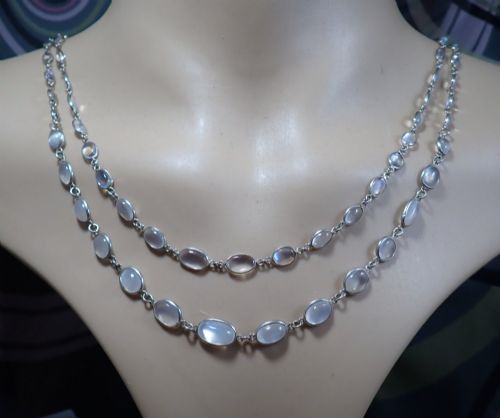


Edwardian Moonstone Necklace
An edwardian moonstone necklace brings together shimmering adularia and fine precious metals to create a luminous piece of historical jewellery.
Edwardian Moonstone Necklace
An edwardian moonstone necklace represents a distinct era of design, drawing on the aesthetics of the early twentieth century. When searching for an edwardian moonstone necklace, buyers encounter pieces that span from the Edwardian period itself into the 1920s and 1930s.
The forms vary between delicate pendants, lavaliere necklaces, and elaborate festoon arrangements. Many examples incorporate the hand-wrought philosophies of the Arts and Crafts movement or the flowing motifs of Art Nouveau.
Silver, sterling silver, and various grades of gold form the structural foundations for these items. Gemstones such as sapphire, garnet, blister pearl, amethyst, and coral frequently accompany the central moonstones.
How they were made
Silversmiths and goldsmiths shaped precious metals by hand, utilising techniques appropriate for both delicate wirework and heavier settings. Sterling silver and golds of various carats provided durable yet malleable frameworks for mounting stones.
Moonstones were typically cut en cabochon to maximise their adularescence, the characteristic floating light effect. Stones were then secured within bezels or surrounded by clusters of pearls, garnets, and sapphires.
Edwardian Moonstone Necklace Retail Price Guide 2026
Typical asking prices for edwardian moonstone necklace among the pieces listed under this phrase on Sellingantiques today, from the lower quarter to the upper quarter. They describe what is for sale here now, not the wider market.
What varies in quality
The distinction between items rests upon the quality of the workmanship and the pedigree of the maker. Pieces bearing attributions to notable designers command greater attention from collectors due to their documented provenance.
Material selection also dictates distinction, particularly the size and optical clarity of the moonstones alongside the inclusion of supplementary gemstones like diamonds or sapphires.
George Hunt·John Paul Cooper·Dorrie Nossiter·Amy Sandheim
The Edwardian Moonstone Necklace Glossary
- Adularescence
- The optical phenomenon where a milky, bluish light shimmers across the surface of a moonstone when turned in the light. This ethereal glow is the primary visual characteristic that defines the gemstone.
- Cabochon
- A gemstone shaped and polished with a smooth, rounded domed top rather than faceted edges. This cut is traditionally utilised for moonstones to best display their internal sheen.
- Lavaliere
- A pendant necklace featuring a central drop stone or ornament suspended below the main chain line. Popular during the early twentieth century, this style often incorporates delicate chains and secondary gem drops.
- Festoon
- A necklace style featuring draped chains, swags of metal, or linked elements that sit across the collarbone. These pieces frequently incorporate multiple gemstone drops.
- Arts and Crafts
- A design movement spanning the late nineteenth and early twentieth centuries that emphasised hand-craftsmanship and natural materials. Jewellery from this period often displays visible hammer marks and distinctive bezel settings.
Edwardian Moonstone Necklace: Frequently Asked Questions
What defines an edwardian moonstone necklace?
An edwardian moonstone necklace is characterised by the use of polished adularescent stones mounted in silver or gold, frequently associated with Arts and Crafts or Art Nouveau design principles.
These pieces typically date from the early twentieth century and showcase hand-wrought details, sometimes accompanied by pearls, garnets, or sapphires.
How should I care for an antique moonstone necklace?
Moonstones are relatively soft gemstones that require gentle handling to avoid scratches. Store your necklace separately in a soft pouch.
Clean the metal and stones gently with a soft cloth and avoid harsh chemical dips or ultrasonic cleaners.
How do I distinguish Edwardian pieces from later styles?
Edwardian jewellery often relies on light silver or gold wirework, floral motifs, and delicate garland styles. Pieces extending into the 1920s and 1930s may show heavier Arts and Crafts hand-hammered textures or geometric Art Nouveau influences.
Examining the metal purity marks and setting techniques helps clarify the period of manufacture.
What metals are typically used in these necklaces?
Makers of this era utilised sterling silver alongside various carats of gold, including nine-carat, fifteen-carat, and eighteen-carat varieties. The choice of metal often reflects the aesthetic goals of the designer, with silver favoured by Arts and Crafts workshops.
Gold was frequently employed for more formal lavaliere pendants and gemstone-rich cluster designs.