



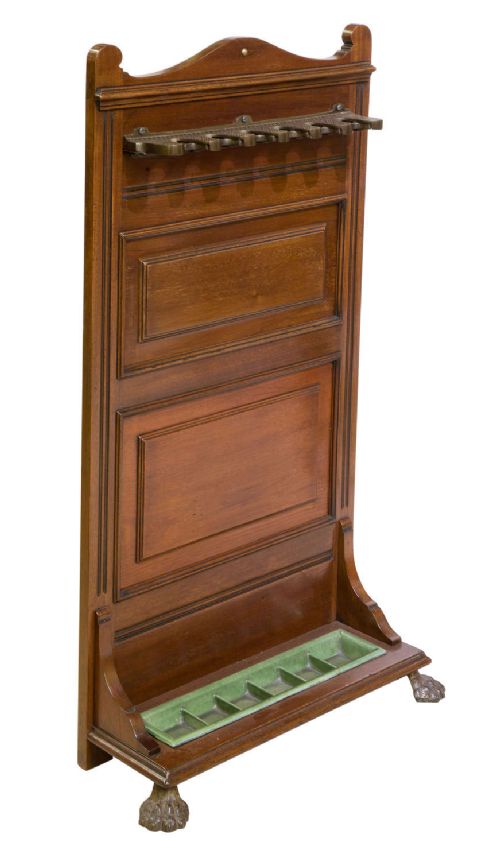


Edwardian Mahogany Stick Stand
An Edwardian mahogany stick stand brings disciplined British utility to a hallway, keeping wet weather gear organised in richly grained timber.
Edwardian Mahogany Stick Stand
When you search for an edwardian mahogany stick stand, you encounter hall furnishings built to receive walking canes, umbrellas and coats upon entering a home. The evidence records pieces spanning the Victorian and Edwardian periods, including the Arts and Crafts style.
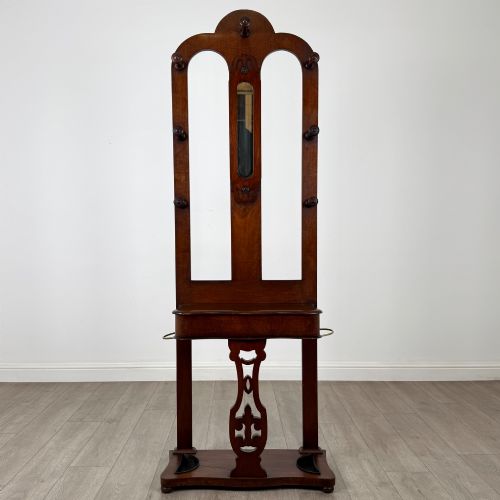
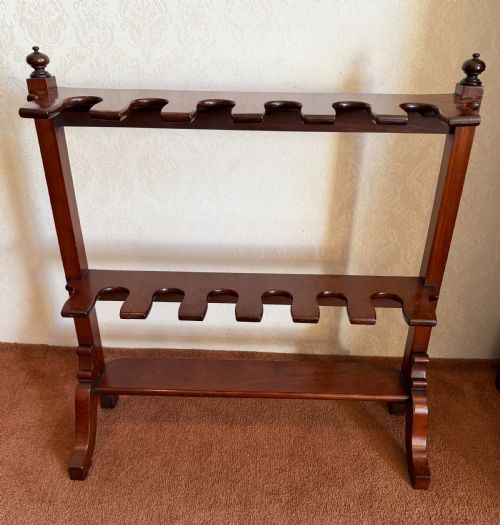
You meet variations ranging from compact circular frames and demi-lune hall stands to tall combinations incorporating mirrors, hat hooks and coat racks. Some examples extend their purpose to hold boots, whips or snooker cues alongside walking sticks.
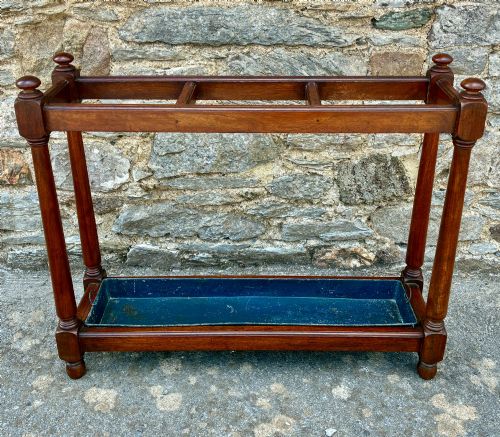
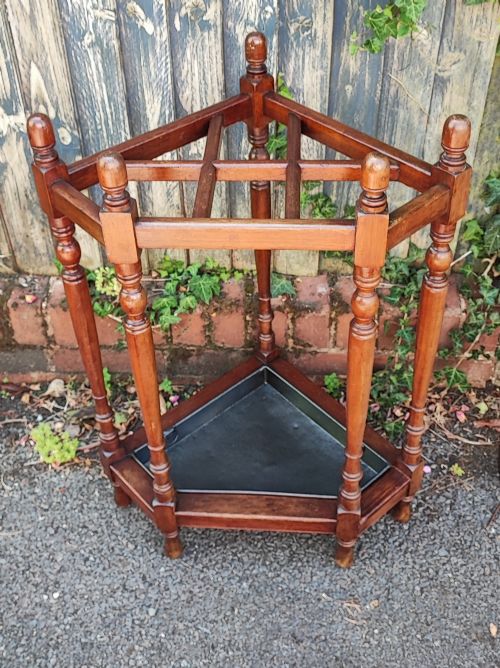
The prevailing form on this page relies on solid mahogany timber combined with metal liners to catch rainwater from umbrellas. These practical items occupied the entrance halls of country houses and urban properties alike.
Construction and Materials
Makers utilised mahogany as the primary timber, sometimes enhancing the surfaces with tulip inlay or Arts and Crafts decorative motifs. Turned woodwork appears frequently in the upright supports and structural framing.
Brass elements, including rods, rails and drip trays, provide functional contrast to the dark wood. Cast iron and painted sheet metal frequently appear in the base components to manage moisture and add necessary weight.
Some Edwardian halls clearly welcomed sporty households, providing specialised storage for both walking sticks and snooker cues under one roof.
Factors of Quality
Quality rests upon the selection of timber and the precision of the joinery, particularly where turned components meet the base. Better examples integrate brass fittings cleanly into the mahogany structure without loose joints.
The presence of original drip trays and intact metal liners elevates a piece, as these functional elements often suffer from corrosion or replacement over time. Finer execution shows in balanced proportions and restrained inlay rather than excessive ornamentation.
The Edwardian Mahogany Stick Stand Glossary
- Demi-lune
- Having a half-moon shape designed to sit flush against an entrance hall wall. This form saves valuable floor space in narrow corridors.
- Arts and Crafts
- A design movement prioritising traditional craftsmanship and simple forms over mass-produced ornamentation. Pieces from this aesthetic often display understated geometric inlay.
- Drip tray
- A metal base insert designed to catch water running off wet umbrellas. These trays protect the underlying mahogany flooring from moisture damage.
- Hall stand
- A multi-functional hallway furniture piece combining a stick stand with coat hooks, a mirror and sometimes a bench. These comprehensive items dominated large Victorian and Edwardian entryways.
- Turned wood
- Timber shaped on a lathe to create cylindrical or curved components like upright spindles. This technique provides structural support with decorative contouring.
Edwardian Mahogany Stick Stand: Frequently Asked Questions
Where should I place my stick stand?
Position your stand in the main entrance hallway where family members and guests arrive with wet coats and umbrellas. Keeping it near the front door ensures practical daily use.
Ensure the location allows adequate air circulation so that damp wood and umbrellas dry properly without damaging the surrounding wall or flooring.
Can these stands hold walking canes?
Most Edwardian stick stands feature divided upper rings or wooden separators specifically sized to keep slim walking canes upright. The lower tray or base stops the tips from slipping.
Heavier country house stands handle multiple heavy malacca or wooden walking sticks alongside umbrellas without tipping.
How do I distinguish Edwardian from Victorian stands?
Edwardian stands tend to display lighter proportions and occasionally incorporate subtle tulip inlay or simple Arts and Crafts styling. Victorian examples often feature darker, heavier timber and more robust turnings.
Reviewing the overall silhouette and decorative restraint helps separate the late nineteenth-century iterations from those built after nineteen hundred.