

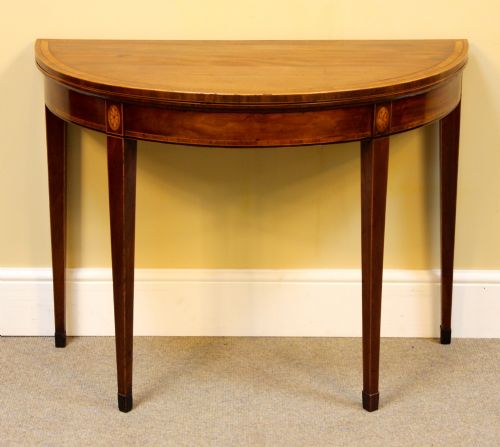
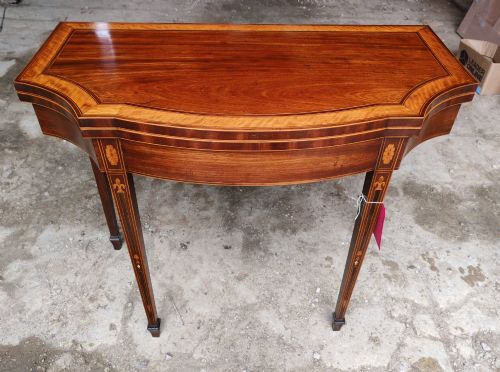


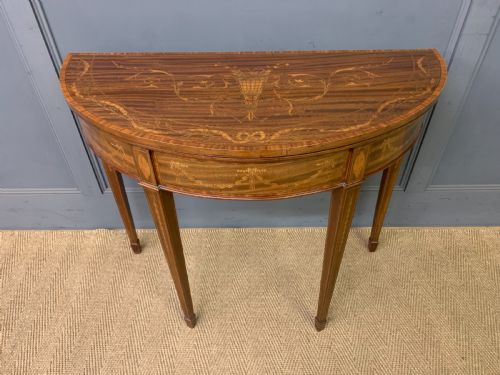


Edwardian Inlaid Demilune Table
An Edwardian inlaid demilune table brings a graceful half-round silhouette and delicate stringing into a room, offering a functional surface that folds or stands with quiet elegance.
Edwardian Inlaid Demilune Table
When searching for an Edwardian inlaid demilune table, you are looking at semicircular furniture designed to hug a wall or open out for cards, tea, and games. The pieces appearing here span Edwardian work alongside earlier Georgian, Regency, and Sheraton Revival reinterpretations.
You will encounter card tables, console tables, and tea tables, often fashioned with fold-over leaves that conceal baize-lined playing surfaces or simple timber tops. Mahogany and satinwood predominate, frequently accented with boxwood stringing and marquetry.
While the Edwardian period dominates the physical dating, the style reaches back to George III and Hepplewhite inspirations, carrying the lighter neoclassical tastes through the twentieth century and into modern homes.
Judging Quality and Execution
Quality rests in the crispness of the marquetry inlay and the selection of figured timber veneers for the top. A superior piece displays tight joints where the demilune leaves meet when folded, and harmonious grain matching across the semicircular top.
The refinement of the legs and the subtlety of the crossbanding separate standard production from exceptional cabinet work. Attribution to known workshops or sophisticated painted satinwood surfaces elevates the standing of individual pieces.
Edwardian Inlaid Demilune Table Retail Price Guide 2026
Typical asking prices for edwardian inlaid demilune table among the pieces listed under this phrase on Sellingantiques today, from the lower quarter to the upper quarter. They describe what is for sale here now, not the wider market.
Some tables double as supper trays, proving that even polite Edwardian card players took their midnight snacking seriously.
Edward and Roberts
The Edwardian Inlaid Demilune Table Glossary
- Demilune
- A half-moon or semicircular shape used for console and card tables designed to sit flat against a wall. This profile saves floor space while providing a decorative focal point.
- Stringing
- Thin lines of contrasting wood inlaid into the surface of a piece to outline drawers, legs, or tabletops. Boxwood is frequently used for this linear detail.
- Crossbanding
- A border of veneer laid around the edge of a table top with the grain running perpendicular to the central panel. This technique frames the primary timber.
- Sheraton Revival
- A late nineteenth and early twentieth century style emulating the lighter neoclassical furniture of Thomas Sheraton. It relies heavily on satinwood, inlay, and tapered legs.
Edwardian Inlaid Demilune Table: Frequently Asked Questions
What is a demilune table used for?
A demilune table functions primarily as a console against a wall or opens out into a larger surface for cards and tea. Its semicircular shape allows it to occupy narrow hallways without obstructing movement.
When opened, the hinged top reveals a baize-lined interior intended for evening games, returning to a compact console form when folded shut.
How do I identify an Edwardian piece?
Edwardian furniture often combines mahogany or satinwood with refined marquetry and boxwood stringing, drawing heavily on Sheraton and Hepplewhite revival styles. The construction methods reflect early twentieth-century machinery alongside traditional hand-finishing.
Examining the secondary timbers underneath and the style of the brass hinges helps confirm the period of manufacture alongside the surface aesthetics.
Are these tables sturdy enough for daily use?
These tables are built from solid hardwoods like mahogany and satinwood, making them durable for everyday placement in a hallway or living room. Fold-over leaves require gentle handling when opening to protect the vintage hinges and supporting swing legs.
Placing them away from direct heat sources ensures the veneers and inlaid stringing remain stable over time.