
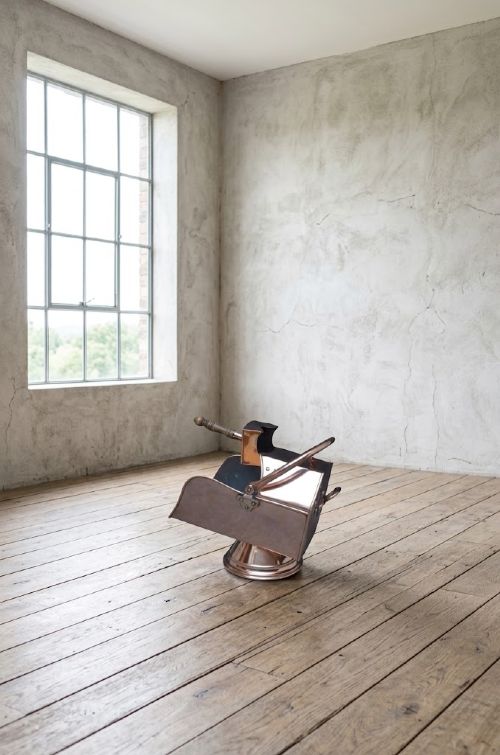
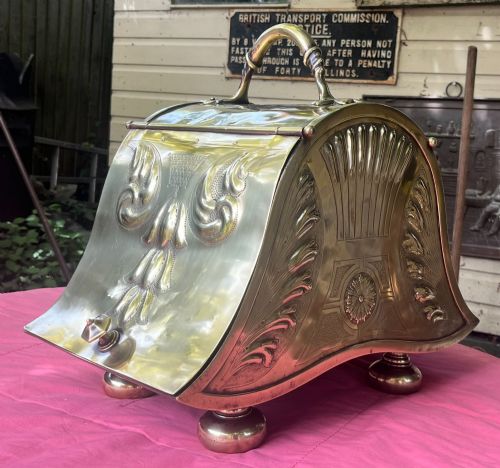
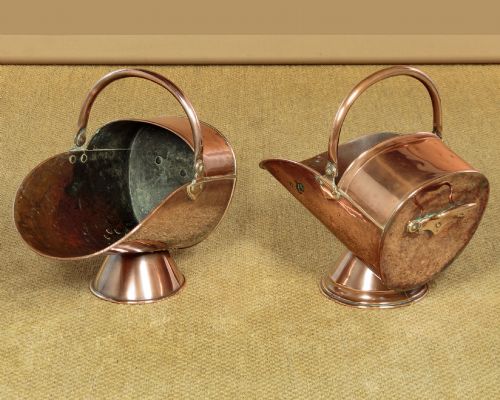


Edwardian Helmet Coal Bucket
An Edwardian helmet coal bucket is a sloping metal fireside vessel designed to hold fuel, combining daily utility with period character.
Edwardian Helmet Coal Bucket
An edwardian helmet coal bucket takes its name from the flared, peaked brim that mimics the historical military headwear, offering a practical scoop for feeding domestic hearths. The form sits upon a circular foot, balanced by a swinging carrying handle mounted on side pivots and a smaller fixed handle at the rear for tipping.
Most examples found on this page emerge from the late nineteenth and early twentieth centuries, spanning the Victorian, Edwardian, Arts and Crafts, and Art Nouveau periods. These fireside pieces appear primarily in warm metals, reflecting the domestic interior fashions of their respective decades.
How they were made
Makers formed these bodies predominantly from sheet brass and copper, joining the seams with dovetailing, visible rivets, or folded joints. Wrought iron and cast brass elements provide structural reinforcement and handle mounts, while wooden grips insulate the carrying hand from conductive metal.
Surface decoration relies on hand-hammering, known as planishing, or repousse embossing to catch the firelight. These techniques leave subtle tool marks across the metal body, distinguishing hand-shaped vessels from later stamped productions.
The tilted helmet shape ensures that even when empty, the coal bucket looks ready to gallop into battle against the evening chill.
What varies in quality
Quality rests in the gauge of the metal and the integrity of the construction rather than mere decorative surface detail. Thicker gauge copper or brass resists denting and holds its structural rigidity under the daily weight of coal.
Superior vessels display confident hand-beaten texturing and secure, well-pinned handle mounts that bear the strain of lifting without loosening from the body. Finer examples retain their matching shovels and balanced proportions when resting on the hearth.
BENHAM AND FROUD
The Edwardian Helmet Coal Bucket Glossary
- Helmet scuttle
- A fireside coal container featuring a sloping, flared rim reminiscent of a traditional helmet. This shape allows fuel to be poured cleanly downwards into the hearth.
- Planished
- A metalworking finish achieved by hammering the surface with a small-faced tool. This technique hardens the metal while leaving a pattern of small, decorative facets.
- Repousse
- A metal shaping method where designs are hammered into relief from the reverse side. It creates raised ornamentation across the body of the copper or brass bucket.
- Arts and Crafts
- A design movement valuing manual skill and traditional construction over mass production. Pieces from this aesthetic often showcase visible hammer marks and honest joinery.
Edwardian Helmet Coal Bucket: Frequently Asked Questions
How do I clean the metal safely?
Wash the surface gently with warm soapy water and a soft cloth to remove soot and dust without stripping the aged patina. Avoid harsh abrasive metal polishes that can erase the historic character of the copper and brass.
Dry the vessel thoroughly after cleaning to prevent water spotting on the bare metal. Preserving a dark, untouched tone is generally preferred by collectors over a bright, mirror-like shine.
Can I still use it for coal?
These vessels were built to hold solid fuel beside a working fireplace, so they remain structurally capable of carrying coal or logs. Many owners continue to load them with kindling or coal for active fires.
Using a modern metal liner inside the bucket protects the historic interior from moisture and chemical corrosion. This prevents residual ash from degrading the original base over time.
How do I distinguish Edwardian from Victorian pieces?
Victorian examples often favour heavy, highly polished brass with ornate embossed ornamentation and cast paw feet. Edwardian designs frequently lean towards simpler, lighter forms influenced by the Arts and Crafts aesthetic.
Examining the manufacturing marks, handle attachments, and overall weight helps place the piece within a specific decade. Stylistic overlap remains common during the transitional years around nineteen hundred.
Where should I place it in a room?
Position the bucket beside a fireplace or wood-burning stove where its metallic surface reflects the ambient light of the room. It also serves as a freestanding decorative accent in a traditional hallway or study.
Keep the vessel away from damp walls or direct outdoor moisture to protect the finish. Placing it on a hearth rug or protective hearth stone prevents scratching on delicate flooring.