
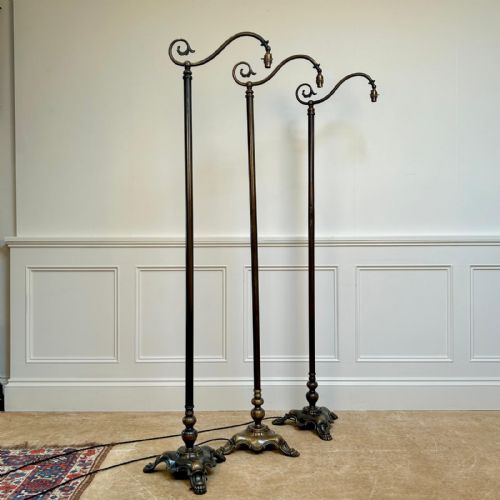


Edwardian Gooseneck Lamp
An edwardian gooseneck lamp brings directional task lighting to a desk or reading corner with distinct period mechanics.
Edwardian Gooseneck Lamp
An edwardian gooseneck lamp offers adjustable illumination through flexible arms, swivels or swan neck joints. These pieces serve as desk lamps, floor lamps, wall sconces and reading lamps designed for focused light.
The materials span brass, bronze, patinated brass and cast iron, often paired with cranberry glass, etched glass or porcelain shades. Many examples date from the Edwardian period alongside pieces from 1890, 1900, 1920 and the 1930s.
Buyers encounter single task lights alongside pairs of floor lamps and wall sconces. Art Nouveau and Art Deco styling frequently influence the metalwork and shade designs.
What varies in quality
The substance of the metalwork determines the solidity of each lamp, separating heavier cast bronze and brass bases from lighter formed sheet metal. Articulation joints hold their tension more reliably when engineered with precision components.
The integrity and type of the shade, whether blown cranberry glass, delicate etched glass or moulded porcelain, influence the character of the piece. Matching pairs and patinated finishes demonstrate greater desirability among surviving examples.
Listings feature designs spanning the Edwardian era, 1890, 1900, 1920 and 1930, constructed from brass, bronze, fabric, cranberry glass, cast iron and porcelain.
The Edwardian Gooseneck Lamp Glossary
- Swan neck
- A curved upper arm that resembles the neck of a swan, allowing the light source to bend downward. This curved profile directs illumination precisely over a desk or reading chair.
- Patinated brass
- Brass that has developed a darkened, oxidised surface sheen through age and environmental exposure. This finish protects the underlying metal while offering a subdued visual tone.
- Cranberry glass
- A rich pinkish-red glass produced by adding gold chloride to the molten batch. It diffuses a warm glow when utilised in lamp shades.
- Wall sconce
- A lighting fixture fixed directly to a vertical wall surface rather than standing on a floor or table. These fixtures project light outward into a room or hallway.
- Art Nouveau
- A design style characterised by flowing, organic lines inspired by natural plant forms. It appears frequently in the whiplash curves of period metalwork.
Edwardian Gooseneck Lamp: Frequently Asked Questions
How do I adjust the arm?
The flexible swan neck or swivel joint pivots by hand to direct the beam of light. Users simply bend or rotate the neck into the desired position for reading or desk work.
Older joints rely on mechanical tension rather than modern springs. Careful handling ensures the internal wiring and structural joints remain undamaged during adjustment.
Can I use modern light bulbs?
Most period lamps accept standard modern bulbs provided the wattage matches the historical socket capacity. Rewired examples ensure compatibility with contemporary electrical safety standards.
LED bulbs generate less heat, which helps protect fragile glass shades and vintage wiring insulation from thermal stress.
Where should I place a floor lamp?
Floor standing reading lamps suit corners behind armchairs or beside writing desks where directional light is required. Their adjustable height and swiveling heads project light exactly where needed.
Pairing matching floor lamps creates symmetrical illumination in larger living spaces or studies.
How do I clean brass safely?
Dusting with a dry microfibre cloth removes everyday grit without disturbing the aged surface. Abrasive cleaners strip away original patination and should be avoided.
Preserving the natural patina maintains the historical integrity of bronze and brass surfaces.