
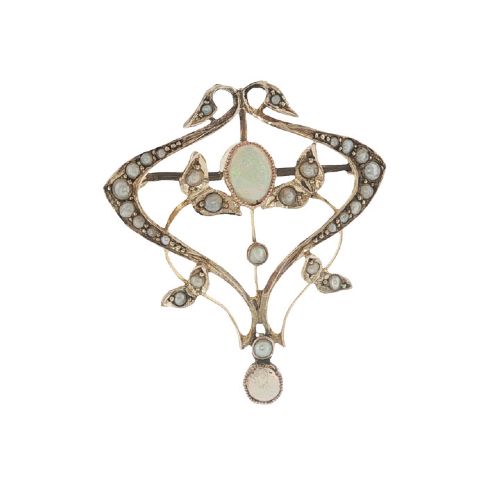


Edwardian Foliate Necklace
An edwardian foliate necklace brings organic leaf and vine motifs into precious metals, offering delicate period charm for the discerning collector.
Edwardian Foliate Necklace
An edwardian foliate necklace captures the delicate botanical motifs popular at the turn of the twentieth century, often translating natural leaf and vine shapes into precious metals. You are most likely to encounter gold pendants and lavaliers featuring symmetrical floral drops alongside silver Arts and Crafts iterations.
The aesthetic bridges the ornate Victorian past with lighter, more fluid Edwardian sensibilities. Pieces frequently integrate central gemstone clusters with articulated drop sections that move gracefully when worn.
Makers of the period utilised naturalistic design vocabulary to celebrate organic forms. The resulting necklaces remain distinct for their airy metalwork and careful arrangement of leaves and petals.
How They Were Made
Goldsmiths constructed these pieces primarily in nine carat and fifteen carat gold, or worked in silver for the Arts and Crafts aesthetic. Metal components were pierced, engraved, and soldered to create lightweight yet structurally sound frameworks for stones.
Gemstones including amethysts, opals, aquamarines, and seed pearls were meticulously set using collet or claw techniques. Pearls were frequently half-drilled and secured onto pins, while cabochon stones were mounted in smooth bezels to highlight their natural luminescence.
Listings feature periods spanning the late nineteenth century through nineteen thirty, encompassing Victorian, Edwardian, Arts and Crafts, and Art Nouveau styles.
What Varies in Quality
Quality rests upon the refinement of the hand fabrication and the sensitivity of the naturalistic carving. Superior examples demonstrate precise piercing of the metal foliage and secure, flush stone settings without excess solder.
The selection and matching of gemstones elevate a piece significantly. Finer makers chose well-matched seed pearls with strong lustre and transparent coloured stones possessing lively internal light.
the Gaskins·WH Haseler for Liberty and Co·Liberty and Co·Dorrie Nossiter·the Artificers Guild
The Edwardian Foliate Necklace Glossary
- Foliate
- Decorated with leaf or plant motifs. This decorative vocabulary defines the curved stems and botanical arrangements seen across the period.
- Lavalier
- A pendant necklace featuring a central drop suspended from a smaller component. This style gained immense popularity during the Edwardian era.
- Seed Pearl
- A very small, naturally formed pearl often used in clusters. These delicate pearls add subtle texture and white contrast to gold settings.
- Cabochon
- A gemstone shaped and polished with a smooth convex surface rather than faceted. This cut suits opals and moonstones by enhancing their optical phenomena.
- Arts and Crafts
- A design movement valuing handcraft and honest materials over mass production. Pieces from this circle often display hammered silver surfaces and bezel-set cabochons.
Edwardian Foliate Necklace: Frequently Asked Questions
What defines an edwardian foliate necklace?
These necklaces feature botanical motifs inspired by leaves, vines, and flowers, typical of jewellery produced around nineteen hundred. The design emphasises lightness and natural curves.
Craftsmanship from this era often combines yellow or rose gold with seed pearls and transparent coloured gemstones arranged in symmetrical pendant drops.
How do I care for my antique necklace?
Store your piece flat in a dedicated jewellery box to prevent chains from tangling and delicate drops from bending. Keep organic gems away from harsh chemicals and ultrasonic cleaners.
Clean the metal and stones gently with a soft dry cloth after wearing to remove natural skin oils and maintain the lustre of the gold and pearls.
Are these necklaces suitable for daily wear?
While structurally robust, Edwardian pieces are antique items containing delicate seed pearls and fine chainwork. They require mindful handling during daily routines.
Reserve the necklace for special occasions or mindful daytime use to protect fragile settings and historical components from accidental impacts.
How can I tell an Edwardian piece from a Victorian one?
Edwardian designs generally favour lighter, airier metalwork with platinum or white gold accents alongside yellow gold. The palette often includes aquamarines, amethysts, and pearls.
Victorian pieces lean toward heavier, more substantial constructions with darker stones and denser ornamentation, though transitional overlaps frequently occur.